


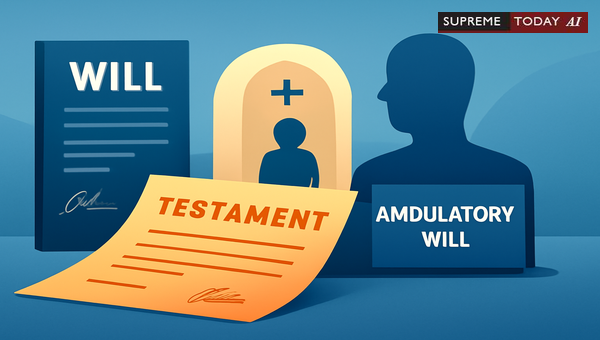
Does a Will Take Effect Only After the Testator's Death?
In estate planning, one common question arises: Will to be Executed only after Death of Executant. This phrasing captures a fundamental principle of testamentary law— a will does not execute in the sense of taking operative effect during the testator's lifetime. Instead, it remains a declaration of intent that springs into action only upon their death. Understanding this distinction is crucial for anyone drafting a will, acting as an executor, or contesting an estate. This post explores the legal foundations, formalities, and implications, drawing from established case law and principles. Note: This is general information and not specific legal advice; consult a qualified attorney for your situation.
The Nature and Definition of a Will
A will is fundamentally a , defined as a legal declaration of the intention of a testator with respect to his property which he desires to be carried into effect after his death2007 4 Supreme 397 2003 8 Supreme 658. Derived from Latin terms and , it represents the expression of the testator's mind 2003 8 Supreme 658.
Its hallmark is its —meaning it is revocable and non-operative while the testator lives, becoming effective only posthumously 2007 4 Supreme 397. Courts consistently affirm this: A Will is a that takes effect only after the death of the testator (executant)2004 1 Supreme 451. This ensures the testator retains full control over their property during life.
Key Characteristics
- Posthumous Operation: Provisions, including trusts or bequests, activate only after death 2007 4 Supreme 397.
- Revocable: The testator can alter or revoke it anytime before passing 2007 4 Supreme 397.
- Presumed Valid: Until proven otherwise, courts construe it as intended for post-death effect 2007 4 Supreme 397.
Formalities Required for a Valid Will
For a will to operate after death, it must meet strict statutory formalities. The testator must sign (or affix a mark) in the presence of at least two attesting witnesses, who also sign after seeing the testator 2007 4 Supreme 397. These steps authenticate the document and confirm the testator's 2004 1 Supreme 451.
Failure to comply can invalidate the will, but even a flawed one does not gain force during the testator's life—it remains ambulatory 2003 8 Supreme 658. As Ulpian noted: est mentis nostrae justa contestatio in id sollemniter facta ut post mortem nostrum valeat2003 8 Supreme 658. Jarman echoes: an instrument by which a person makes a disposition of his property to take effect after his decease, and which is in its own nature ambulatory and revocable during his life2007 4 Supreme 397.
Why a Will Does Not Operate During the Testator's Lifetime
The law presumes a will's provisions are for post-death execution. It has no binding effect (between living persons); it's merely a future intent 2003 8 Supreme 658. This contrasts sharply with deeds or powers of attorney, which can transfer rights immediately.
For instance, in property disputes, deeds executed before death—like a transfer attested by a notary just days prior—convey rights during the executant's life, as seen in cases involving signature identification and pre-death actions 2025 Supreme(SRI)(SC) 9708. Similarly, sale deeds under powers of attorney operate upon execution if formalities are met, even if challenged post-death 2023 Supreme(Online)(KER) 27388. A tax receipt post-death or mutation delays do not retroactively alter this, unlike wills 2022 Supreme(Online)(KER) 42566.
In one case, a deed claimed executed in was contested because an executant allegedly died in , highlighting that deeds purport immediate effect, not posthumous like wills 2022 Supreme(Online)(MAD) 11896. Powers of attorney acted upon during life, without objection until after death, further affirm their live-time enforceability 2023 Supreme(Online)(KER) 27388. These examples underscore: wills alone wait for death.
Legal Presumptions and Challenges to Validity
Courts presume validity if formalities are met, scrutinizing suspicious circumstances like propounder involvement 1958 0 Supreme(SC) 149. However, the core principle holds: operative effect is posthumous 2007 4 Supreme 397. Mental capacity at execution is key, but ambulatory status persists until death 2004 1 Supreme 451.
Common Challenges
- Undue Influence or Fraud: Requires proof; does not change posthumous nature.
- Improper Attestation: May void it, but no lifetime operation.
- Revocation: Explicit or implied during life revokes it entirely 2007 4 Supreme 397.
Exceptions, Limitations, and Contrasts with Other Documents
While wills are strictly posthumous, exceptions are narrow:- Revocation Anytime: Reinforces non-binding status pre-death 2007 4 Supreme 397.- Conditional Wills: Still activate post-death.
Contrast with deeds: A voluntary possession delivery with consideration transfers title immediately, as in village elder disputes post-executant's death but rooted in lifetime acts 2024 Supreme(Online)(AP) 3551. Powers of attorney exempt from registration under fiduciary rules enable live-time sales with valid consideration proven sans full upfront payment 2023 Supreme(Online)(KER) 27388. These instruments highlight wills' unique delay.
Practical Recommendations for Estate Planners
To maximize enforceability:- Execute with witnesses and clear intent language.- Specify post-death operation explicitly.- Review periodically, as it's revocable.- In doubts, courts examine capacity, formalities, and context—but default to posthumous effect.
Heirs should note: No probate or administration until death; premature claims fail.
Conclusion and Key Takeaways
In summary, a will takes effect only after the death of the executant (testator), embodying its ambulatory, revocable essence 2007 4 Supreme 397 2003 8 Supreme 658. This principle, rooted in definitions and formalities, distinguishes it from immediate-effect deeds or powers. For secure estate planning, adhere to formalities and understand this timing.
Key Takeaways:- Wills declare future intent, operative post-death.- Strict signing/attestation required.- Revocable until death; presumed valid.- Consult professionals for personalized guidance.
References:1. 2007 4 Supreme 397: Core definition and .2. 2003 8 Supreme 658: Formalities and posthumous intent.3. 2004 1 Supreme 451: Testamentary effect post-death.4. 1958 0 Supreme(SC) 149: Proof under suspicion.
This framework empowers informed decisions in estate matters.
#EstatePlanning #WillsLaw #LegalWill












