Searching Case Laws & Precedent on Legal Query.....!
Analysing the retrieved Case Laws
Scanned Judgements…!



Searching Case Laws & Precedent on Legal Query.....!
Analysing the retrieved Case Laws
Scanned Judgements…!
Original documents not released despite full settlement of dues and issuance of No Dues Certificates - Main issue is whether the bank is justified in retaining the documents after dues clearance [" 2026 Supreme(Online)(Tel) 2462"]>["2026 Supreme(Online)(Tel) 2462"], [" 2024 Supreme(Online)(KER) 35583"]>["2024 Supreme(Online)(KER) 35583"], [" 2026 Supreme(Online)(Tel) 1962"]>["2026 Supreme(Online)(Tel) 1962"], [" 2026 Supreme(Online)(Tel) 1065"]>["2026 Supreme(Online)(Tel) 1065"], [" 2026 Supreme(Online)(Tel) 70"]>["2026 Supreme(Online)(Tel) 70"], [" 2021 Supreme(Online)(KER) 15664"]>["2021 Supreme(Online)(KER) 15664"], [" 2025 Supreme(Online)(Ker) 57815"]>["2025 Supreme(Online)(Ker) 57815"].
Writ petitions have been filed challenging the unlawful retention of original documents (title deeds, mortgage papers) after dues are cleared, with courts generally holding that once dues are settled and certificates issued, the bank is obliged to release the documents [" 2026 Supreme(Online)(Tel) 2462"]>["2026 Supreme(Online)(Tel) 2462"], [" 2024 Supreme(Online)(KER) 35583"]>["2024 Supreme(Online)(KER) 35583"], [" 2026 Supreme(Online)(Tel) 1065"]>["2026 Supreme(Online)(Tel) 1065"], [" 2026 Supreme(Online)(Tel) 70"]>["2026 Supreme(Online)(Tel) 70"], [" 2021 Supreme(Online)(KER) 15664"]>["2021 Supreme(Online)(KER) 15664"].
Courts have emphasized that the retention of documents after settlement is unlawful unless there are specific legal or procedural reasons (e.g., ongoing criminal investigations or pending litigation). For instance, in ["2026 Supreme(Online)(Tel) 2462"], the court noted the dispute about whether documents can be retained during criminal investigations and whether respondent bank's actions are justified ["2026 Supreme(Online)(Tel) 2462"].
Several cases highlight that once the borrower has cleared the dues, issued No Dues Certificates, and there are no pending legal issues, the bank's refusal to release original documents constitutes unlawful detention, warranting a writ of mandamus or similar order [" 2024 Supreme(Online)(KER) 35583"]>["2024 Supreme(Online)(KER) 35583"], [" 2026 Supreme(Online)(Tel) 1065"]>["2026 Supreme(Online)(Tel) 1065"], [" 2021 Supreme(Online)(KER) 15664"]>["2021 Supreme(Online)(KER) 15664"].
In cases where the bank claims documents are retained due to ongoing legal proceedings or disputes, courts have generally ruled that such reasons do not justify withholding documents after dues clearance, especially when the borrower has fulfilled all obligations [" 2026 Supreme(Online)(Tel) 2462"]>["2026 Supreme(Online)(Tel) 2462"], [" 2024 Supreme(Online)(KER) 35583"]>["2024 Supreme(Online)(KER) 35583"].
Some judgments also indicate that even if the bank's actions are based on procedural grounds, they must act in good faith and cannot unilaterally retain documents indefinitely after dues are paid, and courts have maintained that proper legal procedures must be followed for withholding documents [" 2026 Supreme(Online)(Tel) 2462"]>["2026 Supreme(Online)(Tel) 2462"], [" 2024 Supreme(Online)(KER) 35583"]>["2024 Supreme(Online)(KER) 35583"].
Analysis and Conclusion:Based on the provided sources, the main insight is that banks are generally required to release original documents (such as title deeds or mortgaged papers) once the borrower has fully paid the dues, issued No Dues Certificates, and there are no pending legal or criminal proceedings. The continued retention of documents after dues clearance is typically deemed unlawful, and courts are inclined to uphold the right of the borrower or guarantor to have these documents released through a writ of mandamus or similar remedy. Therefore, if the dues are cleared and no legal impediments exist, the bank should release the original documents, and failure to do so can be challenged legally.
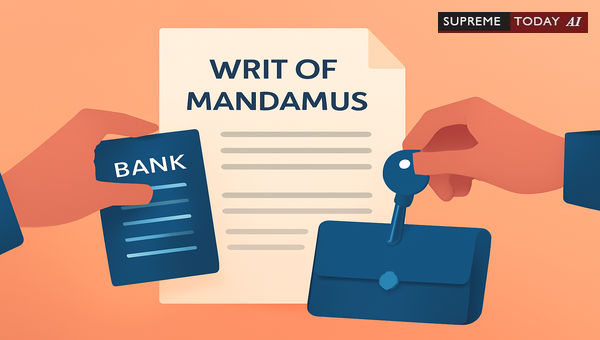
Imagine finally settling your bank loan, receiving that satisfying clearance confirmation, only to find the bank still clutching your original title deeds or documents. Frustrating, right? Many borrowers face this issue: original documents of the party is not releasing by the bank, even after settlement of dues cleared. Whether writ is maintained? This common grievance raises critical questions about borrower rights and bank obligations.
In this post, we explore the legal landscape, drawing from key judgments. Note: This is general information, not legal advice. Consult a qualified lawyer for your specific case.
Once dues are fully paid, banks are typically obligated to return original documents like title deeds without delay or extra conditions. Failure to do so can be seen as arbitrary, opening the door for judicial intervention via a under . This writ compels public authorities (including banks) to perform their legal duties.
Main Legal Finding: In cases where dues have been fully paid and the bank fails to release documents, a is generally maintainable to direct release, provided no legal or contractual impediments exist. 2023 0 Supreme(Mad) 1579
Courts have consistently held: Once the loan dues are cleared, the banks are expected to release the original documents without any condition. This withholding is deemed an unfair practice. 2023 0 Supreme(Mad) 1579
Multiple rulings affirm that full payment triggers an automatic duty to release documents. In one case, the court directed the bank to return title deeds and issue a (NOC) post-liquidation, rejecting excuses like contractual interpretations. 2010 6 Supreme 46
Similarly, reliance on precedents shows writ petitions are viable if banks fail to return documents after dues payment. 2022 0 Supreme(Bom) 936
Banks sometimes cite a '' under to retain documents, especially if linked to guarantees for other loans. However, courts clarify this doesn't apply when the specific loan is cleared and the petitioner isn't directly liable.
In a notable ruling: A bank cannot exercise a to retain title deeds for debts where the mortgagor is not a borrower and has cleared the outstanding loan. The court held retention unlawful, directing immediate release. 2024 0 Supreme(AP) 1452
Another decision reinforced: Bank's is limited; mortgagor has under . Post-repayment under schemes like Stand-up India, documents must be released despite pending matters. 2022 0 Supreme(Bom) 936
Even with pending litigations or OTS () conditions unmet—like withdrawing suits—mere pendency doesn't always bar release if core dues are cleared. One case noted non-compliance with OTS terms (e.g., litigation withdrawal) but highlighted grievances over document non-release. 2026 Supreme(Online)(Tel) 385
Disputes over contract terms or other dues don't override the primary duty: Disputes over interpretation or contractual terms do not bar the issuance of a writ where the primary issue is the non-release of documents after settlement. 2010 6 Supreme 46
While writs are often successful, exceptions exist:
Banks can't indefinitely hold documents as leverage. Retention must be backed by specific provisions. 2022 0 Supreme(Bom) 936
If facing this issue:
Pro Tip: In mortgage cases, invoke early to avoid complications.
Banks may delay due to internal processes, cross-liens, or caution over recoveries. However, judgments like those involving equitable mortgages stress timely release to prevent undue hardship. 2022 0 Supreme(Bom) 936
Consumer forums have also intervened in related wrongful retentions, like goods release without documents, deeming it —paralleling document disputes.
SHAKUMBHRI EXPORTS VS LEIGH HOEGH
2008 0 Supreme(SC) 979Executing courts limit scope to decree enforcement, not nullifying settlements, but ensure obligations like dues clearance for document release. 2013 0 Supreme(Cal) 99
Borrowers, reclaim your documents swiftly. Courts protect against unfair bank practices, ensuring fairness post-settlement. For tailored advice, consult a legal expert.
Disclaimer: Legal outcomes vary by facts. This overview draws from judgments like 2023 0 Supreme(Mad) 1579, 2010 6 Supreme 46, 2024 0 Supreme(AP) 1452, 2022 0 Supreme(Bom) 936, and others—not substitutes for professional guidance.
#WritMandamus #BankDocuments #LoanSettlement


writ, or order or direction more particularly one in the nature of Writ of Mandamus declaring the action of respondent Nos.1 and 3 in not releasing the original documents, which were mortgaged with respondent No.2 bank towards the security of petitioner as guarantor, towards the security against loan ... There is an issue about whether or not the documents can be released in favour of the petitioner when the invest....

sought to be recovered through O.A.No.158 of 2021 and since the entire dues were cleared as seen from Ext.P3, the document is to be returned back to the petitioner. ... It is in the afore circumstances, that the petitioner has filed the captioned writ petition pointing out that the 1st respondent has illegally retained the original title deed of the property in question ignoring the fact that the title deed was deposited as the corporate guarantee as against the dues ... The short issue arising for cons....

Vimal Suhag but he was not arrayed as party respondent to this Writ Petition. Though petitioner No. 1 made OTS payment on 29.06.2024, she did not comply with the agreed mandatory conditions of withdrawl of pending litigation against the bank. ... The grievance of petitioner No.1 is that though there is such a direction, Respondent No.6 is not releasing the documents citing pendency of civil suit filed against her husband and bank. ....
Vimal Suhag but he was not arrayed as party respondent to this Writ Petition. Though petitioner No. 1 made OTS payment on 29.06.2024, she did not comply with the agreed mandatory conditions of withdrawl of pending litigation against the bank. ... The grievance of petitioner No.1 is that though there is such a direction, Respondent No.6 is not releasing the documents citing pendency of civil suit filed against her husband and bank. ....

Vimal Suhag but he was not arrayed as party respondent to this Writ Petition. Though petitioner No. 1 made OTS payment on 29.06.2024, she did not comply with the agreed mandatory conditions of withdrawl of pending litigation against the bank. ... The grievance of petitioner No.1 is that though there is such a direction, Respondent No.6 is not releasing the documents citing pendency of civil suit filed against her husband and bank. ....
Vimal Suhag but he was not arrayed as party respondent to this Writ Petition. Though petitioner No. 1 made OTS payment on 29.06.2024, she did not comply with the agreed mandatory conditions of withdrawl of pending litigation against the bank. ... The grievance of petitioner No.1 is that though there is such a direction, Respondent No.6 is not releasing the documents citing pendency of civil suit filed against her husband and bank. ....

The respondent Nos.2 and 3 did not issue the loan closure letter to the petitioner, even though the loan was cleared. ... The petitioner is only claiming that he is not a party to the Original Application filed by the respondent Bank vide OA No.824 of 2018 before DRT, but he never denied that he was not a guarantor. ... The petitioner is not a party to the said proceedings. The action of the respondent ba....

The only argument raised by the learned counsel for the petitioner is that even if the said amount was meant to be credited in favour of the bank, the petitioner can still not be made a party/defendant in the application filed by the bank for recovery of its dues from M/s Elegance. ... It is also not disputed that the amount was remitted by Respondent No. 6 to 8 in a different account maintained by M/s Elegance. The bank, having #HL....

The petitioners paid the entire amount due from the 2nd respondent to the 1st respondent bank. Even then the bank is not releasing the original title deed to the petitioners because the documents were originally submitted by the 2nd and 3rd respondents. Hence, this writ petition is filed. ... The learned counsel for the 2nd and 3rd respondents submitted that respondents 2 and 3 have no objection in releasing the documents#....
They filed this Writ Petition seeking a declaration that the first respondent Bank has no authority to retain the original documents of the petitioners after the closure of a loan account and further seeking a direction to the respondents to release the title deeds of the petitioners immediately. ... The records clearly indicate that the Bank has issued Exts.P2 and P3 by mistake. It is clear from the records that the petitioners have not cleared the loan liability. ......

Reliance is placed on the judgment of the Apex Court in the case of Zonal Manager, Central Bank of India vs. Ratnakar Gutte vs. Union Bank of India delivered at Nagpur dated June 13, 2022 in Writ Petition No.32 of 2022. The learned counsel submits that if the bank fails to return the documents even after paying the dues then the Writ Petition is maintainable.

Hence, we answer Point-5 also in favour of appellant. (i) Dues of bank were to be cleared and original documents were to be taken back. For that purpose, it was stipulated in agreement that firstly Principal Debtor or defendants themselves would clear outstanding dues. It was mentioned in the plaint, para 5, that Defendants-1 and 2, if failed to clear off dues of Bank, plaintiffs would deposit the same on behalf of Defendants-1 and 2 and adjust the said amount towards balance price. However, if defendants within time fail to clear outstanding dues of Bank, then purchaser on....

After taking it over, the owners cleared off the bank dues. He relied upon the following decisions:- i) All India Reporter 1967 Supreme Court Page-591 (P.V. Subba Rao & Ors. –VS- V. Jagannatha Rao) ii) All India Reporter 1970 Supreme Court Page-406 (Baldevdas Shivlal & Anr. –VS-Filmistan Distributors (India) Pvt. Ltd. & Ors.) iii) All India Reporter 1993 Supreme Court Page-1929 (Prithvichand Ramchand Sablok –VS- S.Y. Shinde) iv) 1997 Volume-III Supreme Court Cases Page-466 (Hajee S.V.M. Mohamed Jamaludeen Bros. & Co. –VS- Government of Tamil Nadu) v) 2004 Volume-IV Supreme ....

3 without receiving the original documents for the said cargo was in contravention of the shipping instructions and contrary to the terms of the contract, particularly that regarding releasing the goods to the consignee only against cleared and paid original documents released by the consignee bank, viz., LaSalle National Bank. From the aforesaid facts, it is clear that the conduct of OP No. 1 in releasing the goods to OP No. 3 without the latter securing and producing the original documents. It appears that there was an oblique purpose in releasing the goods to OP No.

There is also no doubt that the consignments were insured against all risks of loss and damage. It is no doubt true that the complainants had booked the consignments showing the consignee as `unto order thereby indicating that the goods covered by the Bills of lading should be delivered only to the holder/endorsee of the Bills of Lading. There is also no doubt that the original documents were not cleared/retired by the buyer `Atlanta Rugs Inc. and that the original documents were ultimately returned by the foreign correspondent Bank to Punjab National Bank and they are lying with P....


An indispensable Tool for Legal Professionals, Endorsed by Various High Court and Judicial Officers
Please visit our Training & Support
Center or Contact Us for assistance

Scan Me!
India’s Legal research and Law Firm App, Download now!


For Daily Legal Updates, Join us on :



 Back to top


