


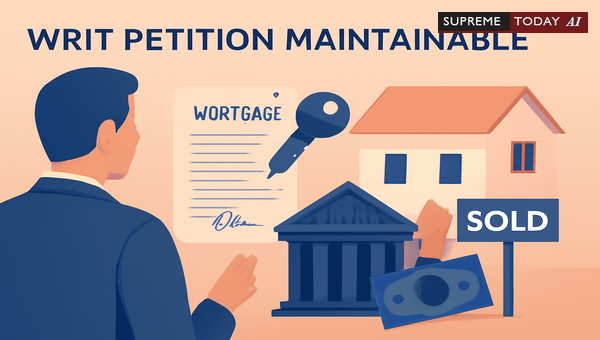
Maintainable for Bank Property Settlement to Son?
In the complex world of banking loans and family property transfers, many individuals face dilemmas when trying to settle properties on heirs while loans remain outstanding. A common question arises: Is a maintainable to get relief directing a bank to allow of a property by way of to the son of the person who availed the loan, by allowing the to continue?
This issue pits constitutional remedies against , often leaving borrowers and their families uncertain. In this post, we delve into Indian law, key judicial precedents, and practical alternatives to provide clarity. Note: This is general information based on legal principles and case law; it is not specific legal advice. Consult a qualified lawyer for your situation.
Main Legal Finding: Generally Not Maintainable
A seeking a direction to a bank to permit of a mortgaged property via to the son of the loan availed, while allowing the to continue, is generally not maintainable under Indian law. Courts have consistently ruled that such relief, which interferes with contractual rights and , falls outside the scope of under of the Constitution. Instead, it must be pursued through . 2015 1 Supreme 644
Key Points:- Writ petitions are for enforcing or extraordinary relief where no exists. 2015 1 Supreme 644- and property transfers are governed by the , and loan agreements, emphasizing contractual remedies. 2025 0 Supreme(SC) 367- Directing a bank to accept a in favor of a third party (like a son) while preserving the involves private rights, not public law issues. 2015 1 Supreme 644
Nature and Scope of Writ Petitions
Writ petitions under are extraordinary remedies designed to protect or address legal violations without adequate alternatives. They are not intended to substitute civil suits or interfere in contractual disputes, particularly in banking and matters. 2015 1 Supreme 644
For instance, courts have held: Writ petitions are primarily suited for enforcing or for extraordinary relief where no exists. 2015 1 Supreme 644 This principle bars using writs for directing banks on property settlements, as under the provide clear paths.
Judicial Approach to Property and Disputes
rights are statutory and contractual. Banks hold that cannot be unilaterally altered via court orders in writ proceedings. A to a son, even with continued , requires bank consent or civil enforcement, not . 2025 0 Supreme(SC) 367
In one case, the court noted: The petitioner had obtained Kisan Credit Card Loan for an amount of Rs.1,99,00,000/- by providing three properties as collateral security by way of registered in favour of the respondent bank... Therefore, the is not maintainable. 2024 0 Supreme(AP) 1452 This underscores that ongoing mortgages preclude writ relief for transfers.
Another judgment highlights: The law recognizes that rights are created and enforced under the , and any transfer or settlement involving such rights must comply with . 2025 0 Supreme(SC) 367
Relevant Case Law and Principles
- Guidance: Relief under /227 is unavailable if an efficacious exists, such as civil suits for . 2015 1 Supreme 644
- Contractual Non-Interference: Directing banks to accept settlements or transfers to successors raises property law questions best resolved civilly. 2015 1 Supreme 644
- Statutory Compliance: A without formalities cannot alter obligations. 2007 6 Supreme 258
Related cases reinforce this. In 2023 Supreme(Online)(MAD) 35054, property offered as security for family loans complicated transfers, directing settlement via dues clearance rather than writs. Similarly, 2024 Supreme(Online)(MAD) 6147 involved a son's plea post-father's loan, but relief was denied in writ, pushing civil routes.
However, precedents like 2023 0 Supreme(Mad) 3248 show writs succeeding for document release post-payment, distinguishing mere release from active transfer directions.
Exceptions and When Writs May Lie
Writs can be maintainable if the bank's actions are , , or (e.g., misuse). For example:- Directing release of documents after full settlement: Maintainable if refusal is unjustified. 2024 0 Supreme(AP) 1452 2024 Supreme(Online)(MAD) 20913- with : Courts have issued where policies apply. 2024 Supreme(Online)(KER) 56491
In 2025 Supreme(Online)(Mad) 62287, a writ directed discharge post-repayment: The bank is not disputing the said facts and they are also willing to execute the Discharge receipt... But for ongoing mortgages and third-party transfers, exceptions are narrow.
Courts clarify: If dues persist or negotiations are private, pursue civil suits. 2022 0 Supreme(Mad) 3873
Integrating Insights from Additional Sources
Various judgments illustrate nuances:- In loan default scenarios with family securities, writs fail without dues clearance. 2024 Supreme(Online)(KER) 15812: Defendants paid towards settlement, but transfers needed separate validation.- via title deeds require strict compliance; writs don't fabricate consents. 2018 0 Supreme(Ker) 434
A balanced view: While some cases (e.g., 2024 0 Supreme(AP) 1452) affirm non-maintainability for transfers, others permit writs for post-settlement releases, highlighting the distinction between enforcement of discharged obligations versus ongoing ones. 2023 0 Supreme(Mad) 3248
Recommendations for Borrowers and Heirs
- Negotiate Directly: Seek bank's no-objection for settlement deeds, ensuring substitution.
- Civil Remedies: File for , declaration, or modification. 2015 1 Supreme 644
- Compliance First: Adhere to ; register deeds properly. 2025 0 Supreme(SC) 367
- Avoid Writs as Shortcut: Use for illegality only; otherwise, face dismissal.
If facing harassment post-settlement offers, document everything for potential writs. 2024 0 Supreme(AP) 1452
Conclusion and Key Takeaways
In summary, a to direct a bank to allow property by to a son while continuing the is generally not maintainable. Respect contractual frameworks and opt for civil proceedings to resolve such disputes effectively. 2015 1 Supreme 644
Key Takeaways:- Writs ≠ Contract substitutes.- Clear dues or prove arbitrariness for success.- Prioritize negotiation and statutory compliance.
This approach upholds legal certainty in banking and property law. For personalized guidance, consult a legal expert.
References:1. 2015 1 Supreme 6442. 2025 0 Supreme(SC) 3673. 2007 6 Supreme 2584. 2024 0 Supreme(AP) 14525. Others as cited.
#WritPetition #BankMortgage #PropertySettlement












