
 Back
Back





SUPREME COURT OF INDIA
SANJAY KAROL, NONGMEIKAPAM KOTISWAR SINGH, JJ.
Bejla Oraon – Appellant
Versus
Kali Das Oraon & Ors. – Respondents
Civil Appeal No. of 2026 (Arising out of SLP (C.) No. 23458 of 2024)
Decided On : 09-07-2026
JUDGMENT :
SANJAY KAROL, J.
1. Leave Granted.
2. Under challenge, at the instance of the original Plaintiff now represented through legal heirs, is the judgment and order dated 10 June 2024 passed by the High Court of Jharkhand at Ranchi in Second Appeal No. 35 of 1995. The impugned judgment upheld the findings returned in first appeal by the 1st Additional District Judge, Gumla in TA No. 42 of 1990 [First Appellate Court] which in turn affirmed the judgment and decree of the Munsif, Gumla in TS No. 22 of 1975 [Civil Court]. In other words, we are asked to examine the correctness of concurrent findings returned by the courts below.
3. One Sukhu Oraon (the grandfather) had three sons, namely Dhungru, Ledura and Bhoula. The plaintiff (Sukhu) was Dhungru’s second son and his grandfather namesake. He claimed ownership of all land owned by Sukhu. Such a claim was opposed by Bhoula’s daughter, Budhain, and her husband Punai (the original defendants 1 and 2). This is based on Sukhu’s second son namely, Ledura, having apparently taken Punai as his ghardamad, for he had no children of his own. It is the undisputed case of the parties that in the local customs that govern them, daughters have no right of inheritance. The defendants claim that Ledura’s property had come to Punai, who is now deceased. The defendants also state that Bhoula having died, Budhain and Ledura partitioned the properties amongst them vide deed dated 27th February 1975, whereas the plaintiff submits that since they had no title whatsoever such a partition deed would be non est. For ease of understanding, a family chart is placed below:
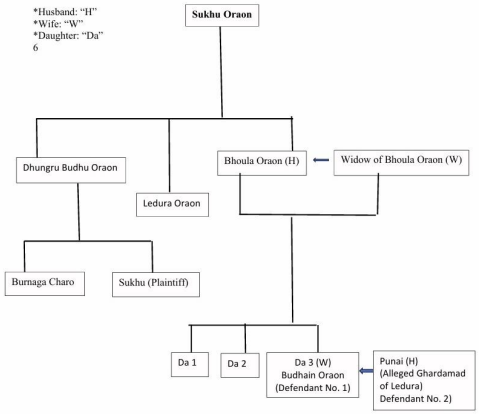
4. The civil court and the first appellate court framed and confirmed respectively the issue as to whether Punai was Ledura’s ghardamad. It is in the impugned judgment that the High Court framed the question of the uncle’s (Ledura Oraon) ability to adopt a ghardamad (Punai). In view of the concurrent dismissal of the plaintiff’s suit, such relationship has been accepted by the courts.
5. Halsbury's Laws of England, (Fourth Edition), Volume 12(1) describes the following attributes of a ‘custom’:
626. Nature of proof. All customs of which the courts do not take judicial notice must be clearly proved to exist, the onus of establishing them being upon the parties relying upon their existence. Proof must be made either by matter of record or by evidence of usage since time immemorial. Evidence to prove a custom must not only be consistent with the custom which is alleged, but must also prove a custom which is no wider than that alleged. If the evidence tends to prove a custom wider than that which is alleged, the party seeking to establish the custom is not at liberty to adopt part only of the evidence and to reject the rest.
[Page No. 177]
627. Usual method of proof. In proving an immemorial custom, the usual course taken is to call persons of middle or old age to state that in their time, usually at least half a century, the custom has always prevailed. This is considered, in the absence of countervailing evidence, to show that the custom has existed from all time. There are two sorts of countervailing evidence. First, other old person may be called to show that there was an interruption during the period spoken of by the first set of witnesses; secondly, evidence may be given that, from the nature of the case, it was quite impossible that such a right should have existed from time immemorial, or that there is some



An indispensable Tool for Legal Professionals, Endorsed by Various High Court and Judicial Officers
Please visit our Training & Support
Center or Contact Us for assistance

Scan Me!
India’s Legal research and Law Firm App, Download now!


For Daily Legal Updates, Join us on :

 Back to top


