
SupremeToday Landscape Ad
Back
Next
Judicial Analysis Court Copy Headnote Facts Arguments Court observation
Listen Audio Icon Pause Audio Icon
judgment-img

2025 Supreme(AP) 1281

IN THE HIGH COURT OF ANDHRA PRADESH AT AMARAVATI
Battu Devanand, A. Hari Haranadha Sarma, JJ.
Nemaligundla Ranganayaka Swamy Temple, Rep. By Its Executive Officer - Appellant
Versus
Akaveeti Ranganayakulu, S/o. Nagai Raju And Ors. - Respondents
Writ Appeal No: 1277 of 2025
Decided On : 04-12-2025

Advocates Appeared:
For the Appellant : Devi Subhashini Anne, SC For Endowments
For the Respondent: Mangena Sree Rama Rao, GP For Services II

Employment in religious institutions must be treated equally; tonsuring work is recognized as religious, warranting equal pay and benefits regardless of financial constraints.

Headnote:(A) Constitution of India - Articles 14, 19(1)(g), and 21 - Mandamus - Relief sought by hereditary employees at temple for implementation of salary scales as per Supreme Court judgment in State of Punjab and Ors. Vs. Jagit Singh and Ors., 2017(1) SCC 148 - Court emphasized that tonsuring is a religious activity and employees performing it are entitled to equal pay without discrimination based on financial constraints or employment status. (Paras 5, 15, 25, 26)

(B) Employment Law - Discrimination in pay - Court held that employees engaged in tonsuring work should not be treated differently from other religious staff as it is inherently a religious service and any denial based on financial implications is unacceptable. (Paras 19, 25)

(C) Employment Rights - Continuous employment - Court ruled that the long-standing engagement of petitioners entitles them to employment benefits, irrespective of the frequency of temple operations. (Paras 14, 18)

Facts of the case:
Writ petitioners, hereditary employees at a temple, contended that their salaries were unjustly fixed while others received benefits under a circular implementing a Supreme Court order; the appeal seeks to challenge a Single Judge's decision rejecting their claims for enhanced pay based on years of service.

Findings of Court:
The court found the tonsuring work performed by the petitioners to be of a religious nature and upheld the claim for salary increment based on continuity of service and equality in treatment against arbitrary standards.

Issues: Whether the tonsuring work constitutes a religious activity and if the petitioners are entitled to salary scales under the relevant circular and Supreme Court precedent, considering arguments on discrimination and financial viability.

Ratio Decidendi: The court affirmed that tonsuring work is religious, hence qualifying for the same treatment as other religious staff, and financial constraints cannot justify discriminatory pay practices.

Result: Writ appeal dismissed, affirming the learned Single Judge's order.

Table of Content
1. overview of the writ appeal and claims of petitioners (Para 1 , 2 , 5)
2. details of petitioner’s employment and rights (Para 6 , 7)
3. respondent's counterarguments regarding employment (Para 9 , 10)
4. tonsuring recognized as religious work (Para 15 , 17)
5. financial objections deemed insufficient to deny pay (Para 18 , 19 , 22)
6. confirmation of benefits under existing legal circulars (Para 24 , 25)
7. conclusion and directives for religious institution management (Para 26 , 27)

JUDGMENT :

A. Hari Haranadha Sarma, J.

Introductory :-

This Writ Appeal is directed against the Order dated 12.09.2025 passed by the learned Single Judge of this Court in W.P.No.15232 of 2020.

2. The 4th respondent in the Writ Petition, feeling aggrieved by the said orders, filed the present appeal with a prayer to set aside the orders of the learned singe Judge. Respondents No.1 to 6 herein are the writ petitioners and respondent No.7, 8 and 9 herein are the respondents 1 to 3 in the said Writ Petition.

3. Heard both sides extensively at admission stage.

4. For the sake of convenience, parties will be hereafter referred to as the writ petitioners and the respondents, as and how they are arrayed in the impugned orders.
Prayer in the Writ Petition:-

5. The writ petitioners sought the relief in the nature of Mandamus, declaring the action of respondents 1 to 4 in not granting the time scale to the petitioners, in terms of the orders of the Honourable Apex Court in State of Punjab and Ors. Vs. Jagit Singh and Ors., 2017(1) SCC 148 and consequential circular in Rc.No.A1/1726091/2018 dated 24.09.2018 issued by the 2nd respondent as illegal, arbitrary, unjust and violative of articles 14, 19(1)(g) and 21 of the Constitution of India and for consequential direction to the respondent No.3 to implement the circular dated 24.09.2018 and grant all consequential benefits including the back wages etc..

Case of Writ Petitioners:-

6. [i] The writ petitioners are the hereditary employees and barbers working in 3rd respondent temple i.e., Sri Nemaligundla Ranganayaka Swamy Temple, Pullalacheruvu, Racherla Mandal, Prakasam District.

[ii] The temple was taken over by the Endowments Department on 01.04.1993. The department has recognised the hereditary employees of the temple and paying consolidated salary, they were given all benefits as hereditary employees and salaries have been enhanced to Rs.13,000/-.

[iii] The Writ petitioners have been working in the temple for several years but the salary is insufficient for maintenance of the family, for education of the children and medical expenses etc. They have no other livelihood except discharging their duties entrusted by the temple authorities. They have put in unblemished service of 27 years. They are entitled for the benefit of in terms of the judgment of the Hon’ble Apex Court in Jagit Singh and Ors.’ case [cited supra].

[iv] In terms of said judgment, the Commissioner of Endowments Department issued a circular in Rc.No.A1/1726091/2018, dated 24.09.2018 for implementation of the guidelines of Supreme Court, fixing the salaries in 6(a) temples concerned.

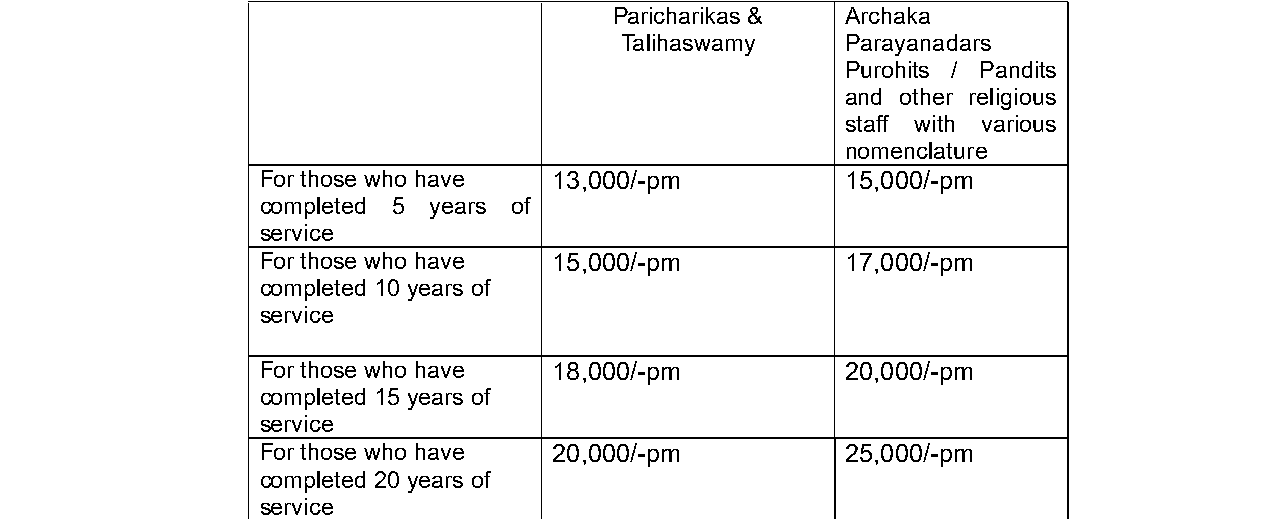
[v] According to the said circular, Archakas, Pandits and other religious staff with the various nomenclature employed and who have completed 5 years of service are entitled to Rs.15,000/-, who have completed 10years of service are entitled to Rs.17,000/-, who have completed 15 years of service are entitled for Rs.20,000/- and those who have completed 20 years of service are entitled for Rs.25,000/-, per month.

[vi] All the writ petitioners have completed 25 years of service, therefore, they are entitled for the benefit in terms of the circular.

[vii] The request of the writ petitioners for enhancement is not considered while granting the same to others. Hence, the same is violative of article 14, 19(1)(g) and 21 of the Constitution of India and hence, they are constrained to file the preset writ petition, seeking the relief in terms of Writ of Mandamus, since their r

Click Here to Read the rest of this document
1
2
3
4
5
6
7
8
9
10
11
Judicial Analysis

AI

SupremeToday Portrait Ad
supreme today icon
logo-black

An indispensable Tool for Legal Professionals, Endorsed by Various High Court and Judicial Officers

Please visit our Training & Support
Center or Contact Us for assistance

qr

Scan Me!

India’s Legal research and Law Firm App, Download now!

For Daily Legal Updates, Join us on :

whatsapp-icon Back to top

