
 Back
Back





IN THE HIGH COURT OF KARNATAKA AT DHARWAD BENCH
M.NAGAPRASANNA, J.
Babu S/o Shankarappa Mukkannvar – Appellant
Versus
The Union Of India – Respondent
Writ Petition No.111248 of 2014 (S-RES)
Decided on : 09-08-2023
Mandamus - Gratuity Payment - The Payment of Gratuity Act, 1972 - Section 7
Fact of the Case:
The petitioner, a retired employee, seeks mandamus to direct the respondents to pay unpaid gratuity of Rs.4,09,550 along with interest from 30.09.2007. The gratuity was determined by the Controlling Authority but not paid by the respondents.
Finding of the Court:
The Court found that the petitioner was entitled to gratuity as a retirement benefit and the delay in payment by the respondents was unjustifiable. The Court issued a writ of mandamus directing immediate payment of gratuity along with interest.
Issues: The main issue concerned the non-payment of gratuity to the petitioner despite the determination by the Controlling Authority.
Ratio Decidendi: The Court relied on Section 7 of The Payment of Gratuity Act, 1972, which mandates the determination and timely payment of gratuity to eligible employees. The Court emphasized that gratuity is not a discretionary benefit and the employer's delay in payment was unjustifiable.
Final Decision: The petition was allowed, and the Court issued a writ of mandamus directing the respondents to pay the determined gratuity amount to the petitioner within 30 days, along with interest. The petitioner was also entitled to a penalty for any further delay in payment.
ORDER :
1. The petitioner is before this Court seeking a direction by issuance of a writ in the nature of mandamus, directing the respondents to pay gratuity, which is left unpaid to the tune Rs.4,09,550/-along with interest from the date it fell due-30.09.2007.
2. Heard the learned counsel Sri. Ramesh I. Zirali and Sri. Shivaraj S. Balloli appearing for the petitioner, the learned CGSC Sri. M.B. Kanavi appearing for respondent No.1-Union of India and the learned High Court Government Pleader Sri. V.S. Kalasurmath appearing for respondent Nos.2 to 5 and 7 and learned counsel Sri. Mallikarjunsamy B. Hiremath appearing for respondent No.6.
3. Facts in brief germane are as follows:
The petitioner is appointed a First Division Clerk at the Postpartum Centre attached to the Jawarharlal Nehru Medical College, Belgaum on 01.12.1973. After completing 34 years of service, the petitioner retires on attaining the age of superannuation. There were several proceedings in the interregnum i.e. between the date of entry of service of the petitioner and his retirement, which are not germane to be noticed. After the retirement, the petitioner was to have been paid gratuity in terms of The Payment of Gratuity Act, 1972 (hereinafter referred to as ‘the Act’, for short). This was not paid, which drove the petitioner, to file an application before the Controlling Authority under the Act to determine the gratuity and direct its payment.
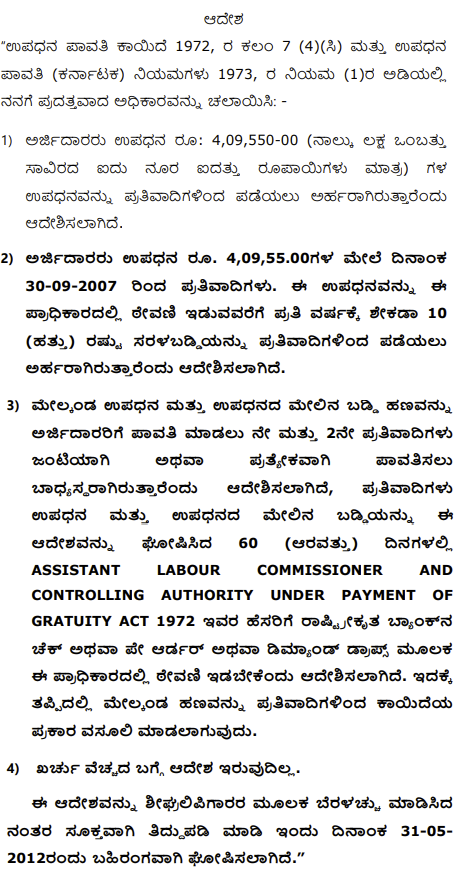
The application is allowed by the Authority in terms of its order dated 31.05.2012 after hearing the parties, determining the gratuity to be paid at Rs.4,09,550/-with interest at 10% per annum from 30.09.2007. The said order becomes final, as the respondent did not question the said order or the determination by the Controlling Authority. The respondent did not pay the gratuity as was directed by the Controlling Authority. This has led the petitioner before this Court in the subject petition.
4. Respondent No.1-Union of India have filed their statement of objections but the State is yet to, despite passage of 9 years.
5. The learned counsel appearing for the petitioner would contend that the Controlling Authority determines the gratuity at the aforesaid amount and directs its payment within three months from 31.05.2012, failing which, it was also directed that it would be recovered as arrears of land revenue. The order, despite it becoming final, is not yet implemented, as the petitioner, who is now aged 74 years, is yet to receive the gratuity that he is entitled to for his working in the institution for 34 years.
6. The learned Government Pleader would seek to plead helplessness, as he received no instruction with regard to payment of gratuity or otherwise to the petitioner, in terms of the order of the Controlling Authority. The counsel for the Union of India-Sri. M.B. Kanavi would only take this Court through the documents appended to the statement of objections but would not dispute the entitlement of the petitioner for receipt of gratuity.
7. I have given my anxious consideration to the submissions made by the respective learned counsel and have perused the material on record.
8. The petitioner joins the service of the institution-Jawaharlal Nehru Medical College on 01.12.1973, retires on attaining the age of superannuation on 31.08.2007 and is relieved from the office of the Postpartem Centre of the Medical College where he works for 34 years. Gratuity was not paid to the petitioner on the ground that a dispute with regard to the service of the petitioner was pending adjudication in Writ Petition No.26349/2004. This was concerning regularization of services of the petitioner’s working at the Postpartum Centre created under the Centrally sponsored scheme of the Family Welfare Department of the year 1969. The Co-ordinate Bench allows the petition by rendering several directions.
9. The issue in the lis does not concern the interpretation of the order of the Co-ordinate Bench. On retirement of the petitioner, the petitioner
AI
The central legal principle established is that gratuity, as a retirement benefit, must be determined and paid to eligible employees in a timely manner as mandated by The Payment of Gratuity Act, 197....


The court has the power to issue a Writ of Mandamus to compel the performance of a public legal duty, such as the payment of gratuity as per the Payment of Gratuity Act.
Interpreting Act unequivocally indicate that payment of gratuity would not depend upon employee filing an application before employer demanding gratuity but will have to be paid immediately on cessat....

The main legal point established in the judgment is the statutory entitlement of an employee to interest on delayed payment of gratuity as per the provisions of the Payment of Gratuity Act, 1972.

Retired employees are entitled to gratuity and interest on delayed payments, with the court having no discretion to deny interest under the Payment of Gratuity Act.

Court enforces timely payment of terminal benefits, including interest for delays.

Delayed payment of gratuity under the Payment of Gratuity Act, 1972 incurs interest at 7% per annum, and statutory revisions to gratuity entitlements must be honored.



An indispensable Tool for Legal Professionals, Endorsed by Various High Court and Judicial Officers
Please visit our Training & Support
Center or Contact Us for assistance

Scan Me!
India’s Legal research and Law Firm App, Download now!


For Daily Legal Updates, Join us on :



 Back to top


