
 Back
Back





IN THE HIGH COURT OF KARNATAKA, DHARWAD BENCH
SHIVASHANKAR AMARANNAVAR, J.
Sri Yallappa S/O Ramappa @ Doddabasappa Lakkannavar – Appellant
Versus
Smt. Kallavva W/O Hanumantappa Kuriyavar – Respondent
Criminal Petition No.100331 of 2023
Decided on : 28-10-2023
Defamation - Civil Suit - Indian Penal Code - Section 500
Fact of the Case:
The petitioners are accused in a case alleging defamation under Section 500 of the Indian Penal Code. The respondent, a daughter of a deceased, filed a suit claiming ownership of certain property. The petitioners, defendants in the suit, made defamatory imputations in their written statement and affidavits, leading to the filing of a private complaint.
Finding of the Court:
The court found that the imputations made by the petitioners were relevant to the issues involved in the civil suit and were not per se defamatory. The court held that the pendency of the civil suit did not preclude the filing of a private complaint for defamation.
Issues: The issues involved the relevance of the imputations to the civil suit, the necessity of waiting for the outcome of the civil suit before filing a private complaint, and the plea of good faith by the petitioners.
Ratio Decidendi: The court emphasized that relevant averments in civil proceedings are necessary and that the pendency of a civil suit does not bar the filing of a private complaint for defamation if the imputations are unrelated to the issues in the civil suit and are per se defamatory. The court also highlighted the requirement to prove good faith and the potential conflict between judgments from criminal and civil courts.
Final Decision: The court allowed the criminal petition and quashed the proceedings in the case, stating that the imputations were not per se defamatory and that the plea of good faith was not disallowed at that stage.
ORDER :
The petitioners are accused in C.C.No.820/2022 on the file of Civil Judge and J.M.F.C., Navalgund. The respondent is complainant in the said case. The respondent has filed complaint in P.C.No.116/2021 alleging that petitioners have committed the offence punishable under Section 500 of Indian Penal Code (hereinafter referred as ‘IPC’ for brevity). Seeking to quash the same, petitioners have come up before this Court with this petition.
2. The facts of the case would be as follows;
The respondent is one of the daughter of Smt. Fakkiravva W/o Huchchappa Lakkanavar. The respondent, her two sisters and mother filed a suit in O.S.No.132/2016 on the file of Senior Civil Judge, Navalgund seeking the relief of declaration that the sale deed dated 22.02.2016 executed by Huchchappa Lakkanavar in favour of 2nd petitioner Sri. Manojkumar in respect of property bearing Sy.No.379 measuring 23-Acres 13-Guntas of Navalgund village is void ab-initio and to declare that they are the absolute owners in possession of suit schedule ‘B’ properties. The said suit is filed claiming that they are the legal heirs of Huchchappa Lakkannavar. The petitioners who were defendant Nos.1 and 2 in the said suit filed written statement and made averment denying the relationship of plaintiffs in the suit with Huchchappa Lakkannavar. According to respondent, in the written statement in O.S.No.132/2016 and in the evidence affidavit of petitioners herein, they have made defamatory imputations making out a clear offence punishable under Section 500 of IPC. With these allegations, the respondent has filed the instant private complaint. The petitioners who are accused Nos.1 and 2 have came before this Court seeking to quash the entire proceedings. The imputations as extracted in the complaint, are reproduced below.
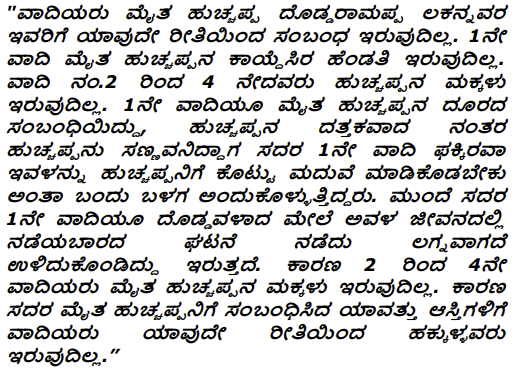
3. The above said imputations are contained in the written statement filed by the petitioners and in their affidavits filed in lieu of examination-in-chief in O.S.No.132/2016. In the averments of written statement and affidavits, the petitioners have stated that respondent, her sisters and their mother are not related to deceased Huchchappa DoddaRamappa Lakkannavar; the 1st plaintiff- Fakkiravva is not the legally wedded wife of Huchchappa. The plaintiffs 2-4 are not the children of Huchchappa. The 1st plaintiff is the distant relative of Huchchappa. After adoption of Huchchappa, the relatives decided to perform marriage of 1st plaintiff-Fakkiravva with Huchchappa. When 1st plaintiff grown up, at that time, some unwanted incident had happened and her marriage was not performed and therefore, plaintiff Nos.2 to 4 are not the children of Huchchappa and they are not having any right in the property of Huchchappa.
4. Learned counsel for the petitioners would submit that these averments have been made in the complaint only out of good faith which would fall squarely under Exception 9 to Section 499 of IPC. The learned Counsel would further submit that these averments are absolutely necessary for proving the issues involved in the civil suit. Learned counsel would further submits that it cannot be stated that these averments, which according to the respondent are defamatory in nature, are absolutely unnecessary for the issues involved in the suit. These averments are necessary and relevant and the petitioners are prepared to prove the same before the Civil Court.
Therefore, according to the learned Counsel for the petitioners, the complaint is liable to be quashed.
5. Here, it is pertinent to note that admittedly, the suit is subjudice and it is yet to be disposed of. Hence, whether the statement is true or defamatory has to be ascertained only after the disposal of the suit. In such circumstances, I am of the opinion, as per the dictum of Hon’ble Apex Court in the case of State of Bihar and Others Vs Kripalu Shankar and Others, (1987) 3 Supreme Court Cases 34 pending matters are immune from comments made by the parties. The averments mentioned in the pleadings fi
AI
The main legal point established is that relevant averments in civil proceedings are necessary, and the pendency of a civil suit does not preclude the filing of a private complaint for defamation if ....

Statements in judicial complaints can constitute defamation; however, delays and the need for evidence in support must be taken into account, reinforcing the importance of reputation and good faith i....

Statements made in civil proceedings that are relevant to the issues cannot be considered defamatory, and a private complaint for defamation cannot proceed if the statements are necessary for the res....

Important points:When concurrent findings of facts rendered by the trial court and the appellate court are sought to be set aside in revision, the High Court does not, in the absence of perversity, u....

Defamatory pleadings made before the Court and not in a public domain may fall under the eighth exception of Section 499 of the Indian Penal Code, and in cases of family disputes, further litigation ....

even in the complaint, there is no averment that other persons read the counter. As such it would not in any way come within the purview of defamation under Section 499 IPC.
A defamation complaint must be filed by the aggrieved party directly, as a Power of Attorney lacks standing under Section 199(1) of the Cr.P.C.

The need for evidence to prove good faith and the limitations of absolute privilege in criminal defamation cases.



An indispensable Tool for Legal Professionals, Endorsed by Various High Court and Judicial Officers
Please visit our Training & Support
Center or Contact Us for assistance

Scan Me!
India’s Legal research and Law Firm App, Download now!


For Daily Legal Updates, Join us on :



 Back to top


