
 Back
Back





IN THE HIGH COURT OF KARNATAKA
Anant Ramanath Hegde, J.
Sultan Mohiyuddin & Ors. – Appellants
Versus
Smt Habeebunnissa – Respondent
RFA No.626 of 2013
Decided On : 25-04-2024
MUSLIM PERSONAL LAW - PROPERTY SETTLEMENT - KARNATAKA STAMP ACT 1957, SECTION 2(q); MUSLIM PERSONAL LAW (SHARIAT) APPLICATION ACT 1937, SECTION 2 - The court analyzed the applicability of the Karnataka Stamp Act and the Muslim Personal Law regarding property settlements among Mohammadans. It concluded that the Karnataka Stamp Act permits property transfers through settlement deeds, which are not expressly forbidden by Shariat Law. The court emphasized that the Act of 1957 is religion-neutral and allows for such transactions, thus overruling the trial court's decision that deemed the settlement deed invalid under Shariat Law.
Fact of the Case:
The case involves a partition suit filed by the daughters of T.A. Abdul Jabbar, who contested the validity of a settlement deed executed by their father in favor of his other family members. The trial court ruled against the validity of the settlement deed based on Shariat Law, leading to an appeal by the defendants.
Finding of the Court:
The court found that the trial court erred in its interpretation of Shariat Law and the Karnataka Stamp Act. It held that the settlement deed was valid and enforceable, as it did not violate any express provisions of Shariat Law and was permissible under the Karnataka Stamp Act.
Issues: 1. Does the Muslim Personal Law (Shariat) Application Act, 1937 override the provisions of the Karnataka Stamp Act regarding property settlements? 2. Is the trial court justified in granting a decree for partition without canceling the settlement deed? 3. Is the suit barred by limitation?
Ratio Decidendi: The court established that the Karnataka Stamp Act allows for property settlements, which are not expressly prohibited by Shariat Law. It clarified that the Act of 1937 does not override the provisions of the Act of 1957, and that the principle of estoppel applies, preventing the plaintiffs from challenging a settlement deed from which they have benefited.
Final Decision: The appeal was allowed, the trial court's judgment was set aside, and the suit was dismissed.
JUDGMENT
Anant Ramanath Hegde, J. - Whether the Muslim Personal Law (Shariat) Application Act, 1937, overrides Section 2(q) and Article 48 of the Karnataka Stamp Act 1957, which deal with the contract of 'settlement' is the question that requires consideration in this appeal.
The trial Court in effect has held that the transfer of property through settlement deed is impermissible among the Mohammadans.
2. The suit is one for partition and separate possession. The plaintiff claimed 1/4th share, out of 7/8th share in the suit schedule property. The suit is decreed as prayed. Aggrieved by the judgment and decree, defendants No.3 to 5 are in appeal.
3. The admitted genealogy of the parties is as under:
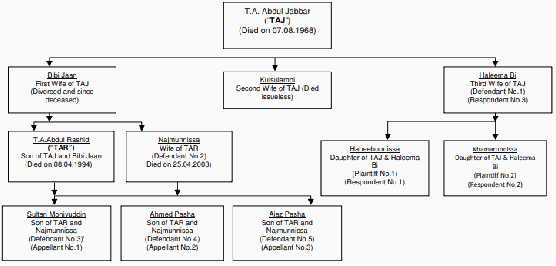
4. One T.A. Abdul Jabbar was the propositus. He had three wives viz., Bibi Jaan, Kusalambi, and Haleema Bi. Abdul Jabbar died on 07.08.1968. When he died in 1968, his first wife Bibi Jaan was divorced, his second wife was not alive and his third wife was alive.
5. The suit is filed by Habeebunnisa and Khairunnisa, the daughters of T.A. Abdul Jabbar from his third wife Haleema Bi. The first defendant is Haleema Bi. The second defendant, Najimunnisa is the widow of T.A.Abdul Rasheed, the son of T.A.Abdul Jabbar from his first wife Bibijan. The defendants No.3 to 5 are the sons of T.A. Abdul Rasheed.
6. Admittedly, T.A. Abdul Jabbar executed a deed of settlement on 10.09.1965, in favour of his grandsons namely Sultan Moyuddin, Ahmed Pasha, and Azaz Pasha. All are the children of T.A. Abdul Rasheed.
7. On 11.09.1965, T.A. Abdul Jabbar executed another settlement deed in respect of sites No.68, 91, and 92 in Sy. No.104 of Guddadahalli i.e., A schedule property and also the entire 'B' schedule property in favour of his only son T.A.Abdul Rasheed. In the same settlement deed, Rs.5,000/- is given to the third wife Haleema Bi.
8. On 13.09.1965, one more settlement deed was executed by T.A. Abdul Jabbar in favour of his minor daughters namely the plaintiffs/respondents No.1 and 2.
9. All the settlement deeds are registered under the provisions of the Registration Act, 1908. The first and the third settlement deeds referred to above are not under challenge.
10. The suit was filed claiming a share in the properties covered by the second settlement deed dated 11.09.1965. Defendants No.2 to 5 resisted the suit and defended the settlement deed. Defendants also contended that the suit is barred by limitation.
11. The trial Court has held that there is no concept of transfer by way of 'settlement' to settle the properties among the Mohammadans. Accordingly, the suit is decreed ordering partition of all the properties covered under the settlement deed of 11.09.1965.
12. Learned counsel for the appellants Sri Manu Kulkarni would contend that the transfer through a 'settlement deed' is not expressly barred under the Mohammadan Law. Even if it is assumed to be barred, the principle of 'estoppel' would apply and the plaintiffs who claimed benefit under the other settlement deed executed by their father cannot be allowed to question another settlement deed executed by the father in which they are not given the benefit.
13. It is urged that the judgment of a co-ordinate bench of this in Abdul Rehman vs. Atifa Begum, 1997 SCC online Karnataka 218 relied upon by the trial Court is per incuriam as the binding precedent of the Supreme Court in the case of Gulam Abbas vs Haji Kayyum Ali and Others (1973) 1 SCC, 1 and judgment in Shehammal vs Hassan Khani Rawther and Others (2011) 9 SCC, 223 are not noticed.
14. The evidence on record namely the settlement deed and revenue records would clearly demonstrate that the possession of the property is transferred to the beneficiaries of the settlement deed.
15. It is also urged that the suit is barred by limitation as the suit is not filed within three years from the date of execution of the settlement deed. Learned counsel for the appellants also points out that three sites described in Schedule A were sold even before the suit was f
AI
The court affirmed that property settlements among Mohammadans are permissible under the Karnataka Stamp Act, and that the absence of explicit prohibition in Shariat Law does not invalidate such tran....

A valid gift under Mohammedan Law requires declaration, acceptance, and delivery of possession; failure to meet these criteria results in the transaction being invalid.


Registered settlement deed proved under Evidence Act Section 68 proviso absent specific denial of execution; certified copy admissible if original lost; partition suit barred without cancelling deed.

The burden of proof lies on the party claiming undue influence to establish that the other party had the ability to dominate their will, which was not proven in this case.
The court emphasized that for claims of undue influence, specific evidence must be provided, and familial relationships alone do not presume such influence, affirming the validity of the executed Set....

(1) Settlement deed/Will – Whether a document is a Settlement Deed or Will, Court has to examine the document as a whole and to look into substance thereof and also to know intention of parties – For....

Inheritance rights under Mohammedan Law are individual, arising only upon death, eliminating claims of joint family property made prematurely based on shared assumptions.



An indispensable Tool for Legal Professionals, Endorsed by Various High Court and Judicial Officers
Please visit our Training & Support
Center or Contact Us for assistance

Scan Me!
India’s Legal research and Law Firm App, Download now!


For Daily Legal Updates, Join us on :



 Back to top


