
 Back
Back





IN THE HIGH COURT OF KARNATAKA AT BENGALURU
M. NAGAPRASANNA, J.
Dr. Shivamurthy Murugha Sharanaru S/O Late Gurumurthy – Appellant
Versus
State Of Karnataka - Respondent
Criminal Petition No.7330 of 2024
Decided on : 13-09-2024
Evidence - POCSO Act - Cr.P.C. Sections 164, 161 - The court interpreted the provisions of Sections 164 and 161 of the Cr.P.C. to clarify that statements recorded under Section 164 are not substantive evidence but can be used for contradiction or corroboration during cross-examination.
Fact of the Case:
The petitioner sought to expunge a portion of a witness's deposition recorded under Section 164 of the Cr.P.C. in a POCSO case. The case involved serious charges under IPC and POCSO Act, and the court had to determine the admissibility of the witness's prior statement.
Finding of the Court:
The court found that the statement recorded under Section 164 of the Cr.P.C. cannot be marked as evidence in chief-examination but can be used for contradiction or corroboration during cross-examination, aligning with established legal precedents.
Issues: The primary issue was whether the evidence recorded on 01-07-2024 was in accordance with the law regarding the admissibility of statements made under Section 164 of the Cr.P.C.
Ratio Decidendi: The court held that statements under Section 164 of the Cr.P.C. are not substantive evidence and can only be used for contradiction or corroboration, as established in various precedents.
Result: The petition was rejected, affirming that the statement under Section 164 cannot be marked in chief-examination.
ORDER :
The petitioner/accused No.1 is before this Court seeking a strange prayer of expunging/redacting a portion of the deposition of PW-1 recorded on 01-07-2024 in Special Case (POCSO) No.181 of 2022 pending before the II Additional District and Sessions Judge, Chitradurga.
2. Facts in brief, necessary for introduction to the case are:
A crime comes to be registered in Crime No.387 of 2022 for offences punishable under Section 376(2)(n), 376(3), 149 of the IPC and under Sections 17, 5(L), and 6 of the Protection of Children from Sexual Offences Act, 2012 (‘POCSO Act’ for short). On completion of investigation the police file a charge sheet on 25-10- 2022 for offences punishable under Sections 376(2)(n), 376(DA), 376(3), 201, 202, 506 r/w 34 and 37 of the IPC, Sections 17, 5(L), and 6 of the Protection of Children from Sexual Offences Act, 2012 (‘POCSO Act’ for short), Sections 3(f) and 7 of the Religious Institution Prevention of Misuse Act, 1988, Section 75 of the Juvenile Justice (Care and Protection of Children) Act, 2015 and Section 3(1)(w)(i)(ii), 3(2)(v)(v-a) of the SC/ST Act, 1989. On 31-05-2024 the concerned Court frames charges in accordance with the order passed by this Court. The facts anterior to the impugned proceedings need not be narrated as they are not relevant for consideration of the issue in the lis. On 10-06-2024 the concerned Court examines CW-2 as PW-1. On 20-06-2024 the concerned Court hears on marking of statement of PW-1 under Section 164 Cr.P.C. On 21-06-2024 the concerned Court passes an order that statements recorded under Section 164(5) of the Cr.P.C. cannot be marked in examination-in-chief of the witnesses as it can only be used for contradiction or corroboration at the time of cross- examination. The examination continued. On 01-07-2024 it appears that the witness says about what she has spoken before the Magistrate while rendering the statement under Section 164(5) of the Cr.P.C. Contending that it is indirectly marking the statement rendered under Section 164 of the Cr.P.C., the petitioner/accused No.1 is again at the doors of this Court.
3. Heard Sri C.V.Nagesh, learned senior counsel appearing for the petitioner and Sri B.N. Jagadeesha, learned Special Public Prosecutor appearing for the respondents.
4. The learned senior counsel would vehemently contend that marking of a statement rendered by the witness under Section 164 is impermissible in law. He would contend that what cannot be done directly cannot be permitted to be done indirectly by even questioning the witness/PW-1 regarding the statement that was rendered under Section 164(5) of the Cr.P.C. This procedure will result in failure of justice and therefore the subject prayer is sought. He would place reliance upon certain judgments rendered by the Apex Court, this Court and other High Court which will all bear consideration qua their relevance in the course of the order.
5. Per contra, the learned Additional State Public Prosecutor would contend that marking of Section 164 statement is not barred in law. The concerned Court has passed an order that Section 164 statement cannot be marked. That would not mean the contents of Section 164 statement cannot be used in the cross-examination for contradiction or corroboration. He would contend that it is only a ruse to drag on the proceedings. He would seek dismissal of the petition in the light of the Apex court directing conclusion of trial as expeditiously as possible.
6. I have given my anxious consideration to the submissions made by the respective learned counsel and have perused the material on record.
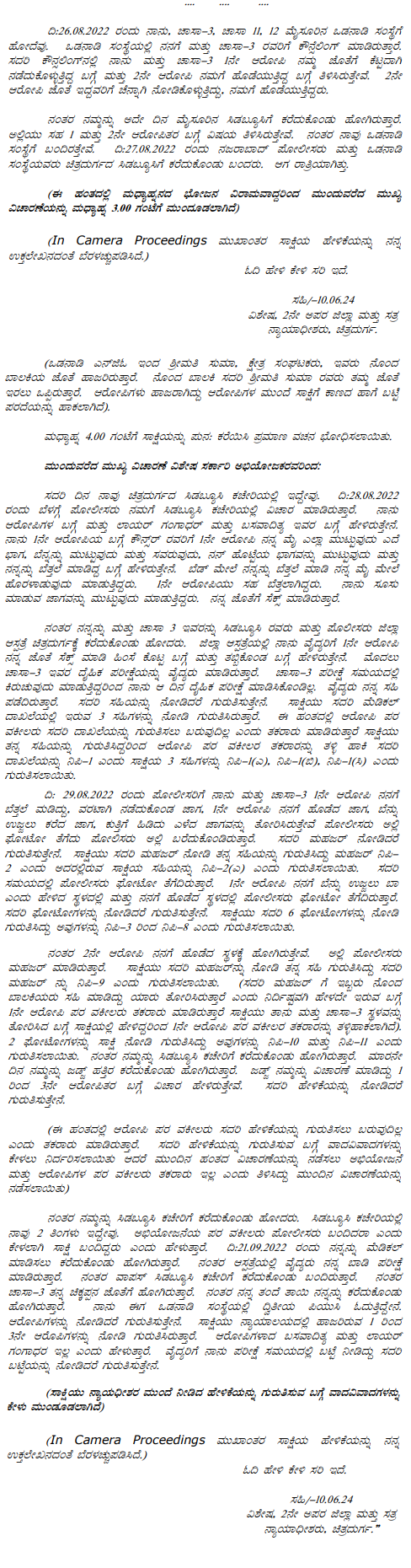
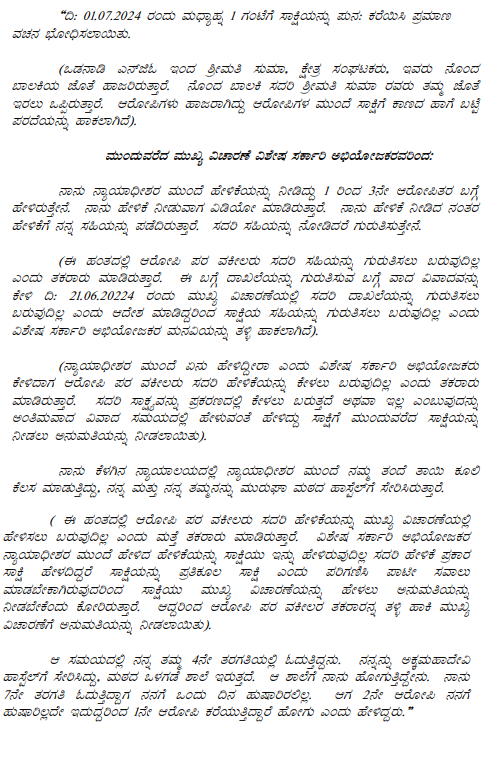
7. The issue that is now brought before the Court lies in a narrow compass. The issue is whether the evidence that is recorded on 1-07-2024 is in tune or contrary to law. When the statement under Section 164(5) of the Cr.P.C., of PW-1/CW-2 was sought to be recorded it was objected to by the defence. The objection led to the concerned Court passing an order. The order reads as follows:
| “RE |
AI
Statements recorded under Section 164 of the Cr.P.C. are not substantive evidence and can only be used for contradiction or corroboration during cross-examination.

The admissibility of statements recorded under Section 164 of the Cr.P.C. as evidence and the conduct of the petitioner's counsel were central legal points established in the judgment.

The evidentiary value of a statement under Section 164 Cr.P.C. is limited and is used as an aid during trial.

The use of statements recorded under Section 164 Cr.P.C. as evidence is limited to corroboration or contradiction, and in the absence of substantial evidence, such statements cannot sustain a convict....

The main legal principle established in the judgment is the importance of confronting witnesses with their previous statements to ensure a fair trial, as mandated by Section 145 of the Evidence Act a....

The court ruled that a witness cannot be recalled to confront them with subsequent statements for impeachment, as only previous statements are permissible under the Evidence Act.



Evidence reliance on Section 164 CrPC statements is inadequate when witnesses become hostile, illustrating the need for corroboration and admissibility standards in criminal proceedings.
The judgment underscores the importance of adhering to procedural requirements in recording witness statements and ensuring the accused's right to explain incriminating evidence.



An indispensable Tool for Legal Professionals, Endorsed by Various High Court and Judicial Officers
Please visit our Training & Support
Center or Contact Us for assistance

Scan Me!
India’s Legal research and Law Firm App, Download now!


For Daily Legal Updates, Join us on :



 Back to top


