
 Back
Back





IN THE HIGH COURT OF KARNATAKA AT BENGALURU
M. NAGAPRASANNA, J.
Sri Shailesh Kumar S/o A.Janardhan Achar - Appellant
Versus
Smt. Nisha S. Kumar W/o Shailesh Kumar – Respondent
Criminal Petition No.13767 of 2023
Decided on : 06-08-2024
Cognizance - Criminal Procedure - IPC Sections 406, 420, 465 - The court emphasized the proper procedure for taking cognizance post 'B' report, affirming that rejection of the report and subsequent cognizance must reflect judicial application of mind to the allegations presented.
Fact of the Case:
The petitioners challenge the taking of cognizance in a case involving allegations of forgery and cheating against them, stemming from a marital dispute and financial transactions involving forged signatures.
Finding of the Court:
The court found that the trial court's rejection of the 'B' report and taking cognizance was in accordance with legal principles, as it properly considered the allegations and evidence presented.
Issues: Whether the trial court's rejection of the 'B' report and taking cognizance of the offences was legally sound.
Ratio Decidendi: The court reiterated that a magistrate must apply their mind to the contents of a 'B' report and any protest petition before taking cognizance, ensuring that proper legal procedures are followed.
Result: The petition challenging the cognizance taken by the trial court is rejected.
ORDER :
The petitioners/accused Nos.1 and 2 are before this Court calling in question proceedings in C.C.No.166 of 2023 pending before the II Additional Senior Civil Judge and CJM, D.K., Mangalore arising out of crime in Crime No.168 of 2014 registered for offences punishable under Sections 406, 420 and 465 of the IPC by which the concerned Court rejects ‘B’ report and takes cognizance of the offences alleged against the petitioners/accused. The 1st respondent is the complainant and the 1st petitioner is her husband. The 2nd petitioner is the manager of the Company run by the 1st petitioner.
2. Heard Sri P.P. Hegde, learned senior counsel appearing for the petitioners, Smt. Nisha S. Kumar, 1st respondent/party-in- person and Sri P.Thejesh, learned High Court Government Pleader appearing for respondent No.2.
3. On 19-03-1999 the complainant gets married to accused No.1 and from the wedlock, they have a son who is now 21 years old. Accused No.1 was the Director of Giltec International Private Limited in which the complainant was also a Director. The name of the Company is said to have been changed from Giltec International Private Limited to Steelnox International Private Limited. Accused No.1 was also running his own proprietorship business in the name of Shagil Precision India, a 100% Export orient unit. It is the case of the complainant that after 5 months of marriage, accused No.1 had forced her parents to purchase two properties in Mangalore measuring 50 cents each, out of which 20 cents was registered in her name and 30 cents in the name of accused No.1.
4. It is the averment that the accused No.1 forced the complainant to offer surety for the loan borrowed by him at Syndicate Bank. Later, in the year 2005, alleging physical abuse against accused No.1 upon the complainant the Police was asked to interfere. It is the contention that the Police did not take any action upon the assault made by the husband. In the year 2006, it appears, that certain Swiss partners of accused No.1 had initiated criminal proceedings against accused No.1 for the offences of cheating, forgery and intimidation. This is said to have been closed by a settlement. These facts are narrated in the complaint by the wife. The story in the lis would begin from 2007. The complainant had two personal bank accounts in Syndicate Bank, Kankanady Branch, Mangalore – one current account and the other savings bank account. The complainant secures employment in New York, USA. After securing employment at Citi Bank, USA she was regularly visiting India. After the exit of the complainant from the Company, it appears that the relationship between the husband and the wife had completely floundered. Accused No.1 on 17-04-2007 creates a mortgage with the Syndicate Bank for his Company Shagil Precision on the properties that had been purchased in the year 2005, narration of which is made hereinabove. Several proceedings have taken place thereafter.
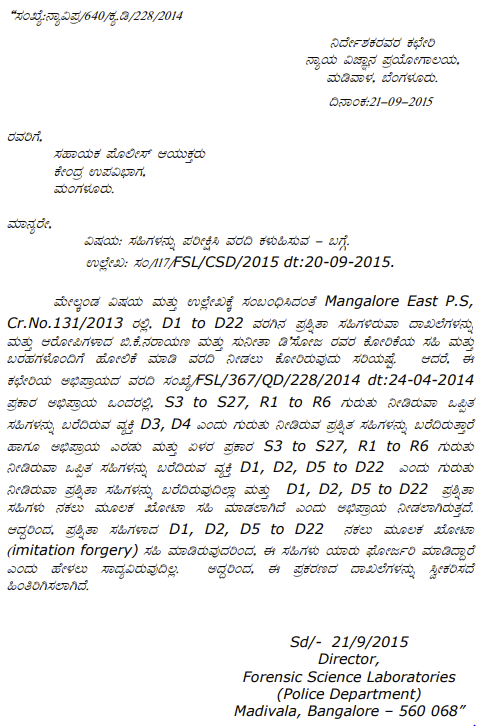
5. The criminal law in the lis is sought to be set into motion in year 2014 when the complainant registers a complaint on 28-01-2014 alleging offences of forgery and cheating against her husband/accused No.1, the Manager of Shagil Precision, accused No.2 and the Branch Manager of Syndicate Bank, accused No.3. It is the allegation in the complaint that her signatures were forged to withdraw money or create equitable mortgage with the connivance of the Branch Manager. The matter was referred to investigation by the learned Magistrate under Section 156(3) of the Cr.P.C., which then becomes a crime in Crime No.168 of 2014 for offences punishable under Sections 406, 420 and 465 of the IPC. As observed hereinabove, it was against three accused. The investigation is conducted by the police. The signatures were referred to the Forensic Science Laboratory (‘FSL’) which confirmed that the signatures had a mismatch. Notwithstanding this, it appears that the Police filed a ‘B’ report before the concerned Court. The complainant files a protest pe
AI
A magistrate must apply judicial discretion when rejecting a 'B' report and taking cognizance, ensuring adherence to legal procedures.
Point of law: Cheating – Cognizance of offence - Once the learned Magistrate proceeded to record the sworn statement on the basis of the protest petition that itself is taking of the cognizance
The Magistrate must apply judicial mind when taking cognizance and issuing summons, ensuring sufficient grounds exist for proceeding with the case.

Judicial proceedings involving allegations of cheating and forgery must undergo comprehensive investigation; prima facie evidence suffices for proceeding, dismissing claims of civil nature.

The Magistrate has a duty to order an investigation when a cognizable offense is disclosed in a complaint, particularly in cases involving serious allegations such as forgery.


The court emphasized the necessity for adherence to legal procedure in cognizance of non-cognizable offences, reinforcing the right to fair trial and requiring written complaints for filing concernin....

The word “cognizance” has not been defined under Cr.P.C. To unveil the legal quandary, a brief survey of 'Cognizance' would illuminate everything, clearing all concepts, therefore, this Court is refe....

Section 415 of IPC mandates that there should be inducement from hands of accused to victim to part with any property and transaction should be tainted with dishonest intention right from its outset.



An indispensable Tool for Legal Professionals, Endorsed by Various High Court and Judicial Officers
Please visit our Training & Support
Center or Contact Us for assistance

Scan Me!
India’s Legal research and Law Firm App, Download now!


For Daily Legal Updates, Join us on :



 Back to top


