
 Back
Back





IN THE HIGH COURT OF KARNATAKA AT BENGALURU
M.I. ARUN, J.
SOUTH CANARA DISTRICT CENTRAL CO-OPERATIVE BANK LTD. – Petitioner
Versus
THE STATE OF KARNATAKA – Respondent
Writ Petition No. 25040 of 2023
Decided On : 05-11-2024
Karnataka Land Grant Rules, 1969 - Rule 9 - Ashraya scheme - Grant of land subject to conditions including non-alienation for 25 years - Mortgage permitted for loan purposes - Enforcement of mortgage upheld despite non-alienation clause - The court ruled that the mortgagee can enforce the mortgage and sell the property to recover the loan. (Paras 1-8)
Facts of the case:
The petitioner, a Co-operative Bank, sought to enforce a mortgage on property granted under the Ashraya scheme after the respondent defaulted on a loan. The State denied permission to sell the property based on the non-alienation condition.
Findings of Court:
The court found that the law permits mortgage of the property, allowing the mortgagee to enforce the mortgage despite the non-alienation clause.
Issues: The main issue was whether the mortgage constituted an alienation under the grant conditions.
Ratio Decidendi: The court held that the mortgage does not constitute alienation and the mortgagee has the right to enforce the mortgage.
Result: The impugned endorsement was set aside, allowing the Bank to sell the property.
ORDER :
1. Respondent No. 5 has been granted a free site by the State under the Ashraya scheme under the provisions of the Karnataka Land Grant Rules, 1969 (for short ‘the Rules’). The said grant is subject to certain conditions as mentioned in the grant order which reads as under:
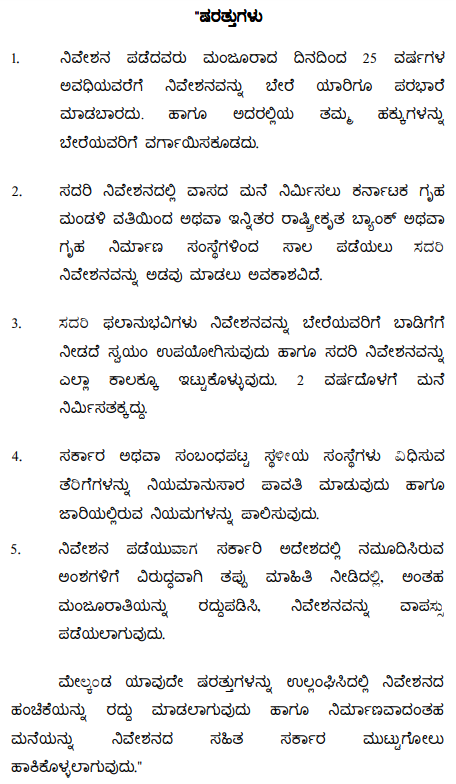
Further, Rule 9 of the Rules, reads as under:
“9. Conditions of grant:
(1) The grant of lands under these rules for agricultural purposes shall be jointly in the name of husband and wife and shall be subject to the following conditions namely:
(i) the grantee shall not alienate the land for a period of twenty-five years from the date of taking possession:
Provided that he may, after a period of five years, with the previous permission of, and subject to the provisions of the Karnataka Scheduled Castes and Scheduled Tribes (Prohibhition of Transfer of Certain Lands) Act 1978 (Karnataka Act 2 of 1979), and such conditions as may be specified by the Deputy Commissioner, alienate the whole or any portion of such land. But however, the Deputy Commissioner shall not grant such permission unless he is satisfied that the alienation is for the purpose of acquiring other land or for improving the remaining land and the grantee credits to Government an amount equal to fifty per cent of the market value of such land as on the date of sanction of such alienation as determined by the Deputy Commissioner:
Provided that no person who has obtained permission to alienate land under the rule shall, notwithstanding the provisions of Rule 4 be eligible for grant of any Government Land.
(ii) the land granted shall be brought under cultivation within three years from the date of taking possession:
Provided that the Deputy Commissioner, may, if he is satisfied that the grantee could not do so for bona fide reasons extend the aforesaid period upto 5 years.
(iii) the grantee shall cultivate the land personally.
(iii-a) where the land is granted for coffee cultivation the grantee shall apply within the period specified in Section 14 of the Coffee Act, 1942 (Central Act 7 of 1945) to the Registering Officer appointed under the said section to be registered as an owner of such land.
(iv) the land shall not be appropriated for any purpose other than that for which it was granted, except with the prior approval of the Granting Authority who may grant such permission subject to such conditions as he may consider proper and subject to payment of additional upset price as he may consider fit provided the conversion is for a nonagricultural purpose and the price is within the maximum specified in Rule 12.
(iv-a) the grantee shall within a period of one year from the date of his taking possession of the granted land plant and maintain not less than one tree per every 10 (ten) acres of land or ten trees per hectare of land, at his cost.
In case the tree/trees planted were to die or get damaged due to causes beyond his control, he shall replant in its place another tree/trees and rear them.
(v) for contravention of any of the above conditions the grant shall be liable to be cancelled and resumed to Government free from all encumbrances by the authority granting the land: Provided that before cancelling the grant, the grantee is afforded with an opportunity of being heard. Provided further that where the grant has been cancelled for non-payment of upset price, the Deputy Commissioner may restore the grant on payment of upset price with a penalty of 10 per cent of the upset price, within a period of 2 years after the grant if the land in question has not been disposed of otherwise.
(2) The following shall not be regarded as alienation for purposes of sub-rule (1):
(a) mortgage of the land in favour of State Government or a Co-operative Society or the Indian Coffee Board or a Scheduled Bank or the Agricultural Refinancing Corporation or the Karnataka State Agro Industries Corporation for loans obtained for improvement of such land or for buying cattle or agricultural implements for the cultivation of such
AI
The court affirmed that a mortgage does not constitute alienation under the Karnataka Land Grant Rules, allowing the mortgagee to enforce the mortgage despite a 25-year non-alienation clause.

Government permission for alienation of granted lands is only required during the specified non-alienation period; after this period, no permission is necessary for valid alienation.

The grant of land retained government ownership, with limited rights conferred to the grantee, who remained subject to resumption powers due to violation of conditions.

Amendments to property alienation rules do not apply retrospectively if the original rule's lock-in period has expired.
The 12-year restriction on alienation of assigned land applies from the date of patta issuance, not the original assignment date, due to non-payment of dues.



An indispensable Tool for Legal Professionals, Endorsed by Various High Court and Judicial Officers
Please visit our Training & Support
Center or Contact Us for assistance

Scan Me!
India’s Legal research and Law Firm App, Download now!


For Daily Legal Updates, Join us on :



 Back to top


