
 Back
Back





IN THE HIGH COURT OF KARNATAKA AT BENGALURU
M. NAGAPRASANNA, J.
John Moses D @ Madan Kumar, S/o John Devamani – Appellant
Versus
State Of Karnataka – Respondent
Writ Petition No.22042 of 2024 (GM – RES)
Decided on : 28-11-2024
ORDER :
The petitioner is knocking at the doors of this Court seeking a declaration that the arrest of the petitioner is illegal and in gross violation of his fundamental rights, guaranteed under Articles 21 and 22 of the Constitution of India in Crime No.8 of 2022 and has sought quashment of remand order dated 22-07-2024 to be again in violation of the said constitutional mandate and seeks release of the petitioner as a consequence of holding the arrest to be illegal.
2. Heard the learned senior counsel Sri Sandesh J Chouta appearing for the petitioner and Sri Ashok Naik, learned Special Public Prosecutor for the respondent.
3. Sans details, facts in brief, germane are as follows:-
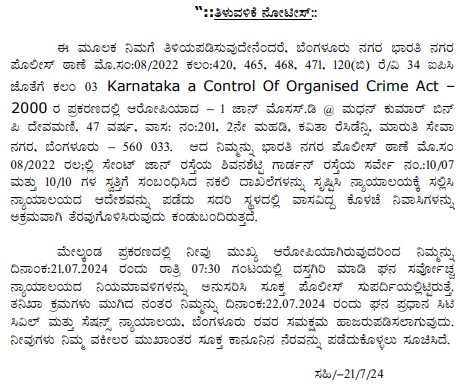
The backdrop of the present proceedings is from a crime registered in Crime No.467 of 2021 for offences punishable under Sections 417, 420, 465, 468, 471, 120B r/w 34 of the IPC against John Moses, accused No.1; S.N.Narendra, accused No.2, Smt. Kanthamma, accused No.3 and Chaitra, accused No.4. The FIR pertaining to the said offence was transferred to the Crime Investigation Department. The Crime Investigation Department then registers a fresh crime in Crime No.8 of 2022 for the aforesaid offences. The investigation in the said crime was continued against 19 persons. The petitioner was one of them. A notice under Section 41A of the Cr.P.C. was issued to the petitioner and in furtherance of the notice, the petitioner is said to have appeared before the Investigating Officer on 28-05-2024. He was taken into custody at that moment and remanded to judicial custody till 11-06-2024. On 11-06-2024, the petitioner was granted bail in Crime No.467 of 2021. On the score that he was on a body warrant in another crime in Crime No.449 of 2021, he was again produced before the Magistrate and the Magistrate remands him to policy custody for three days between 18-06-2024 and 21-06-2024. The Investigating Officer in Crime No.467 of 2021 files a charge sheet on 28-06-2024.
4. The petitioner was granted bail in another crime in Crime No.449 of 2021 in which he was taken into custody on 18-06-2024. The moment he was granted bail, the petitioner was again taken into custody on a body warrant in another crime in Crime No.8 of 2022, the subject crime. The Director General and Inspector General of Police of the CID, on an application made, grants prior approval for invocation of Karnataka Control of Organized Crimes Act, 2000 (‘KCOCA’ for short) which is reflected in the remand application. On 20-07-2024, the petitioner is produced before the learned Magistrate along with the remand application and is remanded to judicial custody till 02-08-2024. In the light of invocation of KCOCA, the entire case was transferred to the Special Court, the Court of Sessions and the petitioner continues to be in the Central Prison in Crime No.8 of 2022.
5. The learned senior counsel for the petitioner would project that arrest of the petitioner is illegal, for the reason that it is in contravention of the judgment of the Apex Court in the cases of PANKAJ BANSAL v. UNION OF INDIA, 2023 SCC OnLine SC 1244, PRABIR PURKAYASTHA v. STATE (NCT OF DELHI), 2024 SCC OnLine SC 934 and the subsequent judgment in the case of ARVIND KEJRIWAL v. DIRECTORATE OF ENFORCEMENT, 2024 SCC OnLine SC 1703 and would submit that once the arrest is held to be illegal, the consequential action of release of the petitioner on grant of interim bail should follow.
6. Per contra, Sri Ashok Naik, learned Special Public Prosecutor would refute the submission by placing reliance upon the earlier judgment of the Apex Court which holds that intimation of arrest would be enough and not grounds of arrest and he would seek dismissal of the petition on the score that several cases are registered against the petitioner who has swindled away many of innocent investors.
7. The learned additional State Public Prosecutor Sri B.N. Jagadeesha was also asked to assist the Court. In rendering such assistance, the learned Additional State Public P
AI
The court ruled that while informing the grounds of arrest is mandatory, recent Supreme Court interpretations regarding PMLA and UAPA do not apply to general offenses under IPC or KCOCA.


The court affirmed that grounds of arrest must be communicated in writing to the accused, ensuring compliance with constitutional rights and enabling effective legal defense.

The court reaffirmed that informing an arrested person of the grounds for arrest is a constitutional requirement, and non-compliance invalidates the arrest and remand.

(1) Arrest – Constitutional Safeguards – A police officer cannot casually arrest a person against whom commission of an offence punishable with imprisonment for more than seven years is alleged – The....

(1) Arrest – Any person arrested for allegation of commission of offences under provisions of UAPA or any other offences has a fundamental and a statutory right to be informed about grounds of arrest....

Supply of documents to arrestee – Person asserted, if he is informed or made aware orally about grounds of arrest at the time of his arrest and is furnished a written communication about grounds of a....

Absence of written grounds of arrest does not mandate bail absent prejudice; substantial compliance via awareness suffices in serious offences, especially pre-'henceforth' rulings.


The arrest of an individual must comply with constitutional and statutory requirements, including providing specific grounds for arrest, which must be communicated in writing to ensure the accused's ....



An indispensable Tool for Legal Professionals, Endorsed by Various High Court and Judicial Officers
Please visit our Training & Support
Center or Contact Us for assistance

Scan Me!
India’s Legal research and Law Firm App, Download now!


For Daily Legal Updates, Join us on :



 Back to top


