
 Back
Back





IN THE HIGH COURT OF KARNATAKA (DHARWAD BENCH)
ANANT RAMANATH HEGDE, J.
Dr. Basavaraj Shivappa Meti and Ors. - Appellants
Versus
Smt. Premabai and Ors. - Respondent
Regular First Appeal No. 1925 of 2006 (PAR/POS-), Regular First Appeal No.1928 Of 2006.
Decided on : 11-04-2023
| Table of Content |
|---|
| 1. parties' claims for partition based on ancestral property. (Para 1 , 2 , 3) |
| 2. arguments regarding ownership rights under hindu succession act. (Para 6 , 7) |
| 3. court's considerations on the nature of inherited properties. (Para 8 , 9 , 10 , 11) |
| 4. understanding of coparcenary principles and succession rights. (Para 12 , 13 , 18 , 19 , 20) |
| 5. partial allowance of the appeal regarding specific properties. (Para 21 , 22 , 23) |
JUDGMENT :
Mr. Anant Ramanath Hegde, J. - The suit in O.S.No.247/2000 is filed for the relief of partition and separate possession. There are five properties described in the plaint. Four are agricultural lands and one is the residential house. The suit is filed by the wife and children of late Kanaksingh. The relationship is not in dispute. The genealogy is as under:
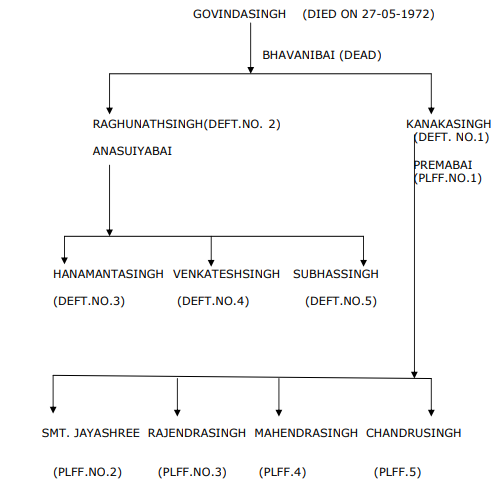
2. One Govind Singh was the propositus. He died in 1972. After his demise, the properties were inherited by his wife Smt.Bhavani Bai, two sons i.e. Kanaksingh and Raghunath Singh and two daughters i.e., Smt Padma Bai and Smt Ambu Bai. The admitted facts would reveal that after the demise of Govind Singh, wife of Govind Singh and his two daughters did not make any claim in respect of the properties. The properties were mutated jointly in the names of two sons viz., Raghunath Singh and Kanak Singh. It appears that Raghunath Singh transferred his share in the properties in favour of his three sons in respect of one of the suit properties namely the property bearing Sy No.233. Later some of the properties were sold in favour of defendants 6 to 10. The sale transactions have taken place in respect of the following suit schedule properties in the following manner:
(a) Kanaksingh and three sons of Raghunathsingh have sold property bearing Sy.No.233 measuring 3 acres 4 guntas in favour of defendant No.6 vide sale deed dated 16.05.1995.
(b) Kanaksingh and three sons of Raghunathsingh have sold property bearing Sy.No.233 measuring 4 acres 20 guntas in favour of defendant No.7 vide sale deed dated 16.05.1995.
(c) Kanaksingh executed registered sale deed in respect of Sy.No.109 measuring 2 acres 28 guntas in favour of defendants 8 and 9 vide registered sale deed dated 23.10.2000.
3. The wife and children of Kanaksingh have filed a suit for partition claiming share in the suit schedule properties on the premise that the properties in the hands of Kanaksingh are the ancestral properties and Kanaksingh could not have sold the properties in favour of defendants 6 to 10. The suit was contested by the purchasers. Raghunathsingh - the brother of Kanaksingh filed written statement opposing the claim.
4. The trial Court has held that the properties could not have been sold and has granted a decree for partition in respect of properties declaring 5/6th share in the suit properties and has held that the alienation made by Kanaksingh in favour of defendants 6 to 10 are not binding on the plaintiffs.
5. Aggrieved by the aforementioned judgment and decree, the present appeal is filed.
6. Sri S S Yadrami, learned senior counsel appearing for the appellants would submit that the properties in the hands of Kanaksingh were the properties inherited under section 8 of the HINDU SUCCESSION ACT , 1956 (for short, the 'Act') as such, he was the absolute owner of the properties and he had every right to alienate the properties and there are no restrictions what-so-ever under any provision of law on Kanaksingh from alienating the properties. He would further submit that the trial Court erred in granting the decree for partition on the premise that the properties are ancestral properties in the hands of Kanaksingh. In support of his contention, he would rely upon the judgment of the Hon'ble Apex Court in the case of Commercial Of Wealth Tax v. Commissioner Of Income Tax, Lucknow (1986)3 SCC 567.
7. Sri Deepak S Shettar, learned counsel appearing for the respondents justifying the judgment and decree would submit that the property in the hands of Kanaksingh though were inheri
AI

The main legal point established in the judgment is that properties derived by the father through a partition deed are to be treated as his self-acquired properties, as per Section 8 of the Hindu Suc....

The main legal point established in the judgment is the determination of ancestral properties available for partition and the validity of gift settlement deeds.

The court affirmed that ancestral property remains so despite partition, and daughters are entitled to equal shares under the Hindu Succession Act, 1956, as amended.
A claimant must prove the ancestral nature of properties to claim entitlement under the amended Hindu Succession Act; mere assertions without evidence are insufficient.

The court affirmed that partition shares from ancestral property remain joint family property for descendants, entitling them to assert claims over the inherited property.

Court ruled that ancestral property retains its character despite prior partition and upheld the validity of a Will despite exclusion of a natural heir.



An indispensable Tool for Legal Professionals, Endorsed by Various High Court and Judicial Officers
Please visit our Training & Support
Center or Contact Us for assistance

Scan Me!
India’s Legal research and Law Firm App, Download now!


For Daily Legal Updates, Join us on :



 Back to top


