
 Back
Back





IN THE HIGH COURT OF JUDICATURE AT MADRAS
K.GOVINDARAJAN THILAKAVADI, J.
Manimegalai – Appellant
Versus
Bakkiyam – Respondent
S.A.No.271 of 2019 and C.M.P.No.3974 of 2019
Decided On : 03-02-2026
| Table of Content |
|---|
| 1. the appellant claimed 1/3 share in property. (Para 2 , 3) |
| 2. defendants assert self-acquired status of properties. (Para 4 , 7 , 8) |
| 3. suit and appeal were dismissed by courts below. (Para 5 , 6 , 9) |
| 4. court analyzed property nature and burden of proof. (Para 10 , 11 , 12 , 13) |
| 5. no interference warranted in lower court findings. (Para 14) |
| 6. second appeal dismissed with confirmed lower court's judgment. (Para 15) |
JUDGMENT :
K. GOVINDARAJAN THILAKAVADI, J.
1. The present Second Appeal is preferred against the judgment and decree dated 14.07.2016 in A.S. No.5 of 2016 on the file of Principal District Court, Darmapuri, confirming the judgment and decree dated 14.08.2015 passed in O.S. No.37 of 2012 on the file of the Sub Court, Harur.
2. For the sake of convenience, the parties are referred to as per their ranking in the trial court.
3. The appellant as plaintiff filed the above suit for partition claiming 1/3 share in the suit properties. According to the plaintiff, the plaintiff and the 2nd defendant are daughter and son of the 1st defendant. On 09.01.1986, the suit properties were purchased from one Muthusamy vagaiyara and the same was enjoyed by the plaintiff and defendants along with their father Sundaram @ Muthu Gounder. The suit properties were purchased by selling the ancestral property on 13.03.1985 and the same is mentioned in the sale deed. Since the 1st defendant and her husband were elderly person of the family, the records stood in their name. While so, on 06.05.2012, the said Muthu Gounder, father of the plaintiff and the 2nd defendant died and thereafter, the plaintiff and the defendants jointly cultivated the suit properties. Even after the marriage of the plaintiff in the year 1995, she jointly enjoyed the suit properties along with the defendants. No partition took place prior to filing of the suit. Thereafter, the plaintiff came to know that the father of the plaintiff and her mother namely the 1st defendant have executed a settlement deed dated 23.09.2010 in favour of the 2nd defendant with an intention to defraud the plaintiff. Since the defendants were attempting to dispossess the plaintiff from the suit properties, she was constrained to file the above suit for partition.
4. Per contra, the defendants would submit that, on 13.03.1985, the father of the plaintiff sold his self acquired property and purchased the suit properties on 09.01.1986. Further the 1st defendant by utilizing the money given to her at the time of marriage, purchased a portion of the suit properties on 09.01.1986 and therefore, the above properties are the self acquired properties of the 1st defendant. On 23.09.2010, the 1st defendant along with her husband, executed a settlement deed in favour of their son namely the 2nd defendant and therefore, the plaintiff is not entitled for any share in the suit properties and prayed for dismissal of the suit.
5. The suit was dismissed by the trial Court and the appeal preferred by the plaintiff was also dismissed by the first appellate court.
6. Aggrieved by this, the present Second Appeal is preferred by the Plaintiff.
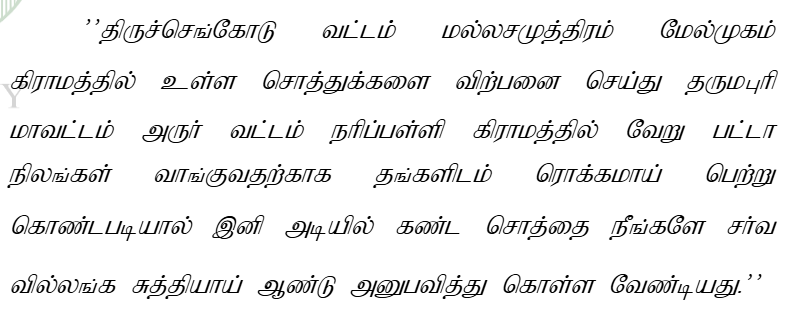
7. The learned counsel appearing for the plaintiff would submit that, the suit properties were purchased by her father Muthu Gounder and her mother namely the 1st defendant by selling the ancestral property, which her father Muthu Gounder had got through a partition deed and therefore, the plaintiff is entitled to get a share as per the amended Hindu Succession Act , 2005. While so, the courts below erred in holding that the plaintiff is not entitled to the benefit of the amended Section 6 of the Hindu Succession Act , 2005, since the properties sold for purchasing the suit properties are the self acquired properties of Muthu Gounder. The recitals found in Ex.A1 sale deed dated 13.03.1985, would clearly show that the properties are ancestral properties of Muthu Gounder. Therefore, the settlement deed executed by Muthu Gounder in favour of the 2nd defendant under Ex.A6 is n
A claimant must prove the ancestral nature of properties to claim entitlement under the amended Hindu Succession Act; mere assertions without evidence are insufficient.

The absence of evidence proving the joint family status of properties allows a presumption that they are individual assets; thus, plaintiffs' claim for partition is dismissed.

The burden of proof lies on the person claiming property as self-acquired to establish that it was acquired without the aid of joint family funds.
The court ruled that an oral partition established the properties as separate and self-acquired, barring claims for partition after 18 years and validating a gift deed executed by the coparcener.
In property disputes, properties obtained through partition are considered self-acquired, affirming the right of absolute ownership and the validity of subsequent transfers unless proven otherwise.
Court ruled that ancestral property retains its character despite prior partition and upheld the validity of a Will despite exclusion of a natural heir.
The properties in question were determined to be ancestral, granting coparcenary rights to the daughter under the Hindu Succession (Amendment) Act, 2005.



An indispensable Tool for Legal Professionals, Endorsed by Various High Court and Judicial Officers
Please visit our Training & Support
Center or Contact Us for assistance

Scan Me!
India’s Legal research and Law Firm App, Download now!


For Daily Legal Updates, Join us on :



 Back to top


