
 Back
Back





IN THE HIGH COURT OF KARNATAKA (DHARWAD BENCH)
ANANT RAMANATH HEGDE, J.
Sri. Shantinath and Ors. - Appellants
Versus
Sri. Mahaveer and Ors. - Respondents
Regular First Appeal No. 100187 of 2015 (DEC/INJ).
Decided on : 30-08-2023
| Table of Content |
|---|
| 1. background of the case and relevant facts (Para 1 , 2 , 3 , 4 , 5 , 6 , 7 , 8 , 9 , 10) |
| 2. arguments regarding the legitimacy of the will (Para 11 , 12 , 13 , 14 , 15 , 16) |
| 3. court's considerations on property nature and will execution (Para 17 , 18 , 19) |
| 4. details on witness credibility and will attestation (Para 20 , 21 , 22 , 25 , 30 , 32) |
| 5. analysis of discrepancies in witness testimonies (Para 26 , 27 , 28 , 31) |
| 6. review of limitations and plaintiff's actions (Para 35 , 36 , 37 , 38 , 39 , 40) |
| 7. final judgment and decree confirmation (Para 43 , 44) |
JUDGMENT :
Mr. Anant Ramanath Hegde, J. - Defendants No.1 to 4 who are the Class-I heirs of late Rayappa Topannavar are before this Court aggrieved by the decree for declaration of title in favour of the plaintiff in O.S.No.35/2011 on the file of the Senior Civil Judge at Saundatti.
2. To understand the case in a proper perspective, it is necessary to refer to the admitted genealogy of the parties, which is as under:
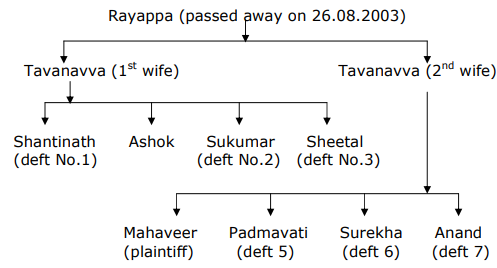
3. The trial Court accepted the plea of the plaintiff who claimed absolute right over the suit schedule property bearing Sy.No.383 measuring 13 acres 33 guntas in Yaraganavi village of Saundatti Taluk based on the Will dated 07.05.1996 alleged to have been executed by Rayappa Topannavar, the father of the plaintiff.
4. The testator Rayappa Topannavar died on 26.08.2003. The first wife was Tavanavva and second wife is also Tavanavva. He married the second wife after the demise of first wife. From the first wife he had three sons and one daughter and from the second wife he had two sons and two daughters. The plaintiff claims that the children from the second wife were residing separately and he was looking after his father and on account of love and affection towards father, his father executed a Will dated 07.05.1996 bequeathing suit schedule property exclusively in his name.
5. It is also his contention that the Will is duly registered. The plaintiff further claims that after the death of the father, he submitted an application to the jurisdictional Tahasildar to enter his name in the property records based on the Will dated 07.05.1996.
6. Defendants No.1 to 4 who are the children from first wife objected to the certification of the mutation based on the Will. The Tahasildar refused to certify the mutation based on the Will. Thereafter, the plaintiff approached the jurisdictional Assistant Commissioner, who accepted the plea of the plaintiff and ordered the name of the plaintiff to be entered in the property record based on the said Will.
7. The defendants challenged the said order of the Assistant Commissioner. The Deputy Commissioner held in favour of the defendants and ordered that the names of all the Class-I heirs to be entered in the property records. This order is called in question by the plaintiff by filing a writ petition which was dismissed and the writ appeal by the plaintiff is also dismissed. After the dismissal of the writ appeal, suit is filed seeking declaration of title based on the aforementioned Will.
8. The defendants No.1 to 4 appeared and contested the claim of the plaintiff. Defendants No.5 to 7 who are the brothers and sisters of the plaintiff did not contest the claim of the plaintiff. They supported the claim of the plaintiff.
9. Contesting defendants No.1 to 4 denied execution of the Will and in addition to that they also took a contention that the property covered under the Will is the property acquired by the testator utilizing the joint family income. Thus, the testator did not have absolute right over the property and could not have executed a Will in respect of the entire property. The trial Court accepted the contention of the plaintiff and held that the execution of the Will is proved and also concluded that the property was the self-acquired property of the testator.
10. Aggrieved by the aforementioned judgment and decree, the contesting defendants No.1 to 4 are in appeal.
11. Sri.Mrutyunjay Tata Bangi, the learned counsel
AI

A registered Will's validity relies on proving the testator's mental capacity and proper execution, with courts deferring to concurrent factual findings by trial and appellate courts.


The court established that the burden of proving a will lies with the proponent, who must dispel any suspicious circumstances surrounding its execution.

The court confirmed the validity of a Will executed in a sound mind, emphasizing the challenger’s burden to prove invalidity, which was not met in this case.

The father of the coparceners had no right to bequeath ancestral property via Will. Wills are invalid unless proven in accordance with statutory requirements.

The execution and validity of a Will require strict adherence to statutory provisions, including proper attestation, which was not proven in this case, rendering the claimed interests void.



An indispensable Tool for Legal Professionals, Endorsed by Various High Court and Judicial Officers
Please visit our Training & Support
Center or Contact Us for assistance

Scan Me!
India’s Legal research and Law Firm App, Download now!


For Daily Legal Updates, Join us on :



 Back to top


