Back
Back





2025 Supreme(Kar) 227
IN THE HIGH COURT OF KARNATAKA AT DHARWAD BENCH
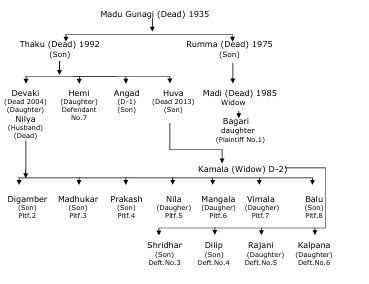
R. NATARAJ, RAJESH RAI K., JJ.
Angad S/o Thaku Gunagi - Appellant
Versus
Bagaribai @ Rukma D/o Rumma Gunagi - Respondent
Regular First Appeal No. 100337 of 2018
Decided On : 02-07-2025
Advocate Appeared:
For the Appellants : S.R. Hegde, P.K. Sanningammanavar
For the Respondents: K.L. Patil, S.A. Sandur
The court affirms joint family ownership of agricultural properties and recognizes claims of all family members, including married daughters, based on their historical contributions to the family estate.
Headnote:(A) Karnataka Land Reforms Act, 1961 - Sections 2(12), 18 & 30 - Partition of joint family properties - The court determined valid claims for shares in ancestral properties, emphasizing that substantial evidence exists to support the joint family ownership of the properties cultivated over generations - The court also addressed the entitlement of plaintiffs based on their contribution to the cultivation of lands. (Paras 10-15)
(B) Appeal - Standard of review - The appellate court affirmed the trial court's findings, indicating that it will not substitute its own views unless the decision is perverse or lacks legal foundation. (Para 11)
Facts of the case:
The plaintiffs sought partition of suit properties following their claim of joint ownership with defendants after non-payment of agreed compensation for state-acquired properties. The trial court ruled in favor of the plaintiffs, confirming their respective shares. (Paras 5, 8)
Findings of Court:
The trial court correctly established that the suit properties were not individually owned by Thaku, the grandfather, but rather were part of joint family property cultivated collectively. Thus, rightful shares were allotted to the claimants. (Paras 13-15)
Issues: The court considered the legitimacy of joint family claims over the property's tenure, the ownership rights associated with land acquired through governmental project compensations, and the validity of claims by married daughters regarding their shares. (Paras 12-14)
Ratio Decidendi: The court concluded that joint family ownership principles underpinned the entitlement to shares, holding that contributions to joint family cultivation justified claims despite earlier marriages; the rights established under the Karnataka Land Reforms Act were deemed applicable to all family members. (Paras 15-16)
Result: Appeal dismissed.
| Table of Content |
|---|
| 1. recognition of joint family property rights (Para 1 , 2 , 3 , 4 , 5) |
| 2. issues framed for determining property rights (Para 6 , 8) |
| 3. arguments from defendants regarding ownership (Para 9 , 10) |
| 4. court's reasoning on joint ownership vs individual ownership (Para 11 , 12 , 13 , 14) |
| 5. consideration of previous contributions to property rights (Para 15 , 16 , 17) |
| 6. final dismissal of the appeal (Para 18) |
JUDGMENT :
R. NATARAJ, J.
1. The defendants 1 to 6 in O.S.No.48/2014 on the file of the Senior Civil Judge, Karwar, have filed this appeal against the judgment and decree dated 27.06.2018 by which the Court declared that the plaintiffs 1(a) and 1(b) are entitled for half share in suit schedule ‘A’ properties and also compensation amount in respect of suit schedule ‘B’ properties, and the plaintiffs 2 to 8 are together entitled to 1/24th share and defendant No.7 is entitled to 1/24th share in the suit schedule ‘A’ and ‘B’ properties. It was further held that the defendant No.1 was entitled for 1/24th share while defendants 2 to 6 together are entitled for 1/6th share and 1/24th share in all the suit schedule ‘A’ and ‘B’ properties.
2. For the sake of convenience and easy understanding, the parties shall henceforth be referred to as they were arrayed before the Trial Court.
3. The suit in O.S.No.48/2014 was filed for partition and separate possession of half share of deceased plaintiff No.1 and share of plaintiffs 2 to 8 in suit ‘A’ and ‘B’ properties. The plaintiffs contended that their genealogy was as follows:
4. The plaintiffs claimed that the mother of plaintiffs 2 to 8 (Smt.Devaki) died on 15.12.2004 and their grandfather (Thaku) died on 21.12.1992. After the death of Thaku, the name of his son Huva was entered in the revenue records as per M.E.No.3362 of Arga village. The said Huva Thaku Gunagi had submitted a Varadi on 28.10.1998 to the Tahasildar, Karwar wherein he had clearly mentioned that the suit schedule ‘A’ properties were the joint family ancestral properties. The plaintiffs contended that there was no partition between the branch of plaintiff No.1 and the branch of plaintiffs 2 to 8, defendant No.1, defendant No.7 and defendants 2 to 6 in respect of the suit schedule ‘A’ properties. They contended that the suit schedule ‘B’ properties were the ones that were acquired by the State Government for ‘Sea Bird’ project. When the defendant No.1 and father of defendants 3 to 6 received the compensation, which was deposited in the Court, they demanded their 25% share. However, the defendant No.1 and father of defendants 3 to 6 assured that the share of the plaintiff No.1 and plaintiffs 2 to 8 would be paid shortly. However, neither defendant No.1 nor Huva Thaku Gunagi shared the compensation as promised by them. Therefore, the plaintiffs approached the defendants 1 to 6 again on 28.09.2014 demanding their legitimate share in the compensation amount. However, the defendants 1 to 6 had agreed to co-operate with the plaintiffs regarding getting back the compensation amount and thereafter advised the plaintiffs to get their share out of the compensation amount as well as the share in the suit schedule ‘A’ properties. The plaintiffs, therefore, contended that the defendants 1 to 6 were trying to dupe them of their legitimate share in the suit schedule ‘A’ lands as well as the compensation amount payable in respect of suit schedule ‘B’ properties. The plaintiffs therefore, sought for partition of their respective shares in the suit schedule ‘A’ and ‘B’ properties.
5. The suit was contested by the defendants 1 to 7, who contended that there was no joint family comprised of Thaku and Rumma, who are children of Madu Gunagi. They claimed that Thaku and Rumma were half brothers born to Madu Gunagi and they never resided under one roof and never cultivated the suit schedule ‘A’ and ‘B’ properties and was never the joint family tenanted lands. They further contended that the Form No.7 filed by Thaku was not on behalf of the jo