
 Back
Back





IN THE HIGH COURT OF KARNATAKA, DHARWAD BENCH
R.NATARAJ, RAJESH RAI K, JJ.
Yallappa @ Yallappagouda, S/o. Shankaragouda Patil - Appellant
Versus
Jagadeeshagouda, S/o. Yallappagouda Patil - respondent
Regular First Appeal No.100634 of 2022 (PAR/POS)
Decided on : 04-06-2025
| Table of Content |
|---|
| 1. defendants challenge partition claim. (Para 1 , 2 , 3) |
| 2. dispute over ancestral property claims. (Para 4 , 10 , 11 , 15 , 16) |
| 3. the nature of the suit and relationships among the parties. (Para 5) |
| 4. court recognizes joint family property. (Para 8 , 14 , 23) |
| 5. conclusion that the appeal lacks merit and is dismissed. (Para 9) |
| 6. court affirms trial court's decision. (Para 12 , 24) |
JUDGMENT :
R.NATARAJ, J.
The defendants No.2, 3, 4 and 5 in O.S. No.27/2020 on the file of the Senior Civil Judge and JMFC, Ron, have filed this Regular First Appeal challenging the judgment and decree dated 28.07.2022 passed therein, by which the suit was decreed and it was held that the plaintiff was entitled to half share in A1 to A6 and B suit schedule properties and 1/4th share in items A7 and A8.
2. For the sake of convenience and easy understanding, the parties shall henceforth be referred to as they were arrayed before the Trial Court.
3. The suit in O.S. No.27/2020 was filed for partition and separate possession in respect of eight items of agricultural lands and a residential property. The plaintiff claimed that defendant No.1 was his sister-in-law, while defendants No.2 to 5 were his nephews and niece. Since the suit schedule No.7 property stood in the name of defendants No.6 to 10, they were also arrayed as formal parties in the suit.
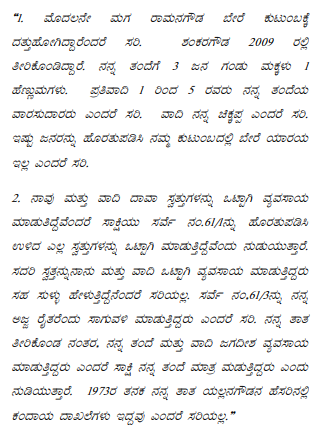
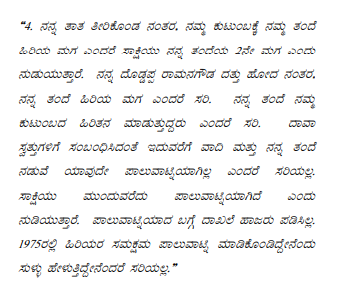
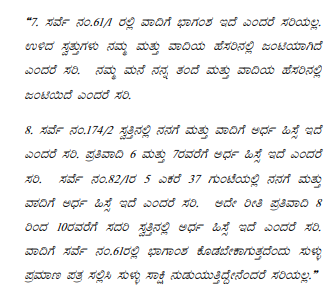
4. The plaintiff claimed that his father had three sons namely Ramanagouda, Shankaragouda and the plaintiff. Amongst them, Ramanagouda was given in adoption and the plaintiff and the husband of defendant No.1 constituted the joint family and were enjoying the suit schedule properties, though they were cultivating separately. Plaintiff claimed that the land bearing Sy.No.61/1 of Budihal Village was cultivated by his father as a tenant and later, after his death, it was granted to the husband of defendant No.1 in the year 1975. It was therefore, contended that all the properties were either joint family properties or ancestral properties of the plaintiff and defendants No.2 to 5. Plaintiff claimed that the defendants refused to partition the suit properties and therefore, he was advised to file a suit for partition and separate possession of his half share in the suit properties.
5. Defendants No.1 to 5 contested the suit and filed their common written statement inter alia contending that the suit filed by the plaintiff was frivolous and mischievous and that the genealogy furnished by the plaintiff was not correct. However, they admitted the relationship of the plaintiff with them and admitted that the eldest brother of the plaintiff was given in adoption. They contended that suit items No.2 to 8 were the ancestral properties of the plaintiffs and the defendants No.2 to 5 but claimed that they had partitioned them in the year 1976 and accordingly, plaintiff and defendants were enjoying their respective shares. In so far as item No.1 of suit ‘A’ property was concerned, it was claimed that it was a separate independent property of the father of defendants No.2 to 5 as it was granted to him by the Tribunal. They contended that by taking advantage of the entries in the RTC extracts for the year 1974-75 that stood in the name of the father of the plaintiff, he had filed the suit including the item No.1 of suit ‘A’ property. They contended that, as per the order of grant by the Land Tribunal, the father of defendants No.2 to 5 had paid land revenue to the State Government and that it was the absolute property of their father over which the plaintiff had no right, title or intrest.
6. Defendants No.6 to 10 were placed ex parte.
7. Based on these contentions, the Trial Court framed the following issues:
1. Whether the plaintiff proves that, the suit schedule properties are the ancestral properties of him and the defendants No.1 to 5?
2. Whether the plaintiff proves that, the suit schedule properties are the joint family properties of him, and the defendants?
3. Whether the plaintiff proves that, the defendants had
AI
Joint family property requires supporting evidence for claims of individual ownership; the absence of documentation for partition nullifies individual assertions of property exclusive rights.

The court affirms joint family ownership of agricultural properties and recognizes claims of all family members, including married daughters, based on their historical contributions to the family est....


The presumption of joint family status in Hindu law requires clear evidence to establish prior partition; the Appellate Court allowed partition of one property acquired post-partition while dismissin....
A plaintiff can only establish entitlement to partition if they demonstrate joint ownership and the failure to do so, particularly through admissions and evidence of prior partition, warrants dismiss....
The distinction between joint family property and self-acquired property is critical in partition suits, and registered sale deeds can effectively rebut claims based on revenue record entries.

The court affirmed the joint family status and the trial court's ruling on partition, rejecting claims of prior oral partition due to insufficient evidence.
A joint family property partition agreement is binding, and claims of exclusive ownership must be substantiated to override such agreements.



An indispensable Tool for Legal Professionals, Endorsed by Various High Court and Judicial Officers
Please visit our Training & Support
Center or Contact Us for assistance

Scan Me!
India’s Legal research and Law Firm App, Download now!


For Daily Legal Updates, Join us on :



 Back to top


