Back
Back





2025 Supreme(Kar) 484
IN THE HIGH COURT OF KARNATAKA, DHARWAD BENCH
M.G.S. KAMAL, J.
Pandurang, S/o. Nagappa Naik – Appellant
Versus
Manjunath, S/o. Nagappa Naik and Ors. – Respondents
Regular Second Appeal No.100026 of 2016(PAR)
Decided On : 24-06-2025
For the Appellant :Sri. Vishwanath Hegde, Advocate
For the Respondents:Sri. Sujeet S. Hiremath, Advocate for Sri. Jagadish Patil, Advocate.
A Will does not constitute alienation, allowing family members to inherit property as per the terms of the grant, even if restrictions exist.
Headnote:(A) Karnataka Land Grant Rules, 1969 - Will Execution - Allegations of violation of Grant Conditions - The courts affirmed that a Will does not constitute alienation as per the Transfer of Property Act, thus allowing defendant No.5 to inherit schedule "A" property. (Paras 20-24)
(B) Family Law - Rights of Heirs - Family members may inherit via a Will even if prohibition on alienation exists, provided terms of the grant are observed. (Paras 20-22)
Facts of the case:
The plaintiff sued for partition of two properties claiming they were joint family properties, asserting that a Will executed by his father was not valid as it violated grant conditions. (Paras 2-4)
Findings of Court:
The execution of the Will did not violate grant conditions, confirming the plaintiff is not entitled to schedule "A" property but only a share in schedule "B". (Paras 10, 24)
Issues: Whether the Will executed violated land grant conditions and whether the plaintiff is entitled to a share in the schedule "A" property. (Paras 6, 10)
Ratio Decidendi: The court concluded that the execution of a Will does not amount to alienation and thus does not violate the grant conditions, upholding the First Appellate Court's decision. (Paras 20-24)
Result: Appeal dismissed.
| Table of Content |
|---|
| 1. plaintiff seeks partition over family properties. (Para 1 , 2 , 3 , 4) |
| 2. defendant claims validity of the will. (Para 5 , 12 , 13 , 14 , 15) |
| 3. court assesses evidence and legal principles. (Para 6 , 10 , 11 , 16 , 17 , 18) |
| 4. execution of a will is not alienation. (Para 19 , 20 , 21) |
| 5. condition on devolution complies with the will. (Para 22 , 23) |
| 6. appeal dismissed; no substantial question of law. (Para 24 , 25) |
JUDGMENT :
(M.G.S. KAMAL, J.)
1. This Regular Second Appeal is filed by the plaintiff, aggrieved by the judgment and decree dated 7th August 2015, passed in R.A. No.76/2013 by the Senior Civil Judge, Honavar (for short “the First Appellate Court”), by which the First Appellate Court while partly allowing the said appeal filed by the defendant No.5, set aside the judgment and decree dated 30th September 2013, passed in O.S. No.109/2012 by the Principal Civil Judge, Bhatkal (for short “the trial Court”), in respect of suit “A” schedule property and held that the plaintiff is not entitled to a share in the schedule “A” property. It further held that the plaintiff and defendant Nos.1 to 10 are entitled for 1/11th share each in the suit “B” schedule property.
2. The above suit in O.S. No.109/2012 was filed by the plaintiff seeking partition and separate possession of two items of landed properties namely; (i) land in Sy.No.70A4 measuring 30 guntas (“A” Schedule property) and (ii) land in Sy.No.70A measuring 16 acres 13 guntas (“B” Schedule property) both situated at Hadin village, Bhatkal taluk, claiming 1/11th share and to hold that the Will dated 13.10.2008, executed by his late father Nagappa Durgappa @ Durgayya Naik in favour of defendant No.5, is not binding on him.
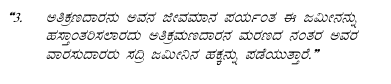
3. The case of the plaintiff is that defendant No.1 is the mother of the plaintiff and defendant Nos.2 to 10. The suit schedule properties were originally granted by the Government in favour of one Nagappa Durgappa @ Durgayya Naik, who was the father of the plaintiff and defendant Nos.2 to 10. The schedule “A” property was granted subject to certain conditions, one of which was that the land shall not be alienated at any point of time by any mode and in any form and that after the death of the grantee it shall be devolved upon the legal heirs of the grantee. That though the schedule “B” property consisting of a residential house was granted in favour of late father of the plaintiff in terms of grant order dated 02.02.1981, the revenue records were not mutated in his name.
4. That the father of the plaintiff was addicted to bad voices and was not in sound mind of dispossession. Defendant No.5 taking advantage of the same, had obtained a Will dated 30.10.2008 executed in his favour in respect of schedule “A” property in gross violation of the terms of the grant. The father of the plaintiff and defendant Nos.2 to 10 was not having right to execute and bequeath the schedule “A” property. As such defendant No.5 cannot derive any right, title and interest over the same. However, in collusion with the village officers, defendant No.5 has obtained transfer of Khata in his name in respect of schedule “A” and “B” properties. Hence, the suit.
5. The written statement is filed by defendant No.5 denying the plaint averments and claimed that the house situated in the schedule “B” property was his absolute property. He contended that father had executed the Will out of his free Will in the presence of two witnesses before the Sub-Registrar and the same was valid and binding. Defendant No.5 is one of the legal heirs, as such the execution of Will in his favour conveying schedule ”A” property was not in violation of grant condition No.3. Hence, sought for dismissal of the suit.
6. The trial Court framed the following issues for its consideration:
1. Whether the plaintiff proves that the suit schedule properties are the joint family properties of the plaintiff and defendants?
2. Whether the plaintiff proves that the Willnama executed by the father of the plaintiff l