


 Back
Back





2025 Supreme(Kar) 1582
IN THE HIGH COURT OF KARNATAKA, DHARWAD BENCH
S.R. KRISHNA KUMAR, C.M. POONACHA, JJ.
Shri Prakash Jakkappa Juvekar and Ors. – Appellants
Versus
Smt. Anusaya, W/o. Laxman Jadhav and Anr. – Respondents
Regular First Appeal No. 100005 of 2018 (PAR/POS-)
Decided On : 11-08-2025
For the Appellants :Sri. Vithal S. Teli, Advocate
For the Respondents:Sri. Shreevatsa S. Hegde & Sri. Abhilash Hanamannavar, Advocates.
In partition disputes, the burden to prove claims, such as that of a will or oral partition, rests on the claimants. Failure to provide evidence results in favor of standard inheritance rights for Class-I heirs.
Headnote:(A) Partition Act, 1893 - Decree for partition and separate possession of property - Respondents-plaintiffs, being daughters of deceased owners, sought shares in properties - Appellants claimed earlier oral partition and a will executed by their mother, both claims rejected - Trial Court decreed suit in favor of plaintiffs for their entitled shares in the properties, ruling appellants failed to prove claims. (Paras 1-23)
(B) Legal burden of proof - In matters of inheritance, the burden of proving the existence of a will lies on the propounder, failing to produce it undermines claims - The trial court emphasized the absence of evidence supporting the will claimed by the appellants. (Paras 18-21)
(C) Inheritance Rights - The parties, as Class-I heirs, are entitled to equal shares in joint family property upon intestate succession after parents' demise. (Paras 4-14)
| Table of Content |
|---|
| 1. factual background of the parties and properties. (Para 1 , 2 , 3 , 4) |
| 2. defendants claim prior partition and possession. (Para 5 , 10) |
| 3. court's assessment of parties' claims. (Para 8 , 22) |
| 4. legal standards for proving a will. (Para 17 , 18 , 21) |
| 5. conclusion that the appeal is dismissed. (Para 23) |
JUDGMENT :
S.R. KRISHNA KUMAR, J.
This appeal is by the defendant Nos.1, 2 and 4 in OS No.147/2015 is directed against impugned judgment and decree dated 03.11.2017 passed by the I Addl. Senior Civil Judge and CJM, Belagavi, [Hereinafter referred as ‘trial court’] whereby the said suit filed by the respondent Nos.1 and 2 against the appellants and respondent No.3-defendant No.3 for partition and separate possession for their alleged 1/6th share each in the suit schedule immovable properties was decreed in favour the plaintiffs against the defendants by the trial Court.
2. The brief facts giving raise to the present appeal are as follows:-
The respondent Nos.1 and 2-plaintiffs are the daughters of Jakkappa who died on 16.05.2011 and Smt.Gangubai, who predeceased on 28.04.1992. The respondent No.1 and 2- plaitniffs instituted the aforesaid suit against the appellants-defendants 1, 2 and 4 and respondent No.3-defendant No.3 who are siblings for partition and separate possession of their alleged 1/6th share in the suit schedule immovable properties and for other releifs. The genealogical tree as pleaded in the plaint is as under:
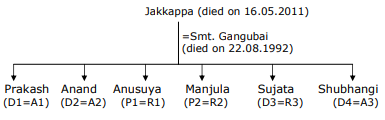
3. As stated supra, the parties are siblings and their parents Jakkappa and Gangubai expired on 16.05.2011 and 28.04.1992 respectively. According to the plaintiffs, among the suit schedule properties, schedule ‘A’ property is a house property while schedule B, C, D and E are landed properties. In that schedule ‘B’ property is R.S.No.65/1 measuring 1 acre 28 guntas while schedule ‘C’ is R.S.No.285/6/1/C measuring 10 guntas and schedule ‘D’ is R.S.No.415/2 measuring 31 guntas and schedule ‘E’ is R.S.No.125/3 measuring 13 guntas situated at respective villages mentioned in the schedule to the plaint.
4. It is an undisputed fact as borne out from the material on record that while schedule-‘B’ property bearing R.S.No.65/1 measuring 1 acre 28 guntas was owned and possessed by Smt.Gangubai, mother of the parties, remaining A, C, D and E schedule properties stood in the name of their father Jakkappa. According to the plaintiffs, since both Jakkappa and Gangubai died intestate living behind the parties to succeed to their estate as their class-I heirs, each one of the parties, being the children and class-I heirs of Jakkappa and Gangubai are entitled for 1/6th share in the suit schedule properties and consequently, the plaintiffs sought for partition and separate possession of their 1/6th share in the suit schedule properties and for other reliefs.
5. The appellant-defendant Nos.1 to 4 filed their written statement interalia disputing the claim of the plaintiffs, while respondent No.3-defendant No.3 supported the claim of the plaintiffs. In their written statement, the appellants- defendant Nos.1 to 4 specifically contended that there was a oral partition during the life time of their father Jakkappa under which schedule A, C and D fell to the share of the appellant Nos.1 and 2-defendants 1 and 2 and schedule ‘E’ property had been sold by the father himself during his life time. In addition to the aforesaid plea regarding oral partition, insofar as schedule-B of the plaint schedule properties are concerned, the appellants specifically contended that the same had been bequeathed in favour of the appellant Nos.1 and 2 by their mother Smt.Gangubai vide a last will and testament dated 29.02.1992 pursuant to which the appellant Nos.1 and 2 have become the absolute and sole owners of schedule ‘B’ property. Under these circumstances, the appellants sought for dismissal of the suit.
6. Based on the aforesaid pleadings, the trial Court framed the following issues:
1. Whether the plaintiffs prove that the suit properti















