
 Back
Back





IN THE HIGH COURT OF KARNATAKA AT BENGALURU
M. Nagaprasanna, J.
Smt. Usha G., W/o K.S.Veerabhadraswamy - Petitioner
Versus
State By Lokayukta Police, Bangalore City Police Station Represented By Special Public Prosecutor And Ors. - Respondents
Writ Petition No.26705 of 2024 (GM – RES)
Decided On : 02-06-2025
ORDER :
M. Nagaprasanna, J.
The petitioner/accused No.1 is before this Court calling in question registration of crime in Crime No.6 of 2024 registered for offence punishable under Section 7 (a) of the Prevention of Corruption Act, 1988 (‘hereinafter referred to as ‘the Act’ for short).
2. Facts in brief, borne out from the pleadings, are as follows:-
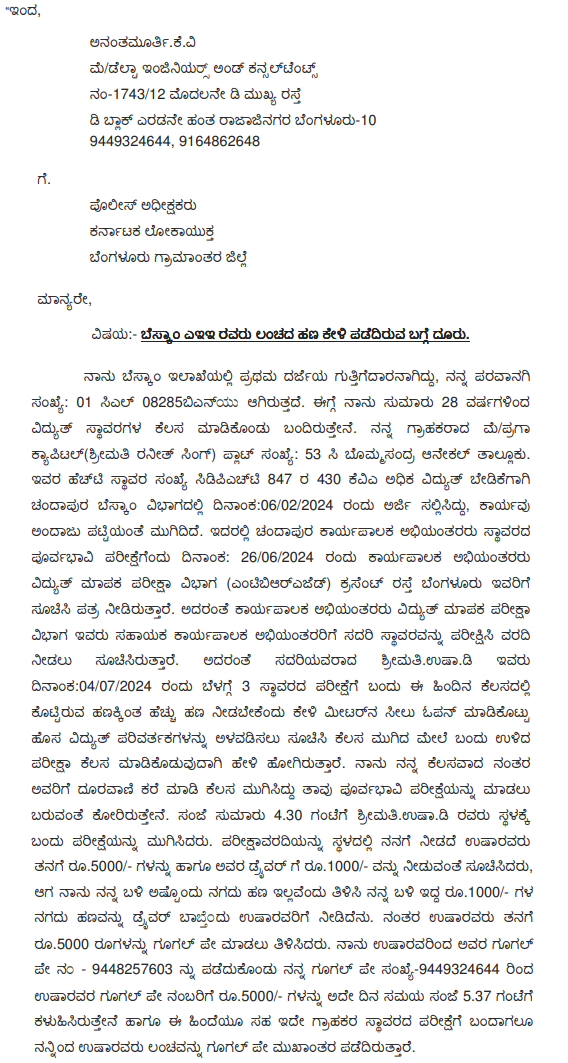
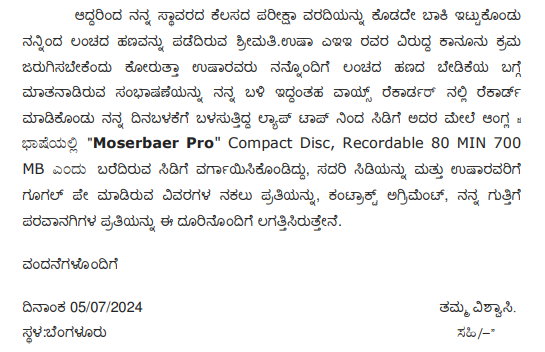
The petitioner is a public servant working as Assistant Executive Engineer, Chandapura BESCOM Division. The 2nd respondent is the complainant, a Class-I Contractor and Proprietor of M/s Delta Engineers and Consultants. The complainant is said to have agreed to conduct some electrical work for his customer one M/s Praga Capital situated in Plot No.53C, Bommasandra, Anekal Taluk. Accordingly, the work was completed and the petitioner was requested to conduct inspection of meters in the said plot and submit his report for the purpose of approval of power supply. On the evening of 04-07-2024 at around 4.30 p.m. the petitioner completes the inspection of the property but did not submit the inspection report on the same day. The allegation is that the petitioner had demanded an illegal gratification of Rs.5,000/- for the purpose of completion of the report and Rs.1,000/- for her driver. Thereafter, it is alleged that the complainant paid an amount of Rs.1,000/- in cash to the petitioner for the driver and transferred Rs.5,000/- to the petitioner through Google pay. The complainant is said to have recorded the demand of illegal gratification on his mobile phone and is said to have transferred the same thereafter to a compact disc. On the said alleged incident on 04-07-2024, a complaint comes to be filed on 05-07-2024 which comes to be registered in Crime No.6 of 2024 for offence punishable under Section 7 (a) of the Act. Registration of crime has driven the petitioner to this Court in the subject petition.
3. Heard Sri Sandesh J. Chouta, learned senior counsel appearing for the petitioner, Sri B.B.Patil, learned counsel appearing for respondent No.1 and Sri Girish Kodgi, learned counsel appearing for respondent No.2.
4. The learned senior counsel appearing for the petitioner would submit that there is no proof of demand and acceptance which is sine qua non for constituting an offence under Section 7 of the Act. Proof of demand should be at the spot or time of the trap. This is most important ingredient to constitute an offence under Section 7 of the Act. There is no post-paid concept under Section 7 and there cannot be an offence under Section 7 (a) when the trap has failed. Elaborating these submissions, the learned senior counsel would submit that the petitioner had completed her job of inspecting the meter. Subsequent to that no report was to be prepared by the petitioner to be handed over to the complainant. She had a duty to submit a report to her superior and not the complainant which she has done on the very next day. Trap mahazar is drawn on 06-07-2024. There is no trap laid. The allegation in the complaint is that the petitioner has demanded Rs.5,000/- for herself and Rs.1,000/- for the Driver. The learned senior counsel would submit that it is a case of failed trap at best, as nothing that is necessary under Section 7 is present in the case at hand.
5. Per contra, the learned counsel Sri B.B.Patil representing the 1st respondent/Lokayukta would vehemently refute the submissions in contending that the submissions so made by the learned senior counsel would all be in the realm of evidence. If the foundational facts are present, the Court should not exercise its inherent power under Article 226 of the Constitution of India or under Section 482 of the Cr.P.C., to quash the proceedings, particularly in cases where they are at the stage of investigation. It is his submission that mere demand itself is sufficient to constitute an offence punishable under Section 7 of the Act and a mere attempt to obtain illegal gratification is sufficient to constitute an offence under the A
AI
Proof of demand and acceptance is essential to establish an offense under the Prevention of Corruption Act. Mere allegations without evidence fail to sustain prosecution.
Proof of demand and acceptance of illegal gratification is essential to establish corruption offences under the Prevention of Corruption Act.

Demand and acceptance of illegal gratification are essential to establish offences under Sections 7 and 13(1)(d) of the Prevention of Corruption Act; mere recovery of tainted money is insufficient fo....

Proof of demand and acceptance of bribes is essential for conviction under the Prevention of Corruption Act; mere recovery of money without evidence of demand does not establish an offence.
Proof of demand for illegal gratification is essential to establish corruption charges under Sections 7 and 7A of the Prevention of Corruption Act, with mere return of money not sufficient without es....
Demand and acceptance of illegal gratification must be established beyond reasonable doubt to sustain charges under the Prevention of Corruption Act.
Demand and acceptance of illegal gratification are essential to establish offences under Sections 7 and 7A of the Prevention of Corruption Act, 1988.
The demand and acceptance of bribes must be proven for prosecution under the Prevention of Corruption Act, highlighting its critical role in establishing culpability.



An indispensable Tool for Legal Professionals, Endorsed by Various High Court and Judicial Officers
Please visit our Training & Support
Center or Contact Us for assistance

Scan Me!
India’s Legal research and Law Firm App, Download now!


For Daily Legal Updates, Join us on :



 Back to top


