
 Back
Back





IN THE HIGH COURT OF KARNATAKA AT BENGALURU
Sachin Shankar Magadum, J.
Koushik B.K. S/o Late Krishnegowda - Petitioner
Versus
State of Karnataka And Ors. - Respondents
Criminal Petition No. 13764 of 2024
Decided On : 17-09-2025
ORDER :
Sachin Shankar Magadum, J.
The present petition is filed by the accused seeking quashing of the proceedings in S.C.No.44/2022 (arising out of Crime No.101/2021) pending before the learned II Additional District and Sessions Judge, Chikkamagaluru, for the offences punishable under Sections 376(2)(n) and 417 of the INDIAN PENAL CODE .
2. The case of the prosecution, in brief, is that respondent No.2/victim, a student of Adichunchanagiri Engineering College, lodged a complaint alleging that she came into acquaintance with the petitioner/accused, and over a period of time they became close friends. It is alleged that the petitioner assured her that he would marry her and, on that pretext, took her to various places and had physical relations with her. According to the victim, after four months of the marriage of the petitioner’s brother, the petitioner distanced himself from her, avoided her company, and became untraceable despite her repeated efforts to contact him over the phone. She further states that, on making enquiries with his family members, they allegedly rebuked her. Consequently, she lodged a complaint alleging that the accused had sexual relations with her under a false promise of marriage, to be fulfilled after his brother’s marriage.
3. On the basis of the said complaint, a case came to be registered, investigation was undertaken, and a charge sheet has been filed against the petitioner/accused for the offences punishable under Sections 376(2)(n) and 417 of IPC.
4. I have heard the learned counsel appearing for the petitioner, the learned counsel for the victim, and the learned High Court Government Pleader representing the State.
5. Before adverting to the rival submissions, this Court considers it appropriate to extract the relevant contents of the complaint, which read as follows:
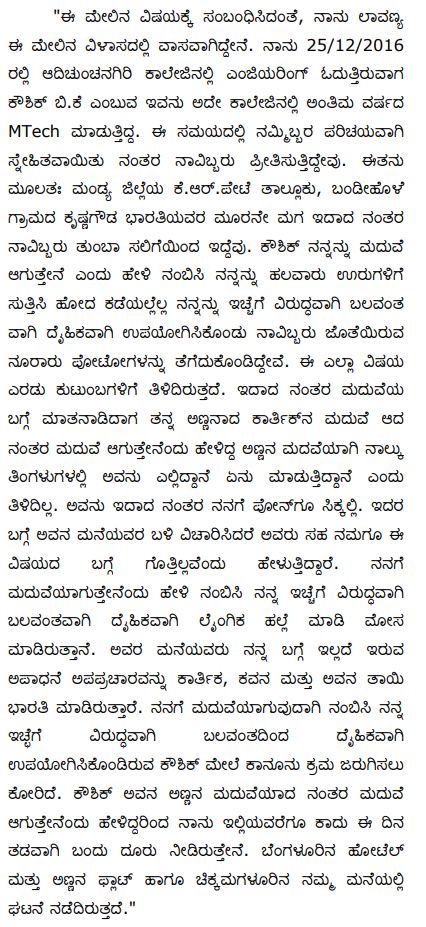
6. On a careful and close reading of the complaint, the victim does not, on the face of the pleading, present herself as a person who was vulnerable in the sense that would negate her capacity to form an informed consent. The complaint itself records that the victim is pursuing engineering at Adichunchanagiri Engineering College. It further records that the parties became acquainted, that they formed a relationship, and that the victim had physical relations with the petitioner. These admissions, being by the complainant herself, weigh against an immediate inference that the complainant lacked the maturity or capacity to consent.
7. The complaint must be evaluated in the light of the legal principles laid down by the Hon’ble Supreme Court in Prashant vs. State of NCT of Delhi , [ SLP (Crl.) No.2793/2024 ], Pramod Suryabhan Pawar vs. State of Maharashtra & Another, [ (2019) 9 SCC 608 ] and Mahesh Damu Khare vs. State of Maharashtra & Another, [SLP (Crl.) No.4326/2018]. Those authorities establish that, to sustain a conviction under Section 375 IPC on the ground of a promise to marry, it is necessary to show that the promise was false ab initio, that is made with no intention ever to perform it. The Supreme Court has further observed that prolonged consensual physical relations, entered into with knowledge of the surrounding circumstances, may negate the contention that consent was vitiated by a misconception of fact under Section 90 IPC. Those rulings require consideration of the parties’ maturity, the factual matrix, and whether there is affirmative evidence of deception or coercion proximate to the sexual act.
8. Applying these principles to the averments before this Court, the material in the complaint tends to show a sustained consensual relationship between two adults. The complainant’s own narrative that she travelled with the petitioner, that they spent time together and that she voluntarily engaged in sexual intercourse, are indicia of informed participation rather than of victimhood or incapacity. The complaint further states that the petitioner distanced himself only after his brother’s marriage and that, thereafter, the complai
AI
Consent cannot be deemed vitiated merely due to a breakdown of a relationship without supporting evidence of fraud or coercion at the time of the act.


A consensual relationship, even under promise of marriage, may not constitute rape if consent is given freely without coercion.

Consensual relationships cannot be classified as rape simply due to a breach of promise to marry; criminal liability requires clear evidence of bad faith or deceit by the accused.

The central legal point established in the judgment is the importance of voluntary consent and the absence of deceit or false promises in determining the nature of a relationship and distinguishing b....

Consent in consensual relationships invalidates allegations of rape; merely non-fulfilling marriage promises does not constitute a crime when prior consent for sexual interactions is established.

Section 375 of IPC states that a man is said to commit rape if he has had any form of sexual intercourse without consent of a woman.

Rape, cheating and stalking – Criminal case cannot be quashed when there are serious factual disputes.
A breach of promise to marry does not constitute rape unless it can be proven that the promise was made with intent to deceive from the outset.



An indispensable Tool for Legal Professionals, Endorsed by Various High Court and Judicial Officers
Please visit our Training & Support
Center or Contact Us for assistance

Scan Me!
India’s Legal research and Law Firm App, Download now!


For Daily Legal Updates, Join us on :



 Back to top


