
 Back
Back





IN THE HIGH COURT OF KARNATAKA AT BENGALURU
E.S. INDIRESH, J.
D.M. Gangamma, Since Deceased, Rep. By Lrs. - Appellants
Versus
D.M. Hanumanthappa Since Deceased Rep. By Lrs.
N R.S.A. No.2027 of 2015
Decided On : 01-09-2025
JUDGMENT :
E.S. INDIRESH, J.
In Regular Second Appeal No.2027 of 2015, appellants are the legal representatives of the original plaintiff, challenging the judgment and decree dated 29th August, 2015 passed in Regular Appeal No.222 of 2013 on the file of the Principal District Judge, Bengaluru Rural District, Bengaluru (for short, hereinafter referred to as 'First Appellate Court'), allowing the appeal in-part and decreeing the Original Suit No.111 of 2009 filed BY the plaintiffs on the file of the Senior Civil Judge and JMFC., Nelamangala (for short, hereinafter referred to as 'Trial Court') in-part.
2. In Regular Second Appeal No.1704 of 2015, appellants are the defendants 1 and 2, challenging the judgment and decree dated 29th August, 2015 passed in Regular Appeal No.222 of 2013 on the file of the First Appellate Court, allowing the appeal in-part and modifying the judgment and decree passed in Original Suit No.111 of 2009 filed by the plaintiffs on the file of the Trial Court.
3. For the sake of convenience, parties in these appeals are referred to in terms of their ranking before the Trial Court.
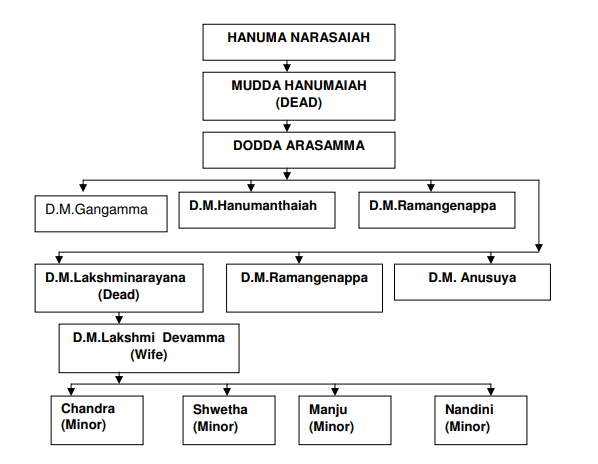
4. The relevant facts for adjudication of these appeals are that the plaintiff No.1-D.M. Gangamma, plaintiff No.2-D.M. Anasuya, defendant No.1-D.M. Hanumanthappa, defendant No.2-D.M. Ramanjanappa, husband of the defendant No.3-D.M. Lakshminarayanappa and defendant No.4-D.M. Jayalakshmi are the children of late Muddha Hanumaiah and late Dodda Arasamma. It is the case of the plaintiffs that, their father Mudda Hanumaiah had several properties mentioned in the schedule to the plaint, which are the joint family properties of the plaintiffs and defendants and accordingly, plaintiffs sought for share in the suit schedule properties and same was denied by the defendants and as such, the plaintiffs have filed Original Suit No.111 of 2009 before the Trial Court, seeking one-sixth share each in the suit schedule properties.
5. After service of notice, defendants 1 to 3 entered appearance and filed written statement. Defendant No.4 remained absent and accordingly, she was placed ex-parte. It is the specific case of the defendants 1 to 3 that there was an oral partition among the members of the joint family properties of plaintiffs and defendants and same was reduced into writing on 15th February, 1989 and thereafter, the said partition was given effect to by entering the name of the defendants in the revenue records. It is also stated that, after partition, the suit properties, which fall into the share of the plaintiffs, have been sold in favour of the third parties by the plaintiffs and accordingly, the defendants 1 to 3 sought for dismissal of the suit.
6. The Trial Court, based on the pleadings on record, formulated the issues for its consideration.
7. In order to establish their case, plaintiffs examined the son of the plaintiff No.1(a) as PW1-M.R. Vivek Kumar [Plaintiff No.1(b)] and produced 46 documents, which were marked as Exhibits P1 to P46. On the other hand, defendants examined two witnesses as DW1 and DW2 and got marked 10 documents as Exhibits D1 to D10.
8. Perusal of the order sheet in the suit would indicate that, originally the suit was filed before the I Additional Civil Judge (Sr.Dn.), Bengaluru Rural District, Bengaluru in Original Suit No.987 of 2002 and thereafter, the suit was transferred to Civil Judge (Sr.Dn.) and JMFC., Nelamangala as per order dated 24th April, 2009. After transfer, the suit was renumbered as Original Suit No.111 of 2009. It is also to be noted that, during the pendency of the suit, the plaintiff No.2-D.M. Anasuya filed memo seeking withdrawal of the suit and accordingly, the suit was prosecuted by the plaintiff No.1.
9. The Trial Court, after considering the material on record, by judgment and decree dated 20th July, 2013, dismissed the suit of plaintiffs. Being aggrieved by judgment and decree passed in Original Suit No.111 of 2009, legal representatives of the plaintiff No.1 have filed Regular Appeal No.2
Prior oral partition established through documentary evidence negated plaintiffs' claims for additional shares in joint family properties under Hindu Succession Act.
Admissions in pleadings or related documents allow for expedited judgments under Order XII Rule 6 CPC, affirming that clear and unequivocal admissions can preclude the need for further evidence.

(1) Judgment on admission – For exercise of discretion by Court under Order XII Rule 6 of CPC, admission must be unequivocal – No particular form of admission is necessary – Judgment on admission is ....


The amendment to Section 6 of the Hindu Succession Act establishes that daughters are coparceners with equal rights in ancestral property, and oral partitions are not sufficient without formal docume....

The amendment to Section 6 of the Hindu Succession Act grants daughters equal rights as coparceners, allowing them to claim shares in ancestral properties irrespective of their birth date.

Partition – Decree - When Apex Court held final decree is always required to be in conformity with preliminary decree but that does not mean that preliminary decree before final decree is passed cann....

The main legal point established in the judgment is the requirement of a partition by metes and bounds for a Partition Deed to be valid under the proviso to Section 6 of the Hindu Succession Act.

Daughters are entitled to equal shares in ancestral property as coparceners under Hindu law, and claims of oral partition require substantial evidence to be accepted.



An indispensable Tool for Legal Professionals, Endorsed by Various High Court and Judicial Officers
Please visit our Training & Support
Center or Contact Us for assistance

Scan Me!
India’s Legal research and Law Firm App, Download now!


For Daily Legal Updates, Join us on :



 Back to top


