Back
Back





2024 Supreme(Mad) 1854
IN THE HIGH COURT OF JUDICATURE AT MADRAS
R. SAKTHIVEL, J.
Vedhavalli (Died) – Appellant
Versus
Venkatesan – Respondent
S.A. No. 141 of 2020, C.M.P. No. 3155 of 2020
Decided On : 23-10-2024
Advocate Appeared:
For the Appellant : N. Suresh
For the Respondent: T.R. Sathiyamohan
The amendment to Section 6 of the Hindu Succession Act grants daughters equal rights as coparceners, allowing them to claim shares in ancestral properties irrespective of their birth date.
Headnote:(A) Hindu Succession Act, 1956 - Section 6 - Second Appeal against the Judgment and Decree of the First Appellate Court regarding partition of ancestral properties - The court held that the daughter is a coparcener by birth, entitled to equal share in ancestral properties, irrespective of her birth date concerning the amendment of the Act. (Paras 8, 19, 21)
(B) Partition - The court clarified that a preliminary decree does not conclude the suit, allowing for re-determination of shares based on subsequent legal developments. (Paras 23, 24)
Facts of the case:
The plaintiffs sought partition of ancestral properties after the death of Govindasamy, with disputes arising over the shares of the parties, particularly concerning the rights of the defendant's children from a void marriage. (Paras 3, 4, 12)
Findings of Court:
The court determined the shares of the plaintiffs and the defendant based on the amended provisions of the Hindu Succession Act, affirming the rights of the daughter as a coparcener. (Paras 26)
Issues: The main issues included the entitlement of the daughter to a share in the ancestral properties and the validity of the defendant's claims regarding necessary parties. (Paras 8, 19)
Ratio Decidendi: The court ruled that the daughter is entitled to equal rights in ancestral property as a coparcener, and the preliminary decree can be amended based on new legal interpretations. (Paras 19, 24)
Result: Second Appeal allowed; Judgment and Decree modified to reflect the correct shares. (Paras 26)
JUDGMENT :
R. SAKTHIVEL, J.
Prayer: This Second Appeal is filed under Section 100 of Code of Civil Procedure praying to set aside the Judgment and Decree dated August 1, 2018 passed in A.S. No. 69 of 2011 on the file of the learned Additional District (Fast Track Court), Villupuram, partly allowing the Judgment and Decree dated October 27, 2010 passed in O.S. No. 64 of 2009 on the file of the Principal Subordinate Judge, Villupuram.
1. This Second Appeal has been preferred against the Judgment and Decree passed by the ‘learned Additional District Judge (Fast Track Court) Villupuram’ [‘First Appellate Court’ for short] in A.S. No. 69 of 2011 modifying the Judgment and Decree passed in O.S. No. 64 of 2009 on the file of the ‘Principal Sub Court, Villupuram’ [‘Trial Court’ for short].
2. For the sake of convenience, hereinafter, the parties will be referred to as per their array in the Original Suit.
Case of the Plaintiffs:
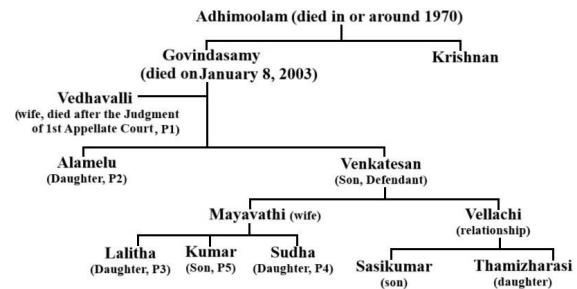
3. The Suit Properties along with some other properties belonged to one Adhimoolam. The said Adhimoolam died intestate 40 years before the date of Plaint. Govindasamy and Krishnan were the sons of said Adhimoolam.
3.1. The Suit ‘A’ Schedule is the genealogy representing the relationship between the parties. The Suit ‘B’ Schedule properties were ancestral properties in hands of said Adhimoolam. After his demise, they were allotted to Govindasamy in an Oral Partition held between he and his brother - Krishnan, and since then Govindasamy is in possession and enjoyment of the same. The Suit ‘C’ Schedule properties are all ancestral properties. It contain 11 items out of which Item Nos.4 to 7 were allotted to the share of Govindasamy along with half share in Item Nos. 1 to 3 in the aforesaid Oral Partition. The remaining half share in Item Nos. 1 to 3 were allotted to the share of Krishnan in the said Oral Partition, which were later sold by Krishnan to Govindasamy. The Suit ‘D’ Schedule properties were purchased from and out of the income derived from the Suit ‘B’ and ‘C’ schedule properties. Thus, all the Suit Properties are ancestral properties.
3.2. Govindasamy died intestate on January 8, 2003 leaving behind the 1st plaintiff (his wife), 2nd plaintiff (his daughter) and the defendant (his son). The Plaintiff Nos. 3 to 5 are the defendant’s children born through his wife - Mayavathi. The 3rd plaintiff got married in January 22, 1999 that is to say after the commencement of Tamil Nadu Act No. 1 of 1990. The defendant neglected and refused to maintain his wife - Mayavathi and Plaintiff Nos.3 to 5 and got into a relationship outside of marriage with one Vellachi. Further, with a view to defeat and defraud the plaintiffs rights over the Suit Properties, the defendant attempted to alienate the same. The plaintiffs caused Notice dated January 20, 2009 to the defendant seeking partition of Suit Properties. The defendant sent Reply dated February 14, 2009 refusing to partition the Suit Properties.
Hence, this Suit for partition.
Case of the Defendant:
4. The defendant filed Written Statement stating that the genealogy in Suit ‘A’ schedule is not described relationship correctly. The 2nd plaintiff is born before the commencement of the Hindu Succession Act, 1956 [‘H.S. Act’ for short] and hence, the 2nd plaintiff is not entitled to any share in the Suit Properties. During the lifetime of Govindamsamy, the 2nd plaintiff received jewels and cash along with some movable properties and after his demise, she relinquished her rights over the Suit Properties orally. Further, the defendant’s wife - Mayavathi deserted him 25 years before the date of Plaint without any reason. Thereafter, the defendant began living with one widow named Vellachi as husband and wife. Through the said Vellachi, the defendant has one son namely Sasikumar and one daughter namely Tamizharasi. The said Sasikumar and Thamizharasi are also having shares in the Suit Properties, who are necessary parties to the Suit. Hence, the Suit is bad of non-joinder of necessary