
 Back
Back





IN THE HIGH COURT OF KARNATAKA AT BENGALURU
V Srishananda, J.
D.V.Ramesh And Ors. - Appellants
Versus
Annadhana Mallegowda And Ors. - Respondents
Regular Second Appeal No.6 of 2020 (PAR)
Decided On : 14-08-2025
JUDGMENT :
V Srishananda, J.
Heard Sri. Vinaya Keerthy M., learned counsel for appellants, Sri K.G. Sadashivaiah, learned counsel for respondent No.1, who appeared through Video Conferencing and Sri N. Kumaraswamy, learned counsel for respondent No.2, who has filed power for respondent No.2 today.
2. Appeal came to be admitted on the following substantial question of law:
“Whether the First Appellate Court could have reversed the decree of partition in the light of the finding that the suit properties were joint family properties and without considering whether Veerasange Gowda could have executed the will in respect of the entire suit schedule property?”
3. Facts which are utmost necessary for disposal of the present appeal are asunder.
4. A suit for partition came to be filed by the appellants herein against mother, brother and nephew of the mother. Properties involved in the suit are culled out hereunder and hereinafter referred to as suit schedule property.

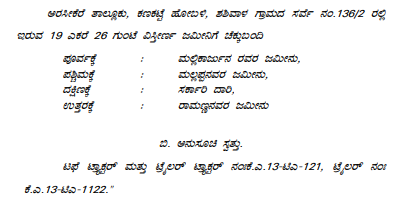
5. Suit on contest came to be decreed and operative portion of the judgment reads as under:
“The suit of the plaintiffs is hereby Partly decreed with cost.
It is ordered and decreed that, plaintiffs and defendant 2 are entitled for 1/3rd share each over the suit schedule properties.
Prayer in respect of mesne profit is hereby rejected.
Draw Preliminary decree accordingly.”
6. Being agreed by decreeing of the suit, defendant No.3 who is nephew of defendant No.1, filed an appeal in R.A.No.111/2017 before the First Appellate Court at Arasikere.
7. Learned Judge in the First Appellate Court noted that there was a Will executed by Veerasange Gowda in respect of the suit schedule properties and noted that the defendant No.3 was able to establish the Will executed by Veerasange Gowda is proved and also recorded a finding that the property was the exclusive property of Veerasange Gowda and allowed the appeal and set aside the judgment and decree passed by the Trial Court and granted decree only with regard to the ‘B’ schedule property by granting 5/16th share to the plaintiffs in ‘B’ schedule property.
8. Being further aggrieved by the same, the plaintiffs being the appellants herein, have filed the present appeal on the following grounds.
The Appellants submit that the Trial Court rightly passed the judgment & decree after considering the documents & clear admission on the part of the first Respondent that the Suit Schedule-A Property is the joint family property and that the same was purchased from the income derived from the other joint family properties.
The Appellants submit that both the Trial & Appellate Courts had upheld the contention that the Suit Schedule Properties are joint family properties, and in this background, it is very much evident that Veerasange Gowda did not have any absolute or exclusive right to execute Will. Considering this fact, the Trial Court rightly decreed the suit. However, the Appellate Court even though upheld the contention that Suit Schedule Properties are joint family properties, allowed the appeal filed by the first Respondent.
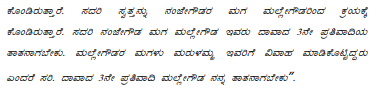
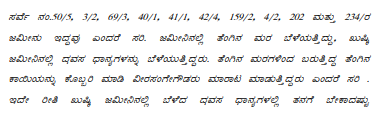
The Appellants submit that all along Veerasange Gowda has been residing with the Appellants and the second Respondent herein and at no point of time was he residing with the first Respondent and at no point of time the first Respondent ever took care of Veerasange Gowda. Further, the first Respondent in his evidence has clearly admitted the fact that at no point of time Veerasange Gowda resided with them and that the Will was prepared by his father and that he alone had taken Veerasange Gowda to the Sub- Registrar's office. The attesting witnesses to the Will deposed that they had not seen Veerasange Gowda or him signing the said Will. These aspects clearly create suspicious circumstances around the execution of the Will. The Trial Court rightly upheld this contention and decreed the suit. However, the Appellate Court without giving credence to this aspect and only on the ground that the Appellants in their rejoinder had not disput








The appellate court must ensure a credible basis for recognizing a will, especially against joint family property claims, failing which its decrees may be reversed.

Point of Law;Suit for partition – Will deed - Court has to be extra cautious in respect of the Wills, the execution of which is surrounded by suspicious circumstances, the Court is required to determ....

The validity of a Will executed by a testator in sound mind is upheld, establishing self-acquisition of property over claims of joint family ownership.

A registered Will, executed in accordance with legal requirements, is valid and can determine the distribution of property, overriding claims for partition based on joint possession.
The court clarified that properties must be inherited or acquired from a joint family nucleus to be classified as ancestral under Hindu law, rejecting claims based solely on joint acquisition.

The court upheld the trial Court's decree for partition, ruling that the alleged Will was not proved, affirming the properties as joint family assets.

Will validly proved by attesting witness; plaintiff failed to establish joint family property for partition entitlement.

legal requirements of proving the Will has been satisfied and the factum of excluding the plaintiff Akha from the properties by the testator is reflected in the Will itself, are sufficiently proved. ....



An indispensable Tool for Legal Professionals, Endorsed by Various High Court and Judicial Officers
Please visit our Training & Support
Center or Contact Us for assistance

Scan Me!
India’s Legal research and Law Firm App, Download now!


For Daily Legal Updates, Join us on :



 Back to top


