
 Back
Back





IN THE HIGH COURT OF KARNATAKA, KALABURAGI BENCH
SHIVASHANKAR AMARANNAVAR, J.
Sharangouda, S/o. Chandramappa Kalagi – Appellant
Versus
Nagamma, W/o. Kareppa Benkotagi, D/o. Late Sidramappa Biredar and Ors. – Respondents
MISCL Second Appeal No.200514 of 2022 (RO)
Decided On : 11-08-2025
| Table of Content |
|---|
| 1. facts around the partition suit and the family lineage. (Para 3 , 4 , 5 , 6) |
| 2. court observations on shares post-death of family member. (Para 7 , 10) |
| 3. arguments raised by the appellant and plaintiff regarding share claims. (Para 8 , 9) |
| 4. final conclusions and directives for re-evaluation. (Para 11) |
JUDGMENT :
SHIVASHANKAR AMARANNAVAR, J.
This second appeal is filed challenging the judgment dated 28.09.2020, passed in R.A.No.15/2018, by the Senior Civil Judge and JMFC, Jewargi.
2. Heard learned counsel for the appellant and learned counsel for respondent No.1.
3. Respondent No.1/plaintiff filed a suit for partition and separate possession of her share in two properties which are as under:
(1) Agricultural Land bearing Sy.No.9 measuring 14 acres 33 guntas.
(2) Agricultural Land bearing Sy.No.47/1 measuring 6 acres 33 guntas.
4. The suit in O.S.No.138/2012 is filed against the appellant/defendant No.4, respondent Nos.2 and 3/defendant Nos.2 and 3 and one Chandawwa (defendant No.1).
5. For the purpose of better understanding, the genealogy of the family of the plaintiff is as under:
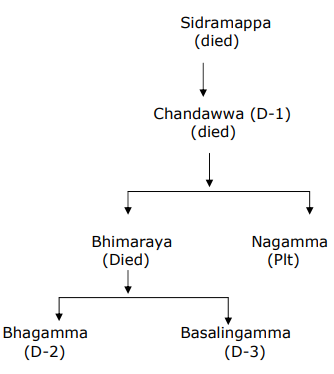
6. The present appellant was defendant No.4 in the said suit. Defendant No.4 had purchased Sy.No.47/1 measuring 6 acres 33 guntas under registered sale deed dated 07.03.2012 from defendant No.1/Chandawwa. Defendant Nos.1 to 4 did not contest the suit. The suit filed by respondent No.1/plaintiff came to be decreed by judgment dated 19.11.2012 declaring that the plaintiff has got 4/9th share in the suit schedule properties. It is further declared that the registered sale deed bearing document No.5700/2011-12 dated 07.03.2012 in respect of suit property bearing Sy.No.47/1 to the extent of share of the plaintiff is null and void and same is not binding on the plaintiff. A preliminary decree was ordered to be drawn. Defendant Nos.1 to 4 challenged the preliminary decree in R.A.No.4/2013 and the same came to be dismissed. Defendant Nos.1 to 4 filed second appeal challenging the judgment of the First Appellate Court in RSA No.200017/2014 and the same came to be dismissed confirming the preliminary decree passed by the Trial Court. The plaintiff thereafter filed FDP No.8/2013 for demarcation of her share in the suit schedule properties and for drawing of final decree. The said petition came to be allowed by order dated 09.04.2018 and the final decree was ordered to be drawn based on the Commissioner report. The said order passed in FDP No.8/2013 has been challenged by defendant Nos.1 to 4 in R.A. No.15/2018. The appellant herein/defendant No.4 was a purchaser has sought allotment of share of Chandawwa (defendant No.1) to his share, as he has purchased the said property from defendant No.1/Chandawwa. During the pendency of the said appeal, Chandawwa died. The First Appellate Court taking note of the same in the impugned judgment has observed as under:
“17. That apart it could be seen from the case papers that the suit was filed by the plaintiff against the defendant No.1 to 4. Defendant No.1 is the mother and defendant No.2 and 3 are the wife and daughter of deceased brother of the plaintiff. Defendant No.4 is none other than the husband of defendant No.3. The trial court has decreed the suit holding that plaintiff is entitle for 4/9th share in the suit schedule properties by metes and bounds and the Registered Sale Deed executed by defendant No.1 in favour of defendant No.4 is null and void and not binding on the share of plaintiff. The trial court has decreed the suit and allotted the share equal to the share of her brother and allotted notional share to the mother. But during pendency of the appeal the defendant No.1 (appellant No.1) was passed away. It is well settled that the share of the members of the joint family will increase in case of death of any member and decrees in case of birth of member. Therefore in view of death of defendant No.1 naturally the share of plaintiff is increased. Therefore in the present case on hand the plaintiff is en
Court ruling emphasized the increased share of joint family members after death and the necessity for procedural fairness in trial court decisions regarding partition matters.

Joint ownership claims require substantiated documentation and evidence; prior agreements affect parties' standing to contest property distributions in court.

Legal heirs, including daughters, are entitled to equal shares in ancestral properties, as affirmed by recent Supreme Court precedent.
The mother of a deceased Hindu male is a Class-I heir and entitled to a share in the property left by the deceased. Her legal heirs are also entitled to a share after her death.

Post-preliminary decree share transfers in partition suits valid, not barred by lis pendens under Section 52 TPA; assignees entitled in final decree.

In matters of inheritance in joint family properties, ancestral status prevails unless a valid Will is presented; thus, equitable shares must be allocated accordingly.

The court upheld the preliminary decree for partition while limiting the shares of certain defendants, emphasizing the need for resolution of the plaintiff's share before final decree.

A daughter's entitlement to inherit a share as a co-parcener in ancestral property is upheld, emphasizing the need to distinguish between ancestral and self-acquired properties.
Co-ownership rights are upheld in joint family property claims, and previous partitions must be established with clear evidence; mere conversion of property does not negate an heir's share.



An indispensable Tool for Legal Professionals, Endorsed by Various High Court and Judicial Officers
Please visit our Training & Support
Center or Contact Us for assistance

Scan Me!
India’s Legal research and Law Firm App, Download now!


For Daily Legal Updates, Join us on :



 Back to top


