
 Back
Back





IN THE HIGH COURT OF KARNATAKA AT BENGALURU
M. NAGAPRASANNA, J.
Lokesh S., S/o. Late Puttaraju and Ors. – Petitioners
Versus
State Of Karnataka, State By Shravanabelagola Police Station, Represented By State Public Prosecutor and Anr. – Respondents
Criminal Petition No.3679 of 2024
Decided On : 07-01-2026
| Table of Content |
|---|
| 1. dispute over land ownership and occupation (Para 1 , 3 , 8) |
| 2. arguments regarding presence and intent (Para 4 , 5 , 6) |
| 3. court's analysis on criminal charges (Para 7 , 9 , 10) |
| 4. outcome of proceedings and charges sustained (Para 11) |
ORDER :
M. NAGAPRASANNA, J.
The petitioners three in number, accused 1, 2 and 3, stand at the doors of this Court, calling in question proceedings in Special Case No.53/2024 registered for the offences under Sections 447, 354, 504, 506 read with Section 34 of the IPC and Sections 3(1)(r), 3(1)(s) and 3(1)(g) of the Scheduled Castes and the Scheduled Tribes (Prevention of Atrocities) Amendment Act, 2015 (hereinafter referred to as ‘the Act’ for short).
2. Heard Sri Girish B. Baladare, learned counsel for the petitioners, Sri B.N.Jagadeesha, learned Additional State Public Prosecutor for respondent No.1 and Sri J.C.Kumar, learned counsel for respondent No.2.
3. Facts enumerated are as follows:
The tussle is between the complainant and these petitioners for a particular piece of land, which the petitioners claim that they are in unauthorised occupation and the complainant claims that it has been granted to her way back in the year 1978. Owing to certain dispute with regard to the said land, the complainant was constrained to institute a suit in O.S.No.956/2023 to protect her possession and restraining the petitioners from interfering with the property. The concerned Court in OS 956/2023 granted an injunction on 25.11.2023. After the grant of injunction, the petitioners appear to have trespassed into the property belonging to the complainant and hurled certain abuses, which would become the ingredients of the offences under the Act. The police after investigation, filed a charge sheet for the afore-quoted offences. Filing of the charge sheet is what has driven these petitioners to this Court in the subject petition.
4. The learned counsel Sri Girish B Baladare appearing for the petitioners would vehemently contend that the petitioners 1 and 3 were not at the spot at all. The first petitioner/accused No.1 is, in fact a teacher who is teaching in a private Institution at Bengaluru. Accused No.2 has applied for regularisation of his unauthorised occupation of the land. Therefore, it is deemed that he is in possession of the property and cannot trespass into his own property. He would submit that the abuses are neither hurled in a public place or a place of public view for the offences under the Act to get attracted. The learned counsel submits that the crime so registered is an abuse of the process of the law as the civil suit is pending between the parties. In that light, he would seek quashment of the proceedings.
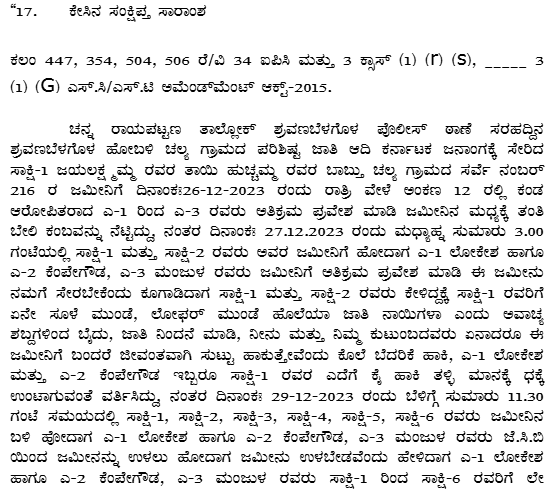
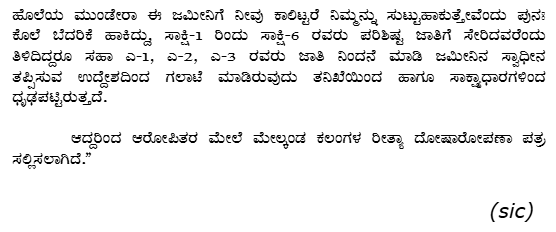
5. The learned counsel for the complainant, Sri J.C. Kumar would take this Court through the summary of the charge sheet as obtaining in column No. 17 to contend that all the offences are clearly met in the case at hand, particularly the offence under Section 354 of the IPC. There was an attempt to outrage the modesty of the complainant. The learned counsel would further submit that after the grant of injunction, as a retaliatory measure, the petitioners have trespassed into the property of the complainant and therefore, the offences are met. He would, however, submit that whether it is in a public place or a place of public view, is not clear in the complaint or in the summary of the charge sheet.
6. The learned Additional SPP Sri B.N.Jagadeesha by taking this Court through the documents appended to the petition would seek to demonstrate that, for the incident there are statements of eyewitnesses, which would indicate that the school teacher who had to be present at Bengaluru in the Institution was present at the spot and has indulged in all those offences. In that light, he would seek dismissal of the petition.
7. I have given my anxious consideration to the submission made by the learned counsel for the respective parties and have perused the material on record.
8. The facts narrate
AI
Charges under the Scheduled Castes and Scheduled Tribes Act cannot stand without evidence of insult or intimidation occurring in public view, while IPC offences are sustained as evidence supports the....


Insults under the Scheduled Castes and Scheduled Tribes Act require public visibility and an intent to humiliate; mere civil disputes do not qualify as offences under this Act.

The main legal point established in the judgment is the application of the principles of abuse of process of law and mala fide intentions in filing a complaint, as outlined in State Haryana Versus Bh....



An indispensable Tool for Legal Professionals, Endorsed by Various High Court and Judicial Officers
Please visit our Training & Support
Center or Contact Us for assistance

Scan Me!
India’s Legal research and Law Firm App, Download now!


For Daily Legal Updates, Join us on :



 Back to top


