
 Back
Back





IN THE HIGH COURT OF KARNATAKA AT BENGALURU
M.NAGAPRASANNA, J.
Gangadhar C/o Shivayya Gandadamata – Appellant
Versus
State of Karnataka – Respondent
Criminal Petition Nos. 4186, 4358 of 2023
Decided On : 06-01-2026
| Table of Content |
|---|
| 1. complaint concerns land dispute leading to alleged assaults. (Para 1 , 4) |
| 2. petitioners argue interim order limited to act's offences. (Para 5 , 6 , 8) |
| 3. court assesses allegations under the act. (Para 7 , 9) |
| 4. ingredients of offences under the act not met. (Para 10 , 11) |
| 5. court's order quashes certain charges. (Para 12 , 13) |
ORDER :
1. The petitioners in both these petitions are before this Court calling in question registration of a crime in crime No.176/2023 for the offences punishable under Sections 143, 147, 148, 323, 324, 504 read with Section 149 of the IPC and Sections 3(1)(r) and 3(1)(s) of the Scheduled Castes and the Scheduled Tribes (Prevention of Atrocities) Amendment Act, 2015 (hereinafter referred to as ‘the Act’ for short). Both these petitions are filed challenging the same crime but are filed by different accused. Therefore, both the petitions are taken together and considered by this common order.
2. Heard Sri. Rohith B.J., learned counsel appearing for the petitioners and Sri. Nageshwarappa, learned High Court Government Pleader appearing for respondent No.1.
3. Respondent No.2 though served 3 years ago has remained unrepresented. The State has preferred an application seeking vacation of the interim order. Therefore, the matter is taken up for its final disposal.
4. The petitioners and the respondent No.2/complainant have a dispute with regard to certain lands. The dispute leads to an altercation between the two on a particular date i.e., on 01.05.2023. It is the allegation in the complaint that on 01.05.2023, the petitioners enter the land of the complainant and assault the complainant and hurl abuses taking the name of the caste. The complaint results in two crimes being registered; one by the petitioners against the complainant and the other by the complainant against the petitioners. The registration of the crime against the petitioners by the complainant, falls within the subject matter of both these petitions. Since the entire issue has now triggered from the complaint, I deem it appropriate to notice the complaint. The complaint reads as follows:
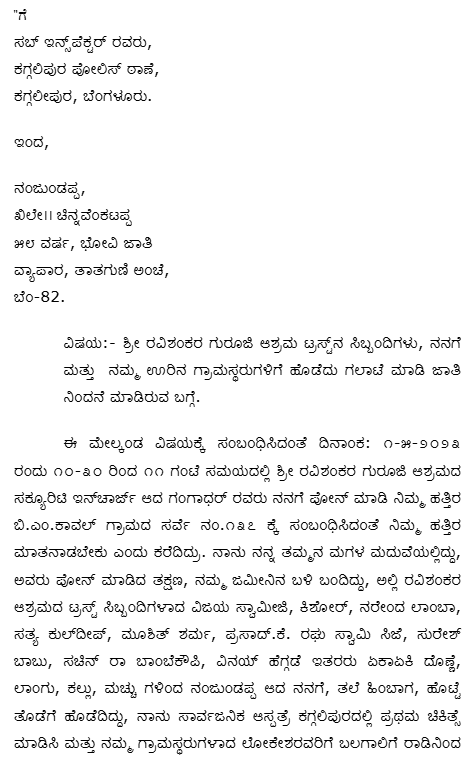
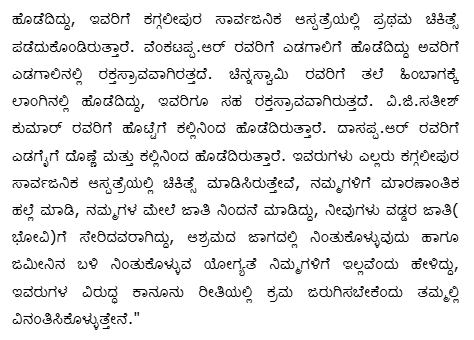
The complaint narrates several instances of assault and other issues.
5. The learned counsel appearing for the petitioners would now restrict his submission in the case at hand to the ones that are concerning the Act. He contends that there is an interim order granted by this Court only insofar as the offences under the Act are concerned.
6. The learned High Court Government Pleader submits that charge sheet is now filed after investigation against these petitioners for all other offences except the ones under the Act, as the offences under the Act have been stayed at the hands of this Court.
7. I have given my anxious consideration to the submissions made by the respective learned counsel and have perused the available material on record.
8. The consideration in the case at hand, therefore, is limited only to the offences under the Act. The complaint is quoted herein above. In the complaint, the offences under the Act are found in the last three lines. The last three lines would indicate that the petitioners have hurled abuses against the complainant by taking the caste of the complainant and therefore, it has become an offence under the Act. The offences alleged are the ones punishable under Sections 3(1)(r) and 3(1)(s) of the Act. Sections 3(1)(r) and 3(1)(s) of the Act reads as follows:
"3. Punishments for offences of atrocities:
(1) Whoever, not being a member of a Scheduled Caste or a Scheduled Tribe—
……… ……… ………
(r) intentionally insults or intimidates with intent to humiliate a member of a Scheduled Caste or a Scheduled Tribe in any place within public view (s) abuses any member of a Scheduled Caste or a Scheduled Tribe by caste name in any place within public view.” (Emphasis supplied)
Sections 3(1)(r) and 3(1)(s) of the Act mandate that the abuses should be hurled taking the name of the caste of the complainant with an intention to insult. Th
AI
Insults under the Scheduled Castes and Scheduled Tribes Act require public visibility and an intent to humiliate; mere civil disputes do not qualify as offences under this Act.

Section 3(1)(r) of the SC and ST Act makes it manifest that mere insult or intimidation with an intention to humiliate a member of Scheduled Caste or Scheduled Tribe by itself is not made an offence.....

Charges under the Scheduled Castes and Scheduled Tribes Act cannot stand without evidence of insult or intimidation occurring in public view, while IPC offences are sustained as evidence supports the....

The court reaffirmed that criminal proceedings cannot be initiated based solely on civil disputes; the FIR was quashed due to lack of substantive allegations of a crime under the relevant laws.

(1) Casteist abuses and criminal intimidation – Place of occurrence must be one “within public view” which is a sine qua non for making out offence under SC/ST Act.(2) Quashing of criminal case – Con....

The court clarified the interpretation of 'within public view' in the context of the Atrocities Act, holding that a place can be considered 'within public view' even if it is a private place, provide....

The judgment established the principle that for an offence under the SC/ST Act, insults or intimidations must be targeted at the victim because of their scheduled caste or tribe status, and the conte....



An indispensable Tool for Legal Professionals, Endorsed by Various High Court and Judicial Officers
Please visit our Training & Support
Center or Contact Us for assistance

Scan Me!
India’s Legal research and Law Firm App, Download now!


For Daily Legal Updates, Join us on :



 Back to top


