
 Back
Back





IN THE HIGH COURT OF KARNATAKA AT BENGALURU
G.BASAVARAJA, J.
Kumara S/o Late Sannegowda – Appellant
Versus
State of Karnataka – Respondent
Criminal Appeal No. 1210 of 2013
Decided On : 09-01-2026
| Table of Content |
|---|
| 1. background of the appeal and parties involved. (Para 1 , 2) |
| 2. factual basis for the prosecution's case. (Para 3 , 4 , 5) |
| 3. procedural details and trial findings. (Para 6 , 7 , 8) |
| 4. arguments presented by the parties. (Para 10 , 11) |
| 5. judicial reasoning on essential ingredients. (Para 12 , 13 , 14) |
| 6. assessment of evidence and trial court's shortcomings. (Para 18 , 19 , 20) |
| 7. final decision and order. (Para 21) |
JUDGMENT :
G. BASAVARAJA, J.
1. The appellant has preferred this appeal against the judgment of conviction and order on sentence passed by the Addl. Sessions Judge at Hassan in Sessions Case No.202/2010 dated 08.07.2013.
2. For the sake of convenience, the parties herein are referred to as per their status before the trial Court.
3. Brief facts leading to this appeal are that the Sub-Inspector of Police, Sakaleshapura Rural Police laid charge- sheet against the accused for the offence under Section 498A and 306 of Indian Penal Code.
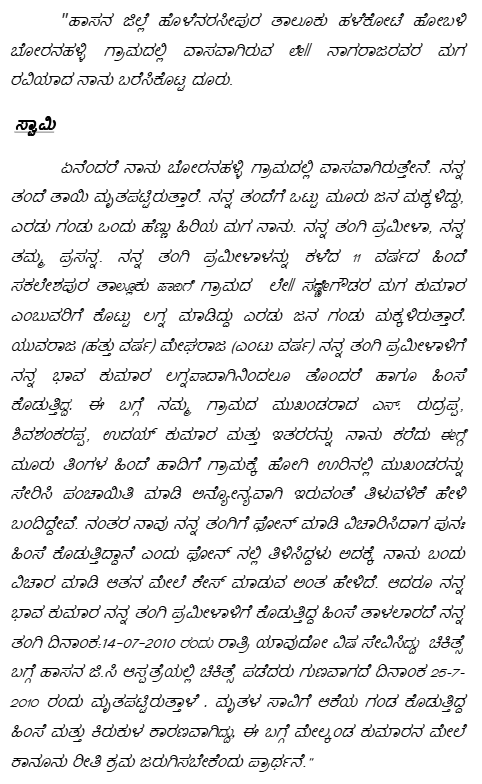
4. It is alleged by the prosecution that, the father of the complainant has three children, i.e. two sons and one daughter. The daughter-Prameela was given in marriage to accused Kumaraswamy and their marriage was solemnized about 12 years ago. In the wedlock, they have begotten two sons Yuvaraj and Megharaj, who are now aged 10 years and 8 years, respectively. Since the date of marriage, the accused was giving harassment, both physically and mentally, to the deceased. Three months prior to the incident, some elders in the village, convened panchayat and advised both husband and wife to live peacefully. In spite of it, accused did not mend his ways and continued ill-treatment. Therefore, being unable to bear harassment and cruelty, on 14.07.2010, the complainant's sister Prameela consumed poison and she was shifted to hospital for treatment where she breathed her last on 25.07.2010. Therefore, the complainant has lodged the complaint. After investigation, the Investigating Officer has submitted the charge-sheet against the accused for the offences punishable under Sections 498A and 306 of Indian Penal Code. The case was registered in CC No.563/2010. The accused was in judicial custody for five months. Thereafter, he was enlarged on bail. After committal to court of Sessions, case was registered in SC No.202/2010.
5. On hearing the charges, the trial Court has framed the charges for the commission of offence under Section 498A and 306 of Indian Penal Code, same were read over and explained to the accused. Having understood the same, accused pleaded not guilty and claimed to be tried.
6. To prove the guilt of the accused, the prosecution, in all, examined 24 witnesses as PW1 to PW24. 14 documents were marked as Exhibits P1 to P14. On closure of prosecution side evidence, statement under Section 313 of Code of Criminal Procedure was recorded. Accused has totally denied the evidence of prosecution witnesses. However, he did not choose to lead any defence evidence on his behalf.
7. Having heard the arguments on both sides, the trial Court has convicted the accused for the offence under Section 498A and 306 IPC and passed sentence to undergo simple imprisonment for a period of two years and to pay a fine of Rs.5,000/- for the offence punishable under Section 498A of IPC and further sentenced the accused to undergo simple imprisonment for a period of 5 years and to pay a fine of Rs.5,000/- for the offence punishable under Section 306 of Indian Penal Code. Being aggrieved by this judgment of conviction and order of sentence, the appellant has preferred this appeal.
8. The learned counsel for the appellant/accused would submit that the impugned judgment passed by the trial Court is erroneous and contrary to law, facts and material on record. The impugned judgment is not based on the proper and material evidence given by the witnesses. The learned Sessions judge has failed to appreciate the fact that the marriage of the accused and the deceased had taken place 12 years back and they had two so
Prosecution failed to establish essential elements of Sections 498A and 306 IPC, leading to the court's finding of insufficient evidence and resulting in acquittal.

The court affirmed that for a conviction under Section 306 IPC, there must be clear evidence of intent to abet the suicide, which was lacking in this case.

The main legal point established in the judgment is that the prosecution must prove the intention of the accused to commit cruelty or abet suicide, and the evidence presented must be specific and cre....
To convict under IPC Sections 498A and 306, credible evidence of cruelty and mens rea must be established; mere quarrels do not suffice.

Conviction requires reliable, corroborative evidence beyond hearsay to prove charges under Sections 498A and 306 IPC.

The main legal point established in the judgment is the reliance on the dying declaration and oral evidence to prove the accused's instigation and cruelty, leading to the finding of guilt for both ch....

Section 306 in Indian Penal Code reads as abetment of suicide.
The acquittal of the accused was upheld due to lack of cogent evidence for Sections 498-A and 306 IPC, reaffirming the principle of presumption of innocence and standards governing appellate review o....
The main legal point established in the judgment is the requirement for the prosecution to prove the presence of the accused at the time of the incident in cases based on circumstantial evidence, and....



An indispensable Tool for Legal Professionals, Endorsed by Various High Court and Judicial Officers
Please visit our Training & Support
Center or Contact Us for assistance

Scan Me!
India’s Legal research and Law Firm App, Download now!


For Daily Legal Updates, Join us on :



 Back to top


