
 Back
Back





IN THE HIGH COURT OF KARNATAKA AT BENGALURU
G.BASAVARAJA, J.
Madhukar S/o Chidanandappa – Appellant
Versus
The State of Karnataka – Respondent
Criminal Appeal No. 233 of 2014
Decided On : 17-12-2025
| Table of Content |
|---|
| 1. conviction and initial details of the case (Para 1 , 3 , 4 , 8) |
| 2. arguments by appellants and defense (Para 9 , 10 , 12) |
| 3. court's critical analysis of evidence (Para 13 , 15 , 16 , 17 , 18 , 19 , 20 , 21) |
| 4. determination of legal infirmity in the trial (Para 22) |
| 5. final order and acquittal of accused (Para 23) |
JUDGMENT :
G. BASAVARAJA, J.
1. The appellants have preferred this criminal appeal against the judgment of conviction dated 05th March 2014 and order on sentence dated 07th March 2014, passed by the Additional District & Sessions Judge, Chitradurga, in Special Case No.17/2011.
2. For the sake of convenience, the parties herein are referred to their rank as before the trial Court.
3. The brief facts leading to this appeal are that the Deputy Superintendent of Police, Challakere Sub-Division, Challakere, submitted a charge sheet against accused No.1 to 3 for the offence under Sections 324 , 504, 506 read with Section 34 of IPC and Section 3(1)(x) of the Scheduled Castes and Scheduled Tribes (Prevention of Atrocities) Act, 1989, read with of . It is alleged by the prosecution that the complainant-Mudalagiri is the resident of Chikkenahalli village, Challakere Taluk and he belongs to Adi Karnataka caste. On 01.05.2011, since there was election to Challakere Taluk APMC, and in that regard, at about 11.15 a.m., the complainant and his father-Dyamanna came to Chikkenahalli bus-stand in order to go to Kaparahalli village to cast their votes and in the said bus stand one Vishwanatha and Thippeswamy were present by holding Voters List. His father asked and took the Voters List to peruse the same, by that time accused Nos.1 to 3 came there and told the complainant, he will not vote for their candidate, why he is seeing the
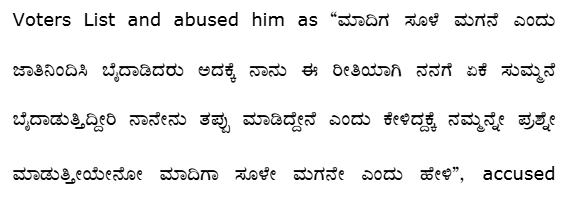
No.1 assaulted him with club on his head causing bleeding injury, accused No.2 picked up the stone which was laying there and assaulted with on his left side ribs and accused No.3 assaulted with stick on his left shoulder. Then Dyamanna, Kenchappa and Vishwanath separated the galata. The accused Nos.1 to 3 while returning, threatened him with dire consequence, and left the spot throwing the sticks, stones and clubs there itself. It is further alleged that the complainant lodged the complaint before the Head Constable, who came to the Government hospital and thereafter, registered a case in Crime No.157/2011, for the above said offences and submitted FIR to the court. The said Head Constable handed over the case file to the Dy.S.P., for further investigation. Further investigation of the case was taken over by Dy.S.P. and after completion of investigation, he has submitted charge-sheet against accused Nos.1 to 3 for the above said offences.
4. After receipt of the charge-sheet, the Trial Court has registered the case in Special Case No.17/2011 and summons were issued to the accused. In response to the summons, the accused appeared before the Court, who were on bail.
5. After hearing both sides, the Trial Court has framed the charges for the offence punishable under Sections 324 , 504, 506 read with Section 34 of IPC and Sec.3(1)(x) of SC/ST (PoA) Act, 1989, read-over and explained to the accused Nos.1 to 3, for which they pleaded not guilty and claimed to be tried.
6. The prosecution, in order to prove the guilt of the accused, examined as many as 12 witnesses as PWs.1 to 12 and placed reliance on documents which were marked at Ex.P.1 to P.8 and three material objects were also got marked M.Os.1 to 3.
7. On closure of prosecution side evidence, statement as contemplated under Section 313 of Cr.PC., was recorded. Accused Nos.1 to 3 have totally denied the incriminating materials appearing against them. But they did not choose to lead any defence evidence on their behalf.
8. Having heard the arguments on both sides, the Trial Court has convicted the accused Nos.1 to 3 for the offence punishable under Sections 324 , 504, 506 read with Sections 34 of IPC and sentenced them to undergo rigorous impriso


AI
Convictions must rely on cogent, corroborative evidence; failure to provide such leads to acquittal.
Convictions under SC & ST (POA) Act must be supported by compelling and consistent evidence of caste-based abuse in public.

The court held that reliance on inconsistent and insufficient witness testimonies, alongside lack of medical evidence for grievous injuries, invalidates the conviction, necessitating acquittal.

The absence of corroborative evidence renders the sole testimony insufficient for conviction under criminal law.
The central legal point established in the judgment is the requirement for trustworthy and corroborated evidence, the evaluation of motive behind the complaint, and the significance of material contr....


Prosecution must prove guilt beyond reasonable doubt; contradictions and a lack of independent witnesses led to the acquittal of the accused.
The main legal point established in the judgment is the requirement for the prosecution to prove the charges beyond reasonable doubt, and the court's duty to consider material contradictions in the e....



An indispensable Tool for Legal Professionals, Endorsed by Various High Court and Judicial Officers
Please visit our Training & Support
Center or Contact Us for assistance

Scan Me!
India’s Legal research and Law Firm App, Download now!


For Daily Legal Updates, Join us on :



 Back to top


