
 Back
Back





IN THE HIGH COURT OF KARNATAKA AT BENGALURU
G Basavaraja, J.
Umesh Babu T.S @ Umesh, S/O Shivarama – Appellant
Versus
State of Karnataka By Nelamangala Rural Police, Represented by The State Public Prosecutor – Respondent
Criminal Appeal No.902 of 2014
Decided On : 13-01-2026
| Table of Content |
|---|
| 1. factual background of the case (Para 1 , 3 , 4) |
| 2. arguments of the appellants regarding conviction (Para 8 , 9) |
| 3. court's evaluation of evidence and inconsistencies (Para 10 , 12 , 26 , 30) |
| 4. lack of evidence leading to conviction reversal (Para 31) |
JUDGMENT :
G BASAVARAJA, J.
The appellants have preferred this appeal against the judgment of conviction and order on sentence passed by the I Additional District and Session Judge, Mandya in a Special Case No.50/2013 dated 17.10.2014.
2. The parties herein are referred to as per their rank and status before the trial Court.
3. Brief facts leading to this appeal are that the Deputy Superintendent of Police, Mandya Sub-division, Mandya submitted charge sheet against the accused for the offence punishable under Sections 504, 326, 323, 114, 324, 506 read with Section 34 of Indian Penal Code (for short 'IPC') and under Sections 3(1)(x), 3(2)(v) of the Scheduled Castes and Scheduled Tribes (Prevention of Atrocities) Act, 1989 (for short 'SC/ST (POA) Act').
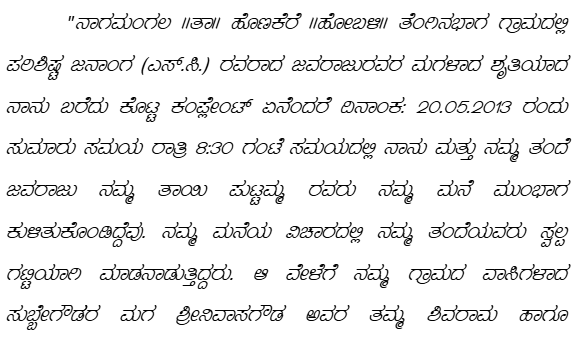
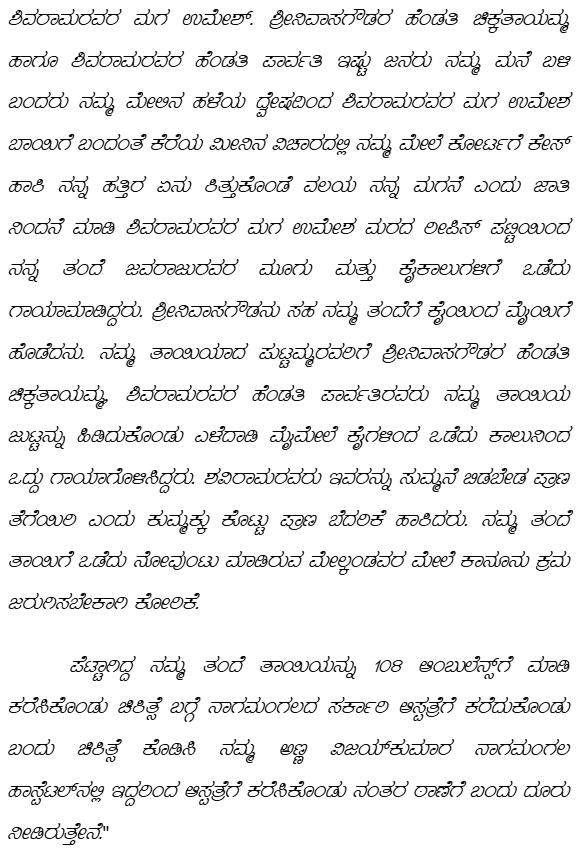
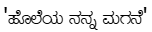
4. It is alleged by the prosecution that on 20.05.2013 at about 08.30 P.M. in Thenginabhaga Village in Nagamangala Taluk, when the complainant-Shruthi and her parents Javaraju and Puttamma, who are CW2 and CW3, were talking with each other in front of their house, at that time accused 1 to 3 with respect to ill-will reading aquaculture in the tank of Tenginabhaga Village and with an intention of giving torture, had been to the house of the complainant and her parents and accused No.1 abused CW.2-Javaraju in filthy language knowing fully well that he belongs to Scheduled Caste community by referring to his caste as,

humiliated him in public view as he had filed a case before the Court with regard to the aquaculture and when he told that he has not filed case, all the accused abused him and accused No.1 assaulted him with a reaper patti on his legs, nose and hands and caused bleeding injuries to him; accused No.2 also assaulted him with his hands. At that time, CW3-Puttamma, wife of CW2 tried to separate the scuffle. Accused No.3 instigated accused 1 & 2, and accused No.3 caught hold of CW.3-Puttamma and dragged her and kicked her and caused and grievous hurt. Thereafter, complainant has taken CW2 and CW3 to the Government Hospital and thereafter went to the Police Station and filed a complaint, based upon which the Nagamangala Rural Police registered a case and the Deputy Superintendent of Police, Mandya, took-up further investigation and collected the evidence and submitted charge-sheet against the accused for the aforesaid offences. The accused were enlarged on bail.
5. Upon hearing on charges, the trial Court has framed the charges for the alleged commission of offences. The same were read over and explained to the accused. Having understood the same, accused pleaded not guilty and claimed to be tried.
6. To prove the guilt of the accused, in all, 13 witnesses were examined as PWs1 to 13. Ten documents were marked as Exhibits P1 to P10. Three material objects were marked as MOs.1 to 3. On closure of prosecution side evidence, statement of the accused under Section 313 of Code of Criminal Procedure was recorded. Accused have totally denied the evidence of prosecution witnesses, however, have filed written statement stating that there is a civil dispute between the complainant and Kalabyraveswara Yuvakara Sangha and his brother is the Secretary of that Sangha, and the complainant, due to intoxication, fell in front of his house and sustained injury. Complainant is the member of Dalita Sangha and received compensation. The complainant filed false complaint and also produced the copy of the judgment of Regular Appeal. However, the accused have not led any defence evidence.
7. Having heard the arguments on both sides, the trial Court convicted accused 1 to 3 for the offence under Sections 504, 323, 324, 326 read with Section 34 of IPC and Section 3(2)(v) of SC/ST (PoA) Act and acquitted accused 1 to 3 for the offence punishable


AI
The court held that reliance on inconsistent and insufficient witness testimonies, alongside lack of medical evidence for grievous injuries, invalidates the conviction, necessitating acquittal.

Convictions must rely on cogent, corroborative evidence; failure to provide such leads to acquittal.

The absence of corroborative evidence renders the sole testimony insufficient for conviction under criminal law.

The court confirmed the conviction under the SC/ST Act for caste-based assault, emphasizing the weight of corroborative evidence from the injured parties and proper explanation for the delay in filin....
Convictions under SC & ST (POA) Act must be supported by compelling and consistent evidence of caste-based abuse in public.

The conviction of the appellants for assault was upheld, while they were acquitted of charges under the SC & ST Act due to lack of proof of the victim's caste.

The central legal point established in the judgment is the requirement for trustworthy and corroborated evidence, the evaluation of motive behind the complaint, and the significance of material contr....
The main legal point established in the judgment is that the prosecution must prove the intention to outrage the modesty of a victim to sustain a charge under Section 3(1)(xi) of S.Cs & S.Ts (POA) Ac....

The main legal point established in the judgment is the requirement for the prosecution to prove the charges beyond reasonable doubt, and the court's duty to consider material contradictions in the e....



An indispensable Tool for Legal Professionals, Endorsed by Various High Court and Judicial Officers
Please visit our Training & Support
Center or Contact Us for assistance

Scan Me!
India’s Legal research and Law Firm App, Download now!


For Daily Legal Updates, Join us on :



 Back to top


