
 Back
Back





IN THE HIGH COURT OF KARNATAKA AT BENGALURU
C.M.JOSHI, J.
V. Shamanna S/o. Late J. Venkataswamy - Appellant
Vs.
Smt. Suguna - Respondent
Regular First Appeal No.163 of 2012
Decided On : 10-12-2025
| Table of Content |
|---|
| 1. plaintiff's claim challenged defendant's interference in property. (Para 1 , 4 , 7) |
| 2. clarified ownership and enjoyment of the property. (Para 2 , 3 , 5) |
| 3. need for declaration of easementary rights before injunction. (Para 10 , 12) |
| 4. court retains plaintiff’s ownership but dismisses common passage claim. (Para 24 , 25) |
JUDGMENT :
C.M.JOSHI, J.
The present appeal is filed by the defendant in O.S.No.4277/2008 assailing the judgment and decree dated 16.01.2012 passed by the learned XLIV Additional City Civil and Sessions Judge, Bangalore (CCH 45), whereby the appellant had been restrained from causing interference to the peaceful possession and enjoyment of the suit schedule property by the plaintiff/respondent.
2. The brief facts i.e., relevant for the purpose of this appeal may be summarized as below:
(a) The suit schedule property is described to be House No.57/1, Municipal New No.10 measuring east-west 36½ ft and north-south 8 ft with a common passage shown by the letters ‘ABCD’ in the hand sketch annexed to the plaint, situated at Jangam Maistry Lane, 2nd Cross road, Balepet, Bengaluru.
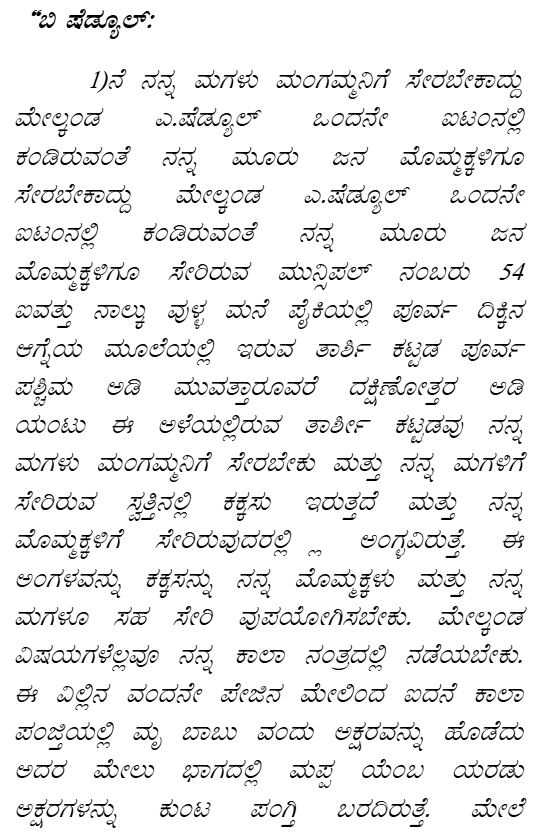
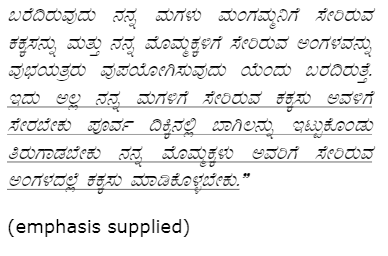
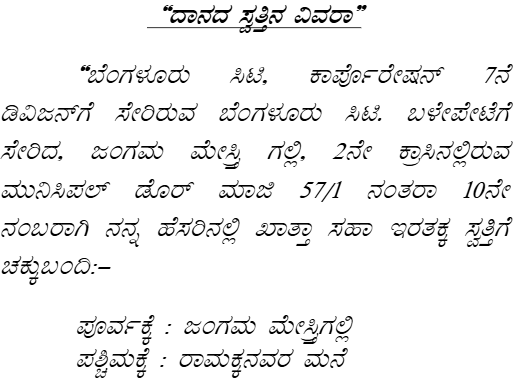
(b) The plaintiff claims that she is the absolute owner of the suit schedule property and he acquired the same by way of registered gift deed dated 13.03.1974. The suit schedule property was earlier owned by one Jangamappa, who had acquired it under registered partition in the year 1950. Thereafter, by Will dated 15.01.1951, a portion of the property acquired by him was bequeathed in favour of Mangamma, who is his daughter. The other portion was bequeathed to his grandsons viz., Narayan, Srinivas and Rajanna. The said Mangamma, who had acquired suit schedule property measuring 36½ ft X 8 ft with a toilet in the adjoining passage, executed a gift deed (Ex.P1) on 13.03.1974 in favour of the plaintiff. The defendant, who happens to be the descendant in the title under the said Narayana, Srinivas and Rajanna is residing in the western portion of the suit schedule property.
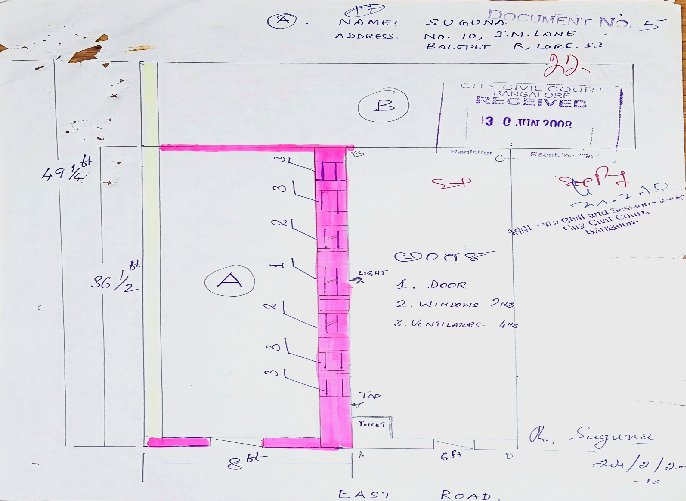
(c) It is the case of the plaintiff that there is a common passage on the northern side of the suit schedule property, which leads to the house of the defendants on the western side and is adjoining the property belonging to the plaintiff. The plaintiff and defendant are jointly using the said common passage with water tap and toilet. While the plaintiff has been in continuous and uninterrupted possession of the suit schedule property, the defendant caused interference for such enjoyment claiming that the northern wall running east-west of the property of the plaintiff (shown as ‘AB’) belongs to the defendant and therefore, there was a cause of action for the suit. On the said ground, the plaintiff sought the injunctive relief against the defendant.
3. On service of summons, the defendant appeared and filed the written statement.
a) The defendant denied the plaint averments and contended that the measurement of the property of plaintiff i.e., 36½ ft east-west and 8 ft north-south is incorrect. In fact, the property did not measure as stated by the plaintiff but it is 30 ½ ft east-west and 8 ft north-south. He also denied that there is any passage as alleged by the plaintiff and there is no such easementary right, which has accrued in favour of the plaintiff. Neither the plaintiff nor anyone of her family at any point of time did reside in the suit property and there is no such common passage as claimed. It is his contention that the premises were used as workshop by one Uday Carto Punch and therefore, the plaintiff residing in the property with her family is totally false. The defendant’s property measures 19 ½ ft east- west and 28½ ft., north-south and there are no windows or ventilators as contended by the plaintiff on the northern wall of his property. It is his contention that the mother of the defendant-Ramakka purchased the same in the year 1962 and the defendant having purchased it in the year 1963, he continues to remain in the possession of the property bear

Court clarified that claims for easementary rights require explicit pleadings and declarations, ruling on injunction based on possession without such declarations is unsustainable.

Where Easement Act inapplicable, easement rights governed by justice, equity, good conscience; right by gift deed extinguished by changed circumstances providing independent access and causing servie....

The court confirmed that claims of property encroachment require substantial proof; failure to demonstrate ownership or obstruction by defendants led to dismissal of the plaintiffs' appeal.

The judgment establishes that a disputed passage is deemed a common passage, rejecting claims of exclusive ownership when the claimant fails to provide adequate evidence of possession.
Ownership established through title documentation is pivotal in determining rightful possession; injunctions are warranted when prima facie evidence supports legal entitlement.


The courts erred in dismissing the plaintiff's suit without addressing critical issues of property title and possession, validating his claim for a declaratory relief against unauthorized deeds.

Easement rights to a common passage persist unless formally surrendered; courts require clear evidence of encroachment to uphold claims.

(1) Decree of permanent injunction cannot be granted by going against stipulations in agreement to sell.(2) Interpretation of Documents – Where language employed in instrument is clear and unambiguou....



An indispensable Tool for Legal Professionals, Endorsed by Various High Court and Judicial Officers
Please visit our Training & Support
Center or Contact Us for assistance

Scan Me!
India’s Legal research and Law Firm App, Download now!


For Daily Legal Updates, Join us on :



 Back to top


