Back
Back





2025 Supreme(Kar) 2288
IN THE HIGH COURT OF KARNATAKA AT BENGALURU
M.NAGAPRASANNA, J.
Sri H.P.Ramesh, S/o. Late Panchaksharaiah and Anr. – Petitioners
Versus
State Of Karnataka, Represented By Its Principle Secretary, Revenue Department and Anr. – Respondents
Writ Petition No.3982 of 2023 (LA - RES)
Decided On : 25-11-2025
For the Petitioner:Sri Kishan K.S., Advocate
For the Respondent: Smt. Rashmi Rao, HCGP
The court held that delay does not negate the right to compensation for property unlawfully appropriated by the State, emphasizing the need for due process and just compensation under established law.
Headnote:(A) Right to Fair Compensation and Transparency in Land Acquisition, Rehabilitation and Resettlement Act, 2013 - Denial of compensation for illegally used land - Court held that non-consideration of representations for compensation violated rights as per law; just compensation must be determined under the Act. (Paras 1, 8, 10, 11)
(B) Property Rights - The State cannot deprive individuals of their property without due process of law; delay does not extinguish the obligation to pay compensation for land used for public purposes. (Paras 10, 11)
(C) Judicial Precedent - Apex Court affirms that right to property is protected, and unjust deprivation by the state mandates compensatory relief. (Paras 10, 11, 17)
Facts of the case:
Petitioners claimed compensation for land in Haradagere Village used for a school and road since 1957, after their repeated unheeded requests for compensation led to a writ petition.
Findings of Court:
Court emphasized that the State's admission of unlawful appropriation necessitates compensation, notwithstanding the delay.
Issues: The crux involved whether the petitioners are entitled to compensation despite the lengthy delay since the land's utilization by the State.
Ratio Decidendi: The court underscored the inviolability of property rights and the State's duty to provide compensation for expropriated land, regardless of the elapsed time since dispossession.
Result: Writ petition allowed; the impugned order quashed; authorities directed to determine compensation as per law.
| Table of Content |
|---|
| 1. ownership and claims for compensation for land use (Para 1 , 3) |
| 2. arguments on entitlement to compensation (Para 2 , 4 , 5) |
| 3. court's observations on prior representations and orders (Para 6 , 7) |
| 4. legal principles regarding property rights and delay in claims (Para 10 , 11) |
| 5. conclusion and order for compensation (Para 12) |
ORDER :
M.NAGAPRASANNA, J.
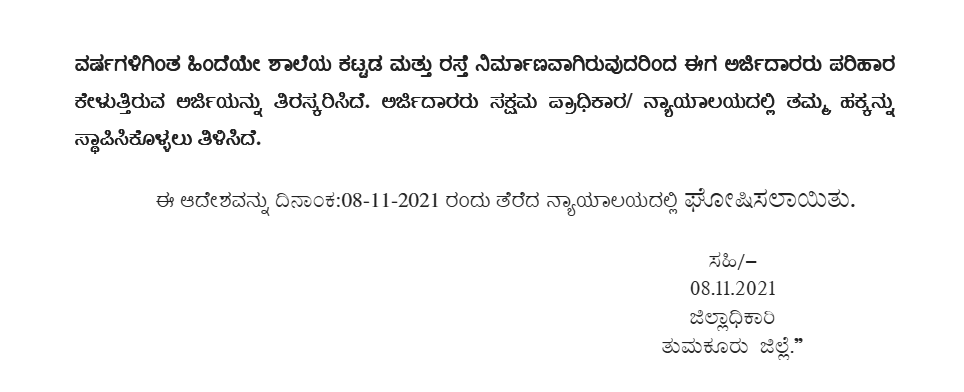
The petitioners are before this Court calling in question an order dated 08.11.2021, passed by respondent No.2 denying payment of compensation for the usage of their lands in Survey No.51 of Haradagere Village and seeks a consequential mandamus to the respondents, to pay compensation for the land utilised, under the provisions of Right to Fair Compensation and Transparency in Land Acquisition, Rehabilitation and Resettlement Act, 2013.
2. Heard Sri Kishan G.S., learned counsel for the petitioners and Smt. Rashmi Rao, learned High Court Government Pleader for the respondents.
3. Facts in brief, germane, are as follows:
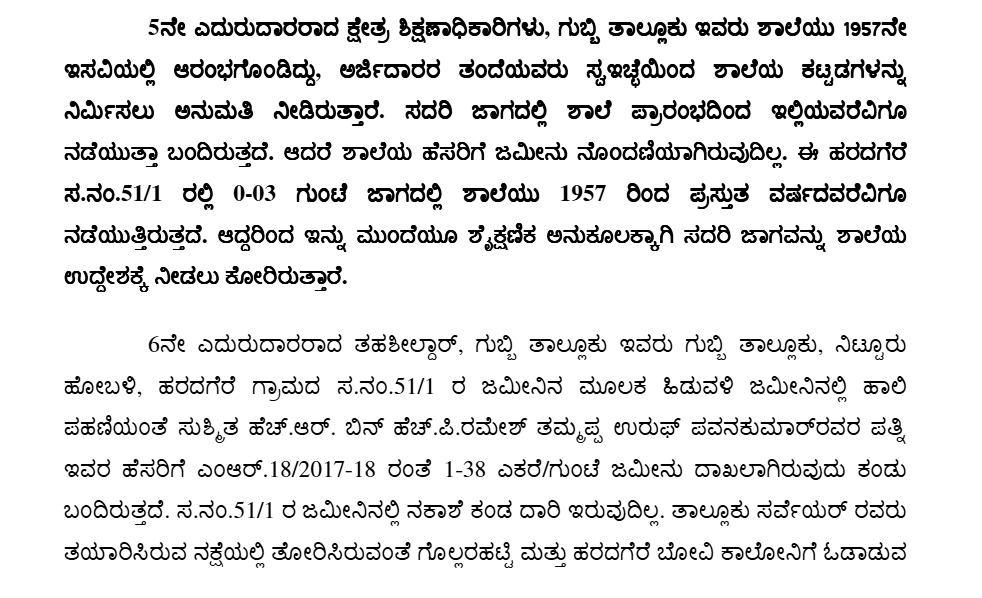
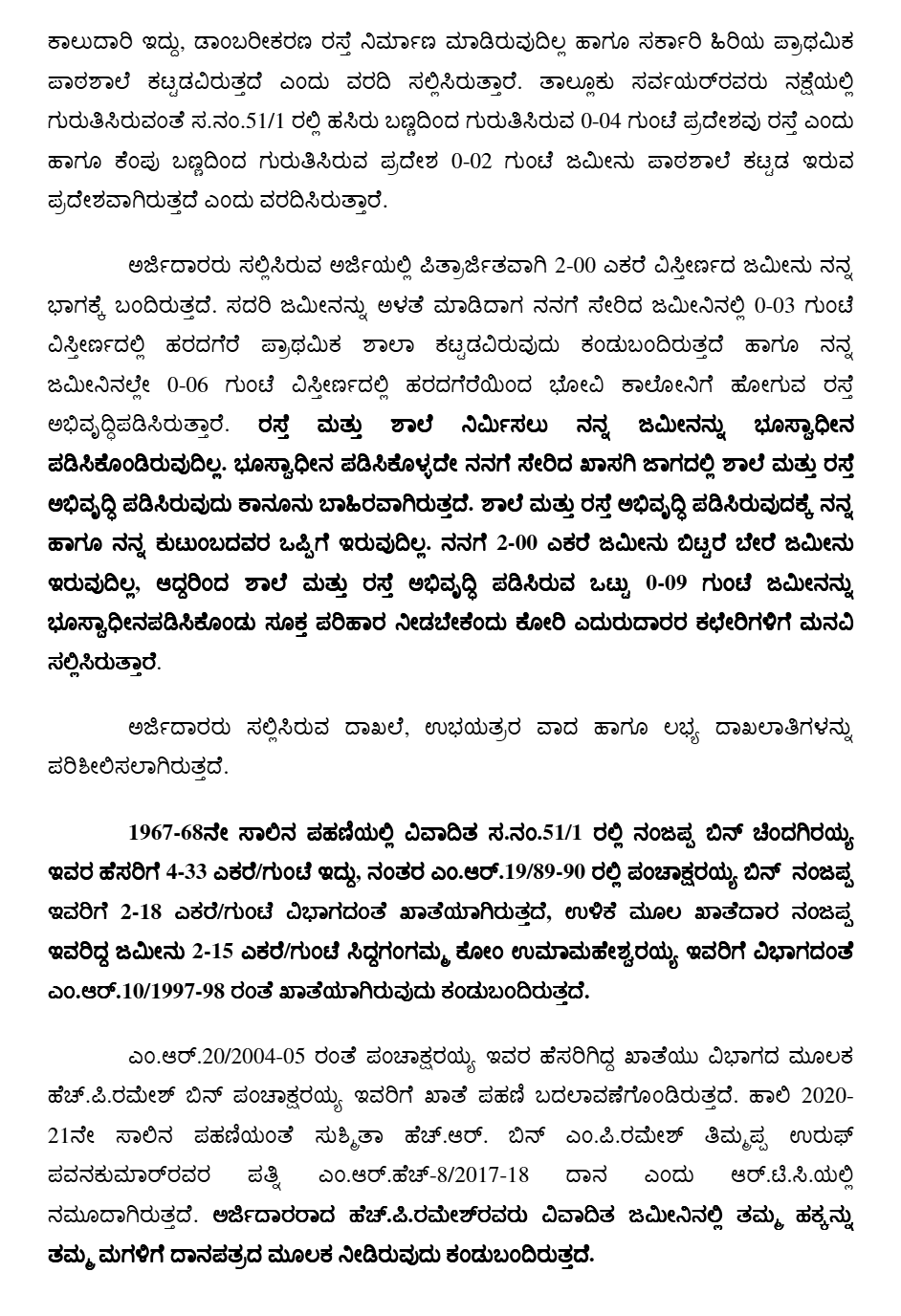
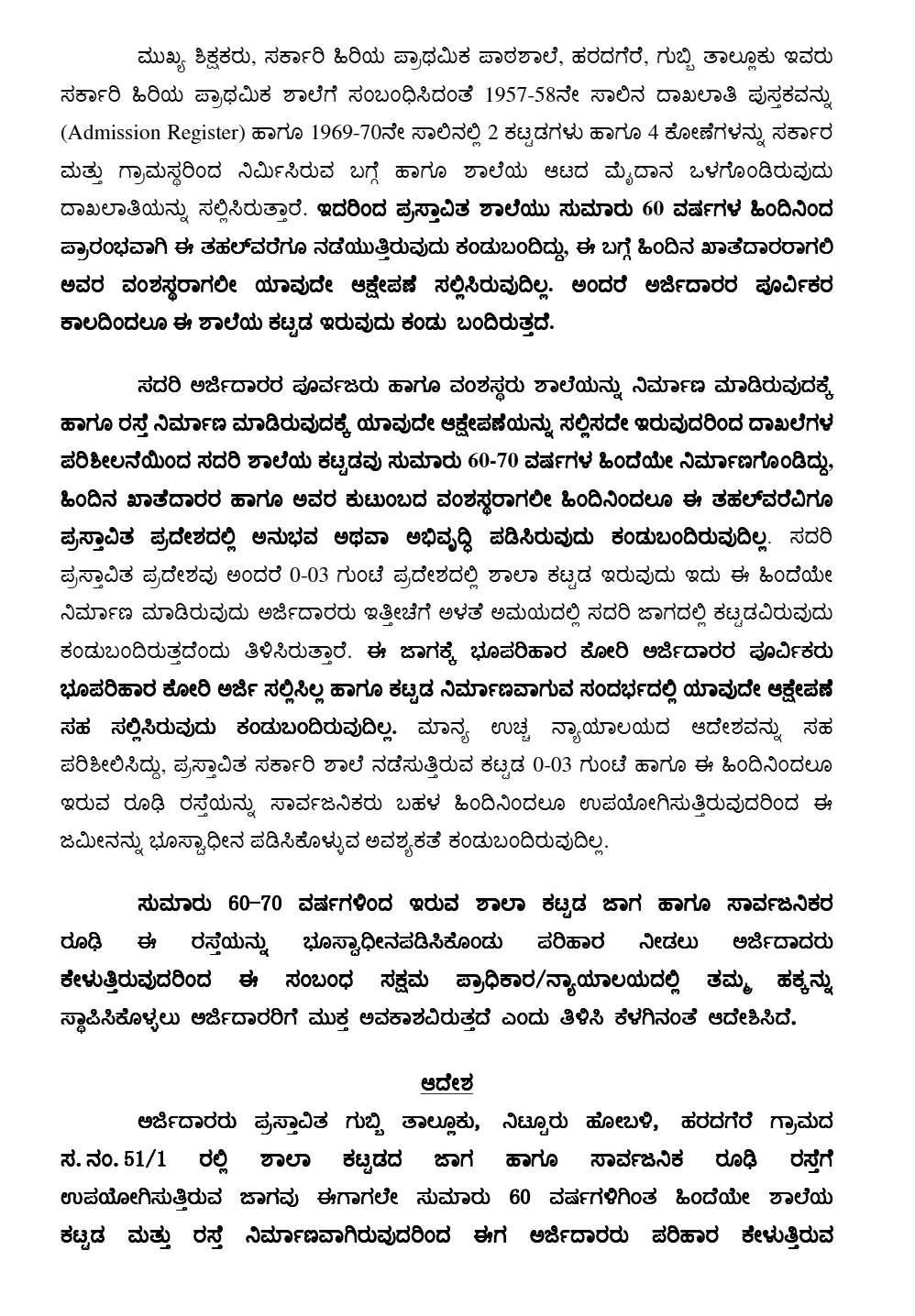
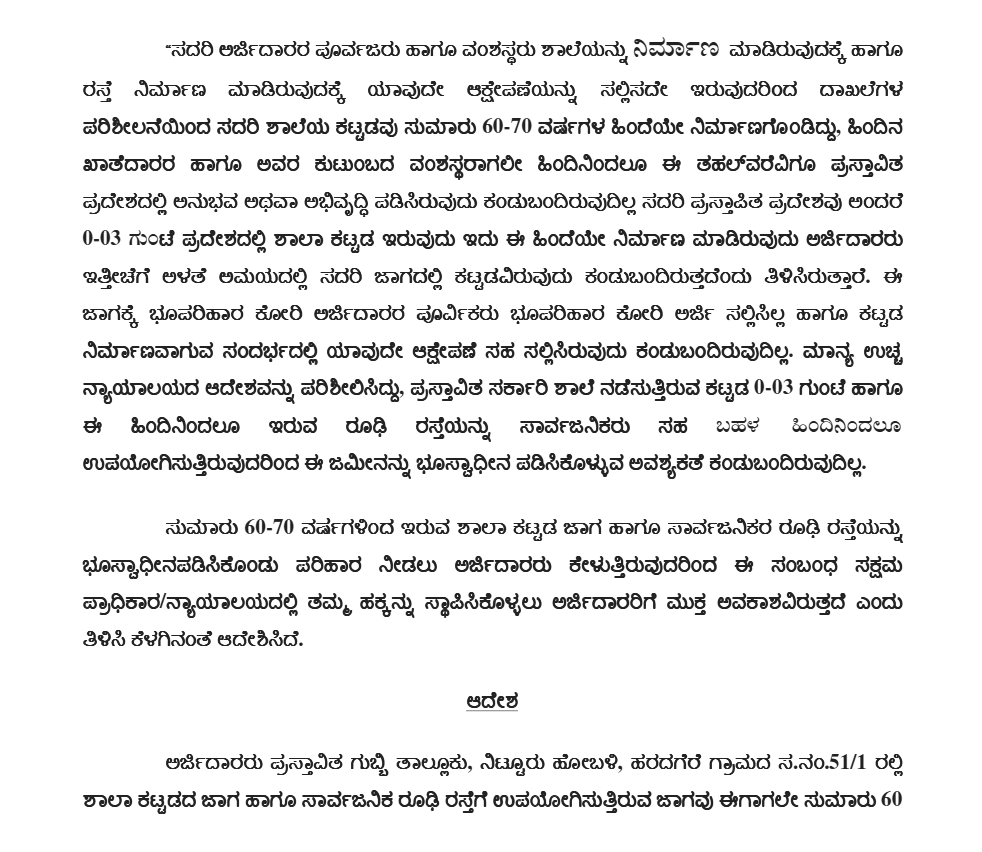
The father of the first petitioner owned certain land measuring 2 acres and 8 guntas in survey No.51 of Haradagere Village. The first petitioner gifts the property in favour of the second petitioner - daughter through a registered gift deed on 04.12.2017. It transpires that the first petitioner noticing the fact that the government has utilised the land belonging to them for the purpose of establishment of a school wayback in the year 1957, submits several representations seeking compensation for having constructed a government school and formation of the road in the property. The representations were not considered and therefore, the first petitioner had approached this Court in W.P.No.12385/2016. A co-ordinate bench disposed the said writ petition with a direction to consider the representations and pass necessary orders. The result of the said direction is the impugned order. The impugned order is passed after the first petitioner invoked the Courts contempt jurisdiction in C.C.C.No.320/2022. It is this order that drives the petitioners to this Court in the subject petition.
4. Sri Kishan G.S., learned counsel for the petitioners submits that the land of the petitioners admittedly is being utilised by constructing a government school and formation of a road. If the fact is admitted, it cannot be said that the petitioners would not be entitled to any compensation.
5. Per contra, the learned High Court Government Pleader would refute the submissions, contending that the land of the petitioners was no doubt utilised but it was voluntarily handed over by the father of the first petitioner long ago in the year 1957. It is his submission that the first petitioner has kept quiet for ages and he could not seek compensation after 65 years of the alleged usage of land at the hands of the State. He would seek dismissal of the petition.
6. I have given my anxious consideration to the submissions made by the learned counsel for the respective parties and have perused the material on record.
7. The afore-narrated facts, link in the chain of dates and events are all a matter of record. The father of the first petitioner submits plethora of representations before the second respondent seeking compensation on the score that his land is utilised for construction of a school building and formation of the road, which is not in dispute. Non-consideration of the aforesaid representations, lead the first petitioner to knock at the doors of this Court in W.P.No.12385/2016. The said writ petition comes to be disposed on 19.09.2019. The order reads as follows:
“…. …. ….
5. Upon hearing the learned counsel for the parties, I find from the materials on record that the petitioner claims to be the absolute owner of the property bearing Sy.No.51 measuring 2 acres 8 guntas. He is tracing the title to certain documents. While it is important that formation or widening of road has to be attended to on priority, as it is a matter of public interest, it cannot be forgotten that rights of the