Back
Back





2025 Supreme(Bom) 1372
IN THE HIGH COURT OF JUDICATURE AT BOMBAY
G. S. KULKARNI, SOMASEKHAR SUNDARESAN, JJ.
Mrs. Sumitra Shridhar Khane – Petitioner
Versus
The Deputy Collector, Spl. Land Acquisition No.12, Kolhapur
WRIT PETITION NO. 4987 OF 2022
AND
Shankar Ganpati Khapre
Versus
Deputy Collector, Spl. Land Acquisition No.12, Kolhapur
WRIT PETITION NO. 4991 OF 2022
AND
Nivrutti Ganu Parit Decd. Thr. Legal heirs Muktabai Nivrutti Parit(since Decd)
Versus
The Deputy Collector, Spl. Land Acquisition No.12, Kolhapur
WRIT PETITION NO. 4988 OF 2022
AND
Maruti Rama Bhoite Decd Thru. Legal heirs
Versus
The Deputy Collector, Spl. Land Acquisition No.12, Kolhapur
WRIT PETITION NO. 11372 OF 2022
AND
Rama Yallappa Bharmal & Anr.
Versus
The Deputy Collector, Spl. Land Acquisition No.12, Kolhapur
WRIT PETITION NO.15996 OF 2022
Decided On : 02-05-2025
For Petitioners: Mr. Nitin P. Deshpande with Ms. Kanchan Phatak, Ms. Rachana Harpale
For the Respondent/State.: Mr. S. B. Kalel, AGP
The duty to compensate upon land acquisition is a constitutional safeguard, ensuring no individual is deprived of property without legal due process and fair compensation, embodied in Article 300A.
Headnote:(A) Land Acquisition Act, 1894 - Section 4 and 6 - Compensation for acquisition of land - Petitioner voluntarily surrendered land for public purpose but was not compensated due to the absence of award including her land - Court emphasizes the constitutional guarantee under Article 300A that no person shall be deprived of property without due process of law and compensation - The State's failure to compensate violates constitutional rights and imposes an obligation to rectify the injustice by compensating the petitioner for the land taken without proper legal process. (Paras 4, 15, 17, 39)
(B) Constitutional Law - Equality before the law - Court asserts that like cases must be treated alike, reinforcing the need for consistent legal application and protection for citizens, especially from rural backgrounds who may lack legal literacy. (Paras 1, 30)
Facts of the case:
The petitioner owned land acquired for a public project but was deprived of compensation due to procedural lapses - Petitioner provided possession voluntarily in 1990 without an award and sought compensation in 2021, leading to a legal challenge.
Findings of Court:
The State's actions led to the petitioner being landless with no compensation despite her land being used for public purposes, constituting a violation of her rights under the Constitution.
Issues: Determining the entitlement to compensation when possession is taken without following due legal process, and the effect of alleged delays in seeking relief.
Ratio Decidendi: The Court ruled that the right to property cannot be extinguished without lawful process and that the demand for compensation constitutes a continuing cause of action, which is not barred by delay or laches.
Result: Writ petitions allowed, compensation directed to be calculated and paid to the petitioner.
| Table of Content |
|---|
| 1. rule of law and equal protection under the constitution. (Para 1 , 2) |
| 2. details about the land acquisition process and petitioner’s rights. (Para 4 , 5 , 6) |
| 3. counterarguments regarding voluntary surrender and claims of delay. (Para 7 , 10 , 11) |
| 4. constitutional protection against deprivation of property. (Para 14 , 15 , 16) |
| 5. requirement of compensation in land acquisition cases. (Para 18 , 19 , 20) |
| 6. continuing wrong and obligation of the state in property rights. (Para 24 , 27 , 30) |
| 7. court's directive on compensation and legal costs. (Para 39 , 40) |
| 8. application of judgment to companion petitions. (Para 41 , 42 , 43) |
ORAL JUDGMENT (Per G. S. Kulkarni, J.):-
Preface
1. In a society governed by the rule of law, there can be no discrimination in the application of law to persons who are similarly placed. In this situation, there cannot be different standards, yardsticks and methods in the application of law, to persons of limited means, who are not literate or who are not well versed of their legitimate legal and constitutional rights or on a consideration that they belong to rural areas. Likes should be treated alike. This is a Constitutional guarantee of equality before the law and equal protection of the laws in a welfare state. It is the solemn duty and responsibility of the State to uniformly apply the law, as also take corrective actions when it is noticed that the State’s actions are in breach of law and the constitutional rights. Any breach of such fundamental mandates has no place in a civilized society. These issues, which stem from the guarantee of equality of rights and the constitutional recognition of a right not to be deprived of property, save by authority of law, confronts us in the present proceedings.
2. Rule. Respondents waive service. By consent of the parties, heard finally.
3. These proceedings under Article 226 of the Constitution of India raise common issues of facts and law. Hence, they are being decided by this common judgment. The first writ petition was argued as the lead petition. For convenience, we refer to the pleadings on this petition.
Facts
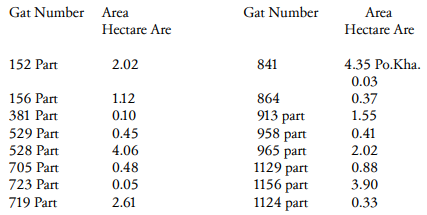
4. The petitioner is the owner of land bearing Gat No.156 admeasuring 1 H. 12 R. situated at village Vhanur, Tal. Kagal, District-Kolhapur. It is the petitioner’s case that in the year 1990 various lands in the petitioner’s village were notified for mass acquisition, for a public project of rehabilitation of the persons affected by the Dudhganga Irrigation Project. To further such intention, mutation entries made in the revenue records indicating that the land would be acquired for the said project. The mutation entry qua the petitioner’s land was dated 6 October 1990. A notification under Section 4 of the Land Acquisition Act, 1894 (for short “the 1894 Act”) was issued on 20 December 1990; thereafter a notification under Section 6 was issued on 8 March 1991. Subsequent thereto, notices under Section 9(1) & (3) were issued on 16 March 1991. On such backdrop, a “land acquisition award” came to be published on 28 February 1992.
5. The petitioner contends that prior to the issuance of the aforesaid statutory notifications as the petitioner’s land was subject matter of mass acquisition, following the pattern being adopted by the Special Land Acquisition Officer and/or a fait accompli, she voluntarily handed over the possession of her land admeasuring 1H 12 R to the State Government on 19 September 1990 which being recorded in a formal affidavit dated 19 September 1990 taken from the petitioner by respondent No.1, which we would refer hereafter. This was also reflected in Mutation Entry No. 729 as borne by the revenue records. Admittedly, the petitioner was not paid the land acquisition compensation. The reason appears to be that the petitioner hailing from a rural area was certainly not a person well versed with her legal rights, that her land could only be taken away or her ownership divested only by following due process of law, and on payment o