
 Back
Back





IN THE HIGH COURT OF KARNATAKA AT BENGALURU
K.S. Hemalekha, J.
Vijay, S/O Shashikanth Pawar - Appellant
Versus
Smt. Manjula .S, W/O Late Jayanth Pawar – Respondent
Regular First Appeal No.323 of 2016 (PAR)
Decided On : 20-11-2025
| Table of Content |
|---|
| 1. background of the partition case and claims (Para 1 , 2 , 3 , 4 , 5) |
| 2. arguments regarding necessity of parties in suit (Para 8 , 9 , 10 , 11) |
| 3. court's analysis of evidence and claims (Para 13 , 14 , 15 , 16) |
| 4. legal standards for proving testamentary claims (Para 19 , 20 , 21 , 22 , 23) |
JUDGMENT :
K.S. HEMALEKHA, J.
This Regular First Appeal is directed against the judgment and decree dated 06.08.2008 passed in OS No. 2846 of 2003 on the file of the I Additional City Civil and Sessions Judge, Bangalore, CCH2 (hereinafter referred to as ‘the trial Court’ for short), whereby the suit filed by the plaintiffs for partition and separate possession in respect of the suit schedule property was partly decreed, declaring the plaintiffs jointly entitled to one sixth share therein.
2. The present appellant who was not a party before the trial Court claims his right under a Will dated 6.03.1997 and Codicil dated 02.05.2001 said to have been executed by the propositus deceased V Jyothoji Rao Pawar, has preferred this appeal challenging the said decree.
BRIEF FACTS
3. The property bearing No. 740, 12th Main III Block, Rajajinagar, measuring 60 feet x 39 feet, (hereinafter referred to as ‘the suit schedule property’ for short) was originally allotted to the propositus V Jyothoji Rao Pawar by the City Improvement Trust Board on 20.11.1957, followed by a sale deed dated 28.08.1958 and he was put in possession. The original propositus V Jyothoji Rao Pawar and his wife Sundara Bai had 6 children. The family genealogical tree is culled out as under for easy reference:
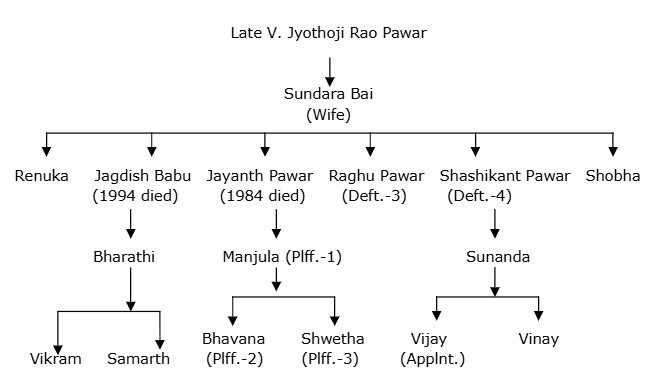
4. The plaintiffs in OS No. 2846 of 2003 are Manjula, widow of late Jayanth Pawar and her daughters Bhavana and Swetha. The plaintiffs contended that the suit property is a joint family property, and the construction of the house thereon was put up using the joint family funds and from the sale proceeds of the ancestral house. Further the husband of plaintiff no. 1 and father of plaintiffs no. 2 and 3 had contributed for the construction.
5. The defendants entered appearance, except tenants- defendant nos. 7 to 9, no written statement was filed. Raghu Pawar, defendant no. 3, made an attempt to file written statement asserting the existence of registered Will dated 06.03.1997 and the Codicil dated 02.05.2001 said to have been executed by V Jyothoji Rao Pawar, which came to be rejected as barred by time. That order of rejecting the filing of written statement has attained finality. The father of the appellant, defendant no. 4, Shashikanth, did not contest the suit.
6. The trial Court upon considering the entire oral and documentary evidence held that V Jyothoji Rao Pawar died inte state and that the suit property devolved upon all the class I heirs under Section 8 of the Hindu Succession Act. By the judgment dated 06.08.2008, the trial Court partly decreed the suit granting plaintiffs one sixth share in the suit schedule property.
7. The present appellant - son of Shashikanth Pawar (defendant no. 4) instituted P&SC No. 199 of 2009 seeking probate of the said Will and Codicil, claiming exclusive rights as legatee. The Probate Court dismissed the petition on the ground that the Codicil dated 02.05.2001 was denied by the contesting respondents, and the appellant failed to examine any attesting witnesses, rendering the testamentary unproved. In the meanwhile FDP 64 of 2015 was filed by Shashikanth Pawar (defendant no. 4) seeking implementation of the preliminary decree by metes and bounds.
8. Heard Sri Srihari N.S and Sri S.Subrahmanya learned counsel appearing for the appellant and Sri Satish Doddamani, Senior Counsel, for respondent Nos. 4, 6 and 9.
9. Learned counsel appearing for the appellant submits that the plaintiffs (respondents 1, 2 and 3) were aware about the existence of the Will dated 06.03.1997 and the Codicil dated 02.05.2001 executed by the testator Late V Jyothoji Rao Pawar, the original propositus. Despite the plaintiffs being aware of the Will have not impleade
AI
A legatee's claim under an unproven Will is not sufficient to establish a legal interest to challenge a partition decree among heirs. Probation of the Will is mandatory to assert rights.

The main legal point established in the judgment is the requirement to prove the validity of a Will and the consequences of non-joinder of necessary parties in a partition suit.

In property disputes, all sharers must be joined as necessary parties to ensure valid adjudication of rights, as established in the judgment.
A registered Will, executed in accordance with legal requirements, is valid and can determine the distribution of property, overriding claims for partition based on joint possession.

Suit for partition - Partial partition not permissible - Admission of parties - Will duly established and cannot be held to be forge or fabricated one.

The main legal point established in the judgment is that the admissibility and proof of a Will should adhere to the mandate prescribed under the Evidence Act, and examination of attesting witnesses i....

A partition suit is non-maintainable if necessary parties, such as co-sharers, are not included, as effective decrees cannot be passed without their presence.

A will must be executed in accordance with the provisions of the Indian Succession Act, and the burden of proof lies on the propounder to establish its validity, especially in the presence of suspici....

The main legal point established is the requirement to prove a Will as per the provisions of the Indian Succession Act and the Indian Evidence Act, and the distinction between a Settlement deed and a....



An indispensable Tool for Legal Professionals, Endorsed by Various High Court and Judicial Officers
Please visit our Training & Support
Center or Contact Us for assistance

Scan Me!
India’s Legal research and Law Firm App, Download now!


For Daily Legal Updates, Join us on :



 Back to top


