


 Back
Back





2025 Supreme(Kar) 2676
IN THE HIGH COURT OF KARNATAKA AT BENGALURU
ASHOK S.KINAGI, J.
Smt. Prema, D/o. Thayagaraju – Appellant
Versus
Sri. Thyagaraju, S/o. Govindappa - Respondent
Regular Second Appeal No. 1542 Of 2013 (PAR)
Decided On : 12-11-2025
For the Appellant :Sri. Kiran G., Advocate
For the Respondent:Sri. G.S. Patil, Advocate, Sri. V.D. Ravi Raj, Advocate.
Children born of void marriages under Hindu law cannot claim rights to ancestral property during the father's lifetime, preventing partition claims until after the father's death.
Headnote:(A) Hindu Marriage Act, 1955 - Sections 5, 11, and 16(3) - Partition suit - Plaintiff claimed share in ancestral properties as a child of a second marriage deemed void - Courts below dismissed suit on grounds that child of a void marriage is not entitled to property during the father's lifetime. (Paras 20-34)
(B) Legal Principles - The validity of marriage under Hindu law and the implications of void marriages on inheritance rights were pivotal. A child born from an invalid marriage lacks a claim to ancestral property while the father is alive. (Paras 30-34)
Facts of the case:
The plaintiff sought partition of ancestral properties, claiming her status as a coparcener, while being born from an invalid marriage to defendant No.1. The first wife was alive, and earlier judgments reinforced the void nature of the marriage. (Paras 4-6)
Findings of Court:
The Court confirmed that children from void marriages could not seek partition during their father's lifetime, aligning with the established law and precedent. (Paras 35-36)
Issues: Whether the courts were justified in dismissing the suit on account of the void marriage and the implications on partition rights. (Paras 22-24)
Ratio Decidendi: The court established that under the Hindu Marriage Act, the child of a void marriage cannot demand partition of ancestral property while the father is alive, asserting the importance of marital legality in inheritance. (Paras 32-34)
Result: Regular Second Appeal is dismissed.
| Table of Content |
|---|
| 1. details of family structure and property (Para 1 , 2 , 3 , 4 , 5 , 6) |
| 2. assessment of evidence and court's interpretation (Para 12 , 16 , 22 , 24 , 30) |
| 3. contentions regarding marriage validity and property rights (Para 18 , 20) |
| 4. legal status of children from void marriages (Para 31 , 33 , 34) |
| 5. final ruling and dismissal of appeal (Para 36 , 37) |
JUDGMENT :
ASHOK S.KINAGI, J.
1. This Regular Second Appeal is filed by the appellant aggrieved by the judgment and decree dated 17.06.2013 passed in R.A. No.39 of 2009 by the learned I Additional District and Sessions Judge, Ramanagara, and the judgment and decree dated 21.01.2009, passed in O.S. No.330 of 2006 by the learned Additional Senior Civil Judge, Ramanagara.
2. The parties are referred to based on their ranking before the Trial Court. The appellant was the plaintiff and the respondents were the defendants.
3. Brief facts leading rise to the filing of this appeal are as follows:
4. The plaintiff filed a suit against the defendants for partition and separate possession of the suit schedule properties. It is the case of the plaintiff that the plaintiff and defendants 1 to 5 are the members of a Hindu undivided joint family and defendant No.2 is the first wife of defendant No.1. Defendant Nos.3 and 4 are the children born to her. One Gowramma was the second wife of defendant No.1 and the plaintiff and defendant No.5 are the children born to her.
5. After the marriage of defendant No.1 and 2, there were no issues to them for sometime. As such, with the consent of defendant No.2 (first wife), defendant No.1 married Smt.Gowramma. Gowramma gave birth to the plaintiff and defendant No.5; and defendant No.2 gave birth to defendant Nos.3 and 4.
6. The suit schedule properties fell to the share of defendant No.1. The said Gowramma died, when the plaintiff and defendant No.5 were minors. Defendant No.1 neglected their welfare and as such, they started to live separately in Anekal Taluk. It is contended that defendant Nos.1 to 4 sold item Nos.1 and 2 of the suit properties to defendant Nos.6 and 7 vide sale deed dated 15.10.2025. Hence, the plaintiff demanded for a partition and separate possession of he suit schedule properties. Defendant Nos.1 to 4 denied to effect a partition and hence, a cause of action arose for the plaintiff to file a suit for partition and separate possession. Accordingly, prays to decree the suit.
7. Defendant Nos.1 to 5 filed a written statement supporting the case of the plaintiff and prays to dispose of the suit.
8. Defendant Nos.6 and 7 filed a written statement denying the averments made in the plaint and contended that the sale deed is executed by defendant Nos.1 to 4 in favour of defendant Nos.6 and 7. It is contended that the suit schedule properties are the ancestral properties in the hands of defendant No.1. Defendant No.2 is the legally wedded wife of defendant No.1. Defendant Nos.3 and 4 are the children of defendant Nos.1 and 2. All of them are residing together having rights over the suit schedule properties as members of a joint family of defendant No.1. The plaintiff and defendant No.5 are the daughter and son of defendant No.1 born to him through his second wife. Admittedly, the first wife of defendant No.1 is alive. The marriage of defendant No.1 with the mother of plaintiff and defendant No.5 is a void marriage and the plaintiff is not entitled to claim a share in the suit schedule properties during the lifetime of her father. Thus, the suit filed by the plaintiff for a partition and separate possession during the lifetime of the father is not maintainable. As such, there is no cause of action to file the suit and the cause of action shown in the plaint is false and imaginary. Accordingly, prays to dismiss the suit against defendant Nos.6 and 7.
9. The Trial Court, based on the pleadings of the parties, framed the following issues:
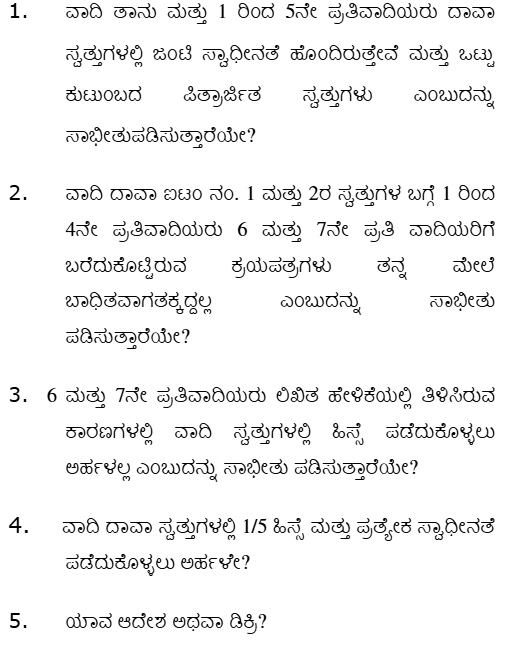
10. The plaintiff, to substantiate her case, examined herself as PW-1 and marked 11 documents as Exhibits












