
 Back
Back





IN THE HIGH COURT OF KARNATAKA AT BENGALURU
G.BASAVARAJA, J.
Chinnu @ Sudarshan, S/o. Sri M. Manaivannan – Appellant
Versus
State By BEML Police Station, Kolar Gold Fields – Respondent
Criminal Appeal No. 211 of 2013 (C)
Decided On : 12-11-2025
| Table of Content |
|---|
| 1. appellant's background and appeal. (Para 1 , 2) |
| 2. facts of the case and charge sheet details. (Para 3 , 4 , 5) |
| 3. arguments from the appellant and respondent. (Para 6 , 8 , 9) |
| 4. final order and acquittal of the appellant. (Para 7) |
| 5. points of consideration by the court. (Para 10 , 11) |
| 6. analysis of evidence and testimonies. (Para 12 , 13 , 16 , 17 , 18 , 19) |
JUDGMENT :
G.BASAVARAJA, J.
The appellant who is accused No.1 before the trial Court has preferred this appeal against the judgment of conviction and order of sentence passed by the Fast Track Court, KGF in S.C.No.89/2012 dated 21.02.2013.
2. Parties herein are referred to their rank as before the trial Court.
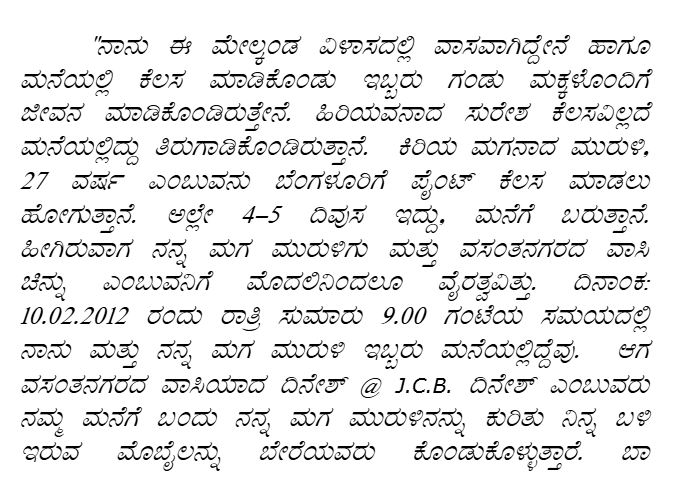
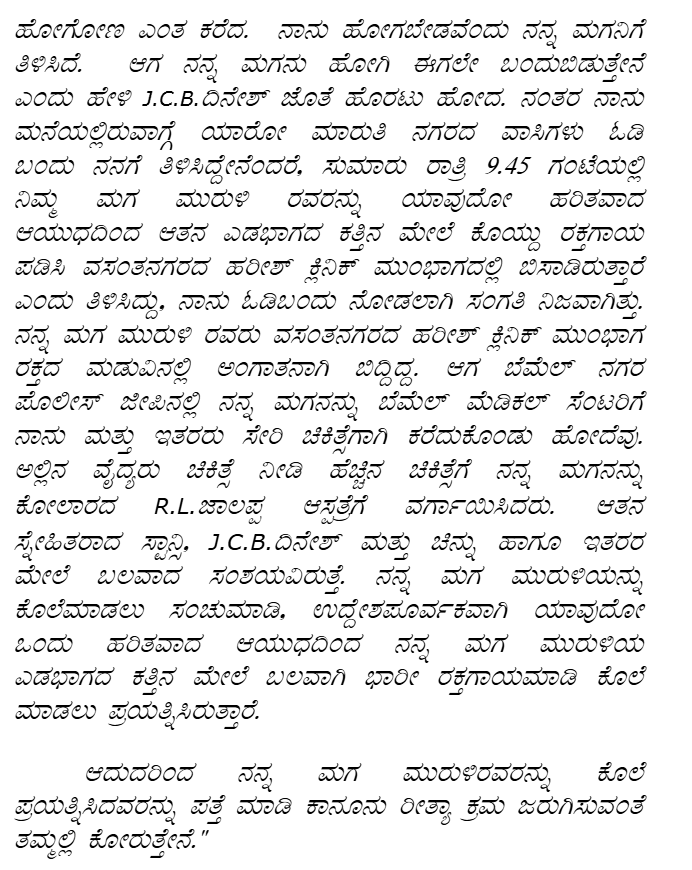
3. The brief facts leading to this appeal are that the Sub-Inspector of Police, BEML Nagara Police Station submitted the charge sheet against the accused Nos.1 to 3 for the offences punishable under Sections 323 , 326 and 307 read with 34 of IPC . It is alleged by the prosecution that accused No.1 was aggrieved with CW12-Suresha in respect of money transaction and in that regard, on 10.02.2012 at about 09.30 p.m. near Sri Anjaneyaswamy Temple, Vasanthanagara within the limits of BEML Nagar Police Station accused Nos.1 to 3 in furtherance of common intention, voluntarily assaulted CW2- Muralidharan and CW12-Suresha. CW2 promised that he would pay the money. When he was moving with accused towards Dasarahosahalli, accused Nos.2 and 3 instigated accused No.1 stating that, he is telling lie and finish him off and on that instigation, accused No.1, with an intention to commit his murder, assaulted CW2 on his neck with a sticker cutting blade causing severe cut injury. Thus, the accused have committed the offences punishable under , 326, 307 read with 34 of .
4. After filing the charge sheet, the case was registered in C.C No.271/2012. Thereafter the case was committed to the Court of Sessions and case was registered in S.C.No.89/2012. Accused appeared and were enlarged on bail. The trial Court has framed the charge only for the offence under Section 307 of IPC read with 34 of . The same was read over and explained to the accused. Having understood the same, the accused pleaded not guilty and claimed to be tried.
5. To prove the guilt of the accused, prosecution has examined, in all, 14 witnesses as PWs.1 to 14 and got marked 17 documents as Exs.P1 to P17 and 4 material objects as M.O.1 to 4. On closure of prosecution side evidence, statement under Section 313 of Cr.PC was recorded. The accused has totally denied the evidence of prosecution witnesses. However, he has not chosen to lead any defence evidence on his behalf. During the course of cross-examination of DWs.2 and 13, three documents were marked as Exhibits D1 to D3.
6. Having heard the arguments on both sides, the trial Court has acquitted accused Nos.2 and 3 for the offence under Section 307 IPC read with 34 of and accused No.1 was convicted for the offence under and passed sentence to undergo rigorous imprisonment for 7 years and pay a fine of Rs.10,000/-.
7. Being aggrieved by the judgment of conviction and order on sentence passed against accused No.1, has preferred this appeal.
8. The learned counsel appearing on behalf of appellant/accused No.1 would submit that the impugned judgment and order of conviction is arbitrary, capricious and opposed to law and facts. The same is not sustainable under law. Absolutely that there are no ingredients to attract the alleged commission of offence under Section 307 IPC . The reading of evidence of PW.2-injured and his brother PW.13-Suresh, falsify the case of the prosecution. There is no financial transaction between the accused and PW.13. The trial Court has failed to consider the material omissions and contradictions in the evidence of PW.2 and PW.13, the other eye-witnesses PW.9 and PW.10 have not supported the case of the prosecution. The trial Court has failed to appreciate the evidence on record in accordance with law and facts and sought to a

AI
Convictions for serious offences require corroborative evidence, and reliance on uncorroborated testimony can lead to reversible errors in judgment.

Eyewitness testimonies can substantiate convictions even amidst substantial trial delays, with the court having the discretion to modify sentences based on the age and circumstances of the accused.
Convictions must rely on cogent, corroborative evidence; failure to provide such leads to acquittal.

The absence of corroborative evidence renders the sole testimony insufficient for conviction under criminal law.
The court emphasized the prosecution's burden to prove guilt beyond a reasonable doubt, ruling that inconsistencies and lack of credible evidence required acquittal.

The evidential value of an injured witness and the requirement to prove the accused's intention or knowledge to commit the act are central legal principles established in the judgment.

The duty of the prosecution to explain discrepancies between ocular and medical evidence and the impact of inimical relationships between witnesses and the accused on the case's outcome.
The appellate court erred by reversing the trial court's acquittal due to insufficient evidence to substantiate grievous hurt, emphasizing the necessity for cogent proof in criminal cases.
Intent is crucial in determining the severity of charges under IPC; relevant evidence must reflect intention to kill for conviction under attempted murder.



An indispensable Tool for Legal Professionals, Endorsed by Various High Court and Judicial Officers
Please visit our Training & Support
Center or Contact Us for assistance

Scan Me!
India’s Legal research and Law Firm App, Download now!


For Daily Legal Updates, Join us on :



 Back to top


