
 Back
Back





IN THE HIGH COURT OF KARNATAKA, AT DHARWAD
R. Devdas, B. Muralidhara Pai, JJ.
Maleppa S/o. Venkappa Chanagoudar – Appellant
Versus
Smt. Parvatewwa W/O. Arjun Biroji – Respondent
R.F.A. NO.100197 OF 2022 (PAR/POS)
Decided On : 03-11-2025
| Table of Content |
|---|
| 1. basic case structure and parties (Para 1 , 2 , 3) |
| 2. claims of property rights and ownership (Para 4 , 5) |
| 3. arguments presented by the parties (Para 7 , 8) |
| 4. court's assessment of party claims and evidence (Para 12 , 19) |
| 5. legal presumption of joint family property (Para 15 , 16) |
| 6. lack of evidence to claim joint ownership (Para 18 , 21) |
| 7. final order on property claims (Para 27) |
JUDGMENT :
B. MURALIDHARA PAI, J.
1. This is the regular first appeal filed by Defendant No.2 in O.S. No.69/2017 on the file of the Prl. Senior Civil Judge and JMFC, Mudhol under Order XLI Rule 1 read with Section 96 of Code of Civil Procedure challenging the judgment and decree dated 22.01.2020, passed therein.
2. The parties to this appeal are referred herein as per their status before the trial court.
3. Admittedly, the Plaintiffs and Defendant Nos.2, 3, 5 and 6 are the children of one Sri Venkappa Maleppa Chanagoudar and Defendant No.1 namely Smt. Parvatewwa.Defendant No.4 is the son of Defendant No.2.
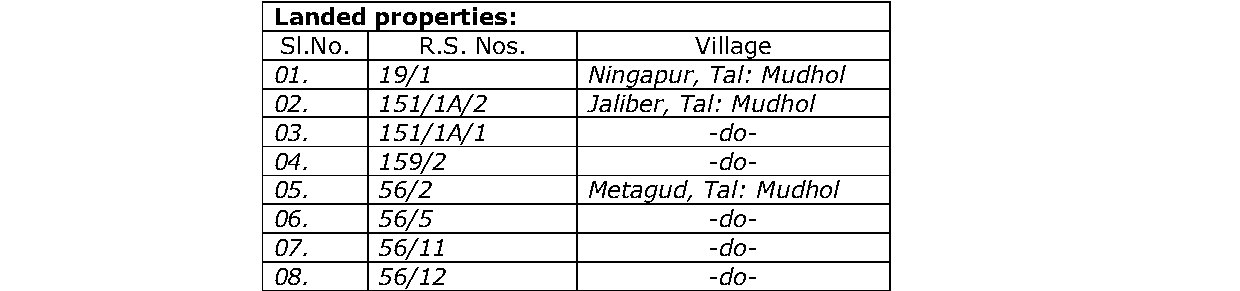
4. The Plaintiffs, who are the daughters of the propositus, have maintained the suit claiming their 1/7th share each in Schedule B properties i.e. 11 items of landed properties and 2 items of house properties. They have claimed the share in these properties on the ground that they are the joint owners of the schedule properties along with the Defendants and that all these properties are possessed and owned by the parties to the suit jointly.
5. Defendant Nos.2 and 3 are the only contesting Defendants in the case. They have categorically admitted that the Plaintiffs and Defendant Nos.1 to 3, 5 and 6 have got legitimate share in land bearing R.S. No.19/1 and house bearing No.VPC No.48 of Metagudda Village and contended that all other properties are their self acquired properties and no one else has got any right, title or interest over those properties.
6. After contest, the trial Court passed impugned judgment and decree holding that the Plaintiffs and Defendant Nos.1 to 3, 5 and 6 are entitled for 1/7th share each in all the schedule properties. Being aggrieved by the said judgment and decree, Defendant No.2 has come up with this appeal. In the appeal memo, Defendant No.2 has prayed to set aside impugned judgment and decree and consequently to dismiss the suit. However, during the course of argument learned Counsel for Defendant No.2 submitted that this appeal has been filed only to set aside impugned judgment and decree passed insofar as their self acquired properties.
7. Sri Mallikarjunswamy B. Hiremath, learned Counsel for Defendant No.2 has vehemently submitted that learned trial Court has committed grave error in not framing proper issues in the case and then wrongly proceeded to hold that all the schedule properties are joint family properties, ignoring pleadings of the parties and the materials available on record. He has contended that the impugned judgment and decree suffers from serious infirmity and resulted in miscarriage of justice. In view of the same, learned Counsel for the above circumstances, he contended that impugned judgment and decree needs to be set aside.
8. Per contra, Sri Gangadhar S. Hosakeri, learned Counsel for Plaintiffs supported the findings recorded by the trial court by contending that the trial court has rightly appreciated the materials available and arrived at a proper conclusion. He submitted there are sufficient evidence on record to show that the propositus namely Sri Venkappa Maleppa Channagoudar had other property, which was sold to J.K. Cement Factory and out of its sale proceeds other properties were purchased in the names of his family members. As such he submitted that learned trial court is fully justified in holding that the Plaintiffs are entitled for1/7th share each in all the schedule properties.
9. We have given our anxious consideration to the arguments advanced by learned counsels appearing for both side and perused all relevant the materials available on record. In the light of above re

AI
The court established that there is no presumption of joint ownership in family properties, and the burden of proof to establish such claims lies with the party alleging joint ownership.

Children born from void marriages are entitled to inherit their father's share but do not hold coparcener rights until the father's death.
The court reaffirmed that daughters have equal rights as sons in ancestral properties, emphasizing the applicability of Section 6 of the Hindu Succession Act.

The burden of proof lies on the party asserting self-acquisition in joint family property, which is subject to partition among co-owners.


Daughters became coparceners under Hindu Succession (Tamil Nadu Amendment) Act, 1989, allowing them equal rights in joint family properties.

The presumption of joint family status in Hindu law requires clear evidence to establish prior partition; the Appellate Court allowed partition of one property acquired post-partition while dismissin....

The plaintiff must prove the existence of a joint family nucleus to establish claims over joint family properties; mere relation does not imply entitlement.



An indispensable Tool for Legal Professionals, Endorsed by Various High Court and Judicial Officers
Please visit our Training & Support
Center or Contact Us for assistance

Scan Me!
India’s Legal research and Law Firm App, Download now!


For Daily Legal Updates, Join us on :



 Back to top


