
 Back
Back





IN THE HIGH COURT OF KARNATAKA,AT DHARWAD
R.NATARAJ, RAJESH RAI K., J.
Sri. Ramanayak, S/o. Dharamanayak Patil – Appellant
Versus
Smt. Sumitra, W/o. Ramanayak Patil – Respondent
Regular First Appeal No. 100284 Of 2018 (Par/Pos) C/W Rfa Cross Obj No. 100010 Of 2018
Decided On : 04-11-2025
| Table of Content |
|---|
| 1. appeals filed against trial court's decree (Para 1 , 2 , 3 , 4) |
| 2. factual background of plaintiffs' claim (Para 5 , 6 , 7) |
| 3. defendants' arguments against plaintiffs' claims (Para 8 , 10) |
| 4. court's analysis of joint family property rights (Para 12 , 14 , 15) |
| 5. legal rationale for notional shares (Para 19 , 20) |
| 6. final judgment and order (Para 23) |
JUDGMENT :
R.NATARAJ, J.
1. The defendant Nos.1 to 5 in O.S.No.85/2009 on the file of the Principal Senior Civil Judge and CJM, Dharwad (henceforth referred to as 'Trial Court') have filed RFA No.100284/2018 challenging the judgment and decree dated 28.04.2017 passed therein whereby the Trial Court declared that the plaintiffs are entitled to 2/9th share each in certain suit schedule properties.
2. The plaintiffs in O.S.No.85/2009 have filed RFA Crob No.100010/2018 challenging the aforesaid judgment and decree dated 28.04.2017 in so far as it relates to refusal to partition some of the suit schedule properties.
3. RFA No.100284/2018 was heard and reserved on 30.06.2025. However, it was noticed that RFA No.100284/2018 was dismissed for default on 07.02.2024. Since no attempt was made for restoration of the appeal, RFA Crob. No.100010/2018 was allowed on 11.09.2024. Later, an application (I.A.No.2/2025) was filed in RFA No.100284/2018 for restoration on 26.03.2025 and the appeal was restored to file. Then R.P.No.100052/2025 was filed to review the judgment passed in RFA Crob. No.100010/2018. Though this bench heard the appeal and Cross-objection and R.P.No.100052/2025, the Registry informed us that RFA Crob.No.100010/2018 was disposed off by a different combination of judges and therefore, RP No.100052/2025 has to be listed before that combination. Accordingly, R.P.No.100052/2025 was listed before the other bench, which allowed it and RFA Crob. No.100010/2018 was restored for fresh consideration. In this process, the judgment could not be pronounced within three months, as required of us as per judgment of the Hon'ble Apex Court of India in Anil Rai vs. State of Bihar [ (2001) 7 SCC 318 ].
4. For the sake of convenience, the parties shall henceforth be referred to as they were arrayed before the Trial Court. The appellants in RFA No.100284/2018 (respondent Nos.1 to 5 in RFA Crob No.100010/2018) were the defendant Nos.1 to 5, while respondent Nos.1 and 2 in RFA No.100284/2018 (Cross- objectors in RFA Crob No.100010/2018) were the plaintiffs and respondent Nos.3 to 6 in RFA No.100284/2018 (respondent Nos.6 to 9 in RFA Crob No.100010/2018) are the legal representatives of the deceased - defendant No.6.
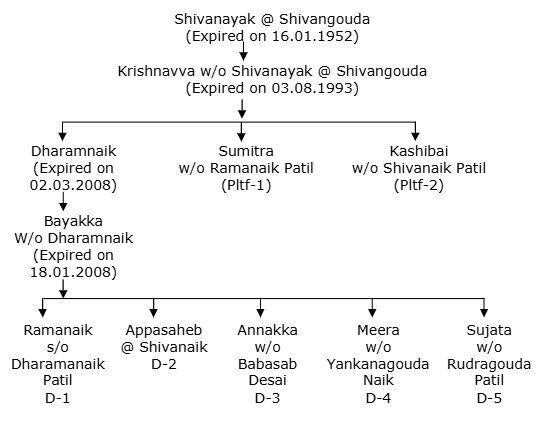
5. The suit in O.S.No.85/2009 was filed for partition and separate possession of the plaintiffs' share in the suit schedule properties. The plaintiffs mentioned their genealogy as follows:
6. The suit properties were agricultural lands in Block Nos.25, 26, 45 and 198 of Chikkamalligwad, Block No.612 of Kelageri and Block No.88 of Daddikamalapur and a house property at Chikkamalligwad.
7. (i) The plaintiffs claimed that their father Sri. Shivanaika died on 16.01.1952 leaving behind him his widow Smt. Krishnavva, his daughters - plaintiff Nos.1 and 2 and his son - Sri. Dharmanaika. Smt. Krishnavva died on 03.08.1993 leaving behind the plaintiffs and Sri. Dharmanaika as her legal heirs. Sri. Dharmanaika died on 02.03.2008 leaving behind him the defendant Nos.1 to 5. The plaintiffs claimed that the properties mentioned in the schedule to the plaint were joint family properties which stood in the name of the propositus Sri. Shivanaika. The plaintiffs claimed that after the death of Sri. Shivanaika, his widow Smt. Krishnavva and Sri. Dharmanaika succeeded to the suit properties. However, the name of Sri. Dharmanaika alone was entered in the record of rights as he was the Manager and kartha of the family. The plaintiffs therefore, contended that after the death of Smt. Krishnavva, they and Sri. Dharmanaika succeeded to the half share of Smt. Krishnavva. They claimed that after the deat
AI
Daughters were denied coparcener status under old inheritance laws but still claimed joint family property rights; trial court granted them shares based on family law principles.

The court reaffirmed that daughters have equal rights as sons in ancestral properties, emphasizing the applicability of Section 6 of the Hindu Succession Act.
Previous family partition and lack of joint family status preclude the plaintiff from claiming coparcenary rights under Hindu law amendments.

Widow's remarriage does not strip her of inheritance rights, and married daughters have equal entitlement to family property under the amended Hindu Succession Act.
The main legal point established in the judgment is that unless prior partition is established, there shall be a presumption that the property is joint family property, and a family arrangement in th....



An indispensable Tool for Legal Professionals, Endorsed by Various High Court and Judicial Officers
Please visit our Training & Support
Center or Contact Us for assistance

Scan Me!
India’s Legal research and Law Firm App, Download now!


For Daily Legal Updates, Join us on :



 Back to top


