


 Back
Back





2024 Supreme(Ori) 355
IN THE HIGH COURT OF ORISSA AT CUTTACK
A.C.BEHERA, J.
Bhagabatia Bhainsa & Another - Appellant
Versus
Ram Bihari Bhainsa & Others – Respondent
SA No.169 of 1997
Decided on : 17-05-2024
For the Appellant - Mr. K.M. Dhal, Adv.
Widow's remarriage does not strip her of inheritance rights, and married daughters have equal entitlement to family property under the amended Hindu Succession Act.
Headnote:(A) Hindu Succession Act, 1956 - Sections 6 and 23 - Partition of joint family properties - Plaintiffs, a widow and her married daughter, seeking a share in ancestral properties - Trial Court ruled against them based on remarriage of plaintiffs and unregistered sale documents. The High Court found that marrying does not divest the widow’s rights over her husband’s estate, and daughters have equal rights as coparceners. The joint recording of properties under settlement shows the land as joint and undivided - Plaintiffs entitled to 1/3 share of properties detailed in schedules A and B. (Paras 14-18)
(B) Legal Principles: It is established that a widow's remarriage does not negate her right to inherit her husband's property, and married daughters are equally entitled to a partition of family property as coparceners. (Paras 14, 15, 17)
Facts of the case:
Plaintiffs filed suit for partition due to defendants' alleged unlawful possession of family property which plaintiffs seek to divide, asserting they are the rightful heirs of deceased husband. (Paras 3-5)
Findings of Court:
Plaintiffs are declared entitled to a 1/3 share of all family properties described in schedules A and B, overruling previous judgments that denied them shares based on outdated legal interpretations regarding remarriage. (Paras 17, 18)
Issues: The court addressed the entitlement of the plaintiffs to partition based on their marital status and the nature of property ownership post remarriage, as well as the validity of unregistered property transactions. (Paras 10-15)
Ratio Decidendi: The judgment emphasized the significance of the Hindu Succession Act post its amendment, asserting women's rights in family property matters regardless of marital status, negating earlier restraints. (Paras 14-18)
Result: The appeal succeeds; the lower courts’ decisions denying the plaintiffs a share are overturned.
| Table of Content |
|---|
| 1. background of the appeal for partition (Para 1 , 2 , 3) |
| 2. defendants' claims and suit issues (Para 4 , 5) |
| 3. trial court's decisions and plaintiff's appeal (Para 6 , 7 , 8) |
| 4. legal implications of remarriage on inheritance (Para 9 , 10 , 11 , 12) |
| 5. daughters' rights to inheritance post-amendment (Para 13 , 14 , 15 , 16) |
| 6. judgment allowed, plaintiffs entitled to partition (Para 17 , 18) |
JUDGMENT :
A.C. Behera, J.
1. This 2nd Appeal has been preferred against the confirming Judgment.
2. The appellants of this 2nd Appeal were the plaintiffs before the Trial Court in the suit vide T.S. No.75 of 1986 and they were the appellants before the First Appellate Court in the 1st Appeal vide T.A. No.20 of 1996.
The respondents of this 2nd Appeal were the defendants before the Trial Court in the suit vide T.S. No.75 of 1986 and they were the respondents before the First Appellate Court in the 1st Appellate Court vide T.A. No.20 of 1996.
The suit of the plaintiffs (appellants in this 2nd Appeal) vide T.S.No.75 of 1986 before the Trial Court against the defendants (respondents in this 2nd Appeal) was a suit for partition.
3. According to the averments made by the plaintiffs in their plaint, they (plaintiffs) are the mother and daughter respectively. Their family pedigree as given in their plaint is depicted hereunder:
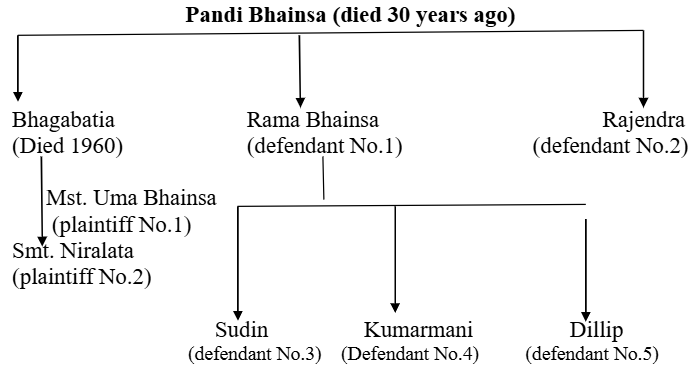
As per the genealogy given by the plaintiffs in their plaint, Pandi Bhainsa was their common ancestor. The wife of Pandi Bhainsa pre deceased him (Pandi Bhainsa). Pandi Bhainsa died about 30 years back leaving behind his 3 sons i.e. Bhagabatia, Rama (defendant No.1) and Rajendra (defendant No.2). The defendant Nos.3 to 5 are the sons of the defendant No.1 (Rama Bhainsa). The plaintiff No.1 is the widow wife of Bhagabatia Bhainsa. The plaintiff No.2 is the daughter of Bhagabatia Bhainsa.
According to the plaintiffs, the properties described in the schedule “A” and “B” of the plaint are the suit properties. The same are their joint and undivided properties. The suit properties have not at all been partitioned between them (parties) till yet through any metes and bounds partition. The suit properties have been recorded jointly in the Hal MS R.o.R in the name of the plaintiffs and defendants. The defendant Nos.1 and 2 are possessing forcibly major portions of the suit properties causing inconvenience to the plaintiffs, for which, the disturbances arose between them. Therefore, the plaintiffs approached the defendants for metes and bounds partition of the suit properties, to which, the defendants did not agree. Then, the plaintiff approached the Civil Court by filing the suit vide T.S. No.75 of 1986 against the defendants praying for partition of their one third share from the suit properties.
4. Having been noticed from the Trial Court in the suit vide T.S. No.75 of 1986 filed by the plaintiffs, the defendants challenged the same by filing their joint written statement taking their stands therein that, Bhagabatia Bhainsa died on 05.03.1956. The entire schedule “A” properties are not the joint ancestral properties of Bhagabatia Bhainsa (predecessor of the plaintiffs). Out of the suit properties described in schedule “A” of the plaint, the plot No.689 Ac.0.06 Decimals, Plot No.686 Ac.0.22 Decimals and Plot No.685 Ac.0.58 Decimals under suit khata No.56 is under the exclusive possession of the defendant Nos.1,3,4 & 5. Because, the said three suit plots were purchased by the defendant No.1 (Rama Bhainsa) from Dukhamati Dei and Sarojini on dated 04.06.1960 through an unregistered document and since the date of purchase i.e. since 04.06.1960, the defendant Nos.1,3,4 & 5 are in possession over the said three plots vide plot Nos.689, 686 & 685. As the defendant Nos.1,3,4 & 5 are in possession over the said three plots, for which, they have perfected their title over the said three suit plots vide plot Nos.689,686 & 685 through adverse possession, in which, the plaintiffs and defendant No.2 have no interest. But the Major Settlement












