
 Back
Back





IN THE HIGH COURT OF BOMBAY
Shrikant D.Kulkarni, J.
Rajesh Panditrao Pawar - Appellant
Versus
Parwatibai Bhimrao Bende - Respondent
Second Appeal No. 515 of 2021
Decided On : 07-04-2022
HINDU ADOPTIONS - Ownership and Succession - Hindu Adoptions and Maintenance Act, 1956 - Sections 8, 12; Hindu Succession Act, 1956 - Sections 8, 15 - The court analyzed the provisions of the Hindu Adoptions and Maintenance Act, 1956, particularly Sections 8 and 12, which govern the capacity to adopt and the effects of adoption. It concluded that the principle of relation back does not apply post-adoption, meaning the adopted son does not inherit rights from the deceased biological father. The court also interpreted Sections 8 and 15 of the Hindu Succession Act, determining the shares of the parties in the property, ultimately declaring the sale deeds executed by the adopted son as null and void to the extent of the plaintiff's share.
Fact of the Case:
The appellants purchased property from the adopted son of the original plaintiff, who later contested the validity of the sale deeds, claiming ownership and possession of her share in the property after the death of her adoptive mother.
Finding of the Court:
The court found that both lower courts erred in determining the shares of the parties. It held that the adopted son could not claim rights to the property based on the principle of relation back, as the adoption occurred after the death of the biological father, and thus the adopted son had no title to sell the property.
Issues: 1. Applicability of the principle of relation back under Section 12 of the Hindu Adoptions and Maintenance Act, 1956. 2. Determination of the share of the original plaintiff in the property. 3. Validity of the sale deeds executed by the adopted son. 4. Errors in determining shares under Sections 8 and 15 of the Hindu Succession Act, 1956.
Ratio Decidendi: The court established that the adopted son does not inherit rights from the deceased biological father due to the severance of ties upon adoption, as per Section 12 of the Hindu Adoptions and Maintenance Act, 1956. The shares of the parties were determined based on the provisions of the Hindu Succession Act, 1956, leading to the conclusion that the adopted son could only claim a share after the death of the adoptive mother.
Final Decision: The second appeal was disposed of by modifying the lower court's decree, declaring the original plaintiff as the owner of ¾ share of the property and the adopted son as the owner of ¼ share. The sale deeds executed by the adopted son were declared null and void to the extent of the plaintiff's share.
JUDGMENT/ORDER
SHRIKANT D.KULKARNI, J. - Heard finally at admission stage with consent of both the sides.
2. Unsuccessful original defendant Nos. 2 to 4 have preferred this second appeal against impugned Judgment and decree passed by the District Court in Regular Civil Appeal No. 149/2014 arising out of Judgment and decree passed in Regular Civil Suit No. 192/2009 by the learned 4th Jt. Civil Judge Junior Division, Parbhani.
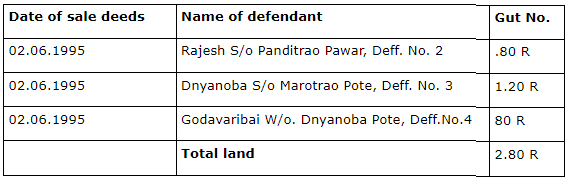
3. It is necessary to have a glance on few facts in order to throw light on the dispute. The appellants have purchased the suit property from respondent No. 2/adopted son of Kausalyabai (original plaintiff No.1 since deceased) vide three registered sale deeds dtd. 2/6/1995. The adoptive mother ( Kausalyabai) and sister Parwatibai had filed a suit on 17/8/2019 for declaration of ownership, recovery of possession with further declaration that sale deeds executed by defendant No.1 (adopted son) in favour of the appellants are not binding their shares.
4. During pendency of the suit, original plaintiff No. 1/ Kausalyabai died and suit was contested by plaintiff No.2/Parwatibai. The trial court was pleased to decree the suit partly as under :-
1. Suit of the plaintiff is partly decreed as follows.
2. Plaintiff No. 2 is declared as owner of suit property to the extent of her half share. Defendant No.1 is declared as owner of suit property to the extent of his remaining half share.
3. Sale Deed bearing No. 1418/1995, 1419/1995, 1420/1995 all dtd. 2/6/1995 executed by defendant No.1 in favour of defendants No. 2 to 4 in respect of suit property Gut No. 95 ad measuring total area 8 Hector 95 Are situated at village Pimpalgaon Tong, Tq. and Dist. Parbhani (more particular described in claim clause of plaint) is declared as null and void to the extent of half share of plaintiff No. 2 and not binding on the plaintiff No. 2 Parwatabai.
4. Plaintiff No. 2 is entitled to recover her half share in the suit property.
5. Writ of precept be send to District Collector, Parbhani for its compliance according to law.
6. Parties to bear their own costs.
7. Decree be drawn up accordingly.
5. Feeling aggrieved by the impugned Judgment and decree passed by the learned 4th Jt. Civil Judge Junior Division, Parbhani, original plaintiff No. 2/Parvatibai Bhimrao Bende has filed Regular Civil Appeal No. 149/2014. The said appeal came to be allowed as under :-
1) The appeal is allowed with costs.
2) The cross-objection filed by defendants/respondents is dismissed.
3) The judgment and decree passed by 4th Jt. Civil Judge Junior Division, Parbhani in R.C.S. No. 192/2009, dt. 30/09/2014 is hereby set aside.
4) The suit is decreed. The appellant is declared as owner of suit property and entitled for recovery of suit property from defendant Nos. 2 to 4. Defendant Nos. 2 to 4 shall evict within one year.
5) Sale deeds bearing registration No. 1418/1995 to 1420/1995 dt.02/06/1995 Exh. 30 to Exh. 32 are illegal and not binding on the plaintiff.
6) R and P be send to trial Court.
7) Decree be drawn up accordingly.
6. The execution proceedings came to be filed at the hands of original plaintiff No. 2/Parvatibai in order to execute the Judgment and decree passed in Regular Civil Appeal No. 149/2014.
7. Feeling aggrieved by the impugned Judgment and decree passed in Regular Civil Appeal No. 149/2014, the appellants/original defendant Nos. 2 to 4 have preferred the second appeal by raising precise substantial questions of law.
8. Heard Mr Prakashsing B. Patil, learned counsel for the appellants and Mr Shahaji B. Ghatol Patil, learned counsel for respondent No.1/original plaintiff No.2.
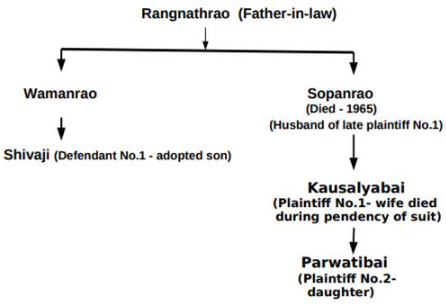
9. It is revealed during the course of argument and while perusing the impugned Judgment and decree passed by the appellate court as well as the trial court that both the Courts below have committed an error in the eye of law while determining the shares. So far as the question of adoption of defendant No. 1/Shivaji S/o Wamanrao alleged adopted son of Sopanrao Tong is concerned, both the Cou
AI

The court upheld that a registered adoption presumes validity unless disproved, affirming married daughters' inheritance rights under Hindu law.

Adopted children obtain full rights in adoptive family property from the date of adoption under Hindu law, superseding traditional limitations imposed by prior legal frameworks.
The main legal point established in the judgment is the validity of the adoption deed and the plaintiff's lack of locus standi to question the adoption.


Adoption does not divest an adopted child of rights acquired through a biological parent if the property was established as independent property prior to adoption.
Adoption severs ties with the biological family, divesting the adopted son of rights to property acquired through the natural father, and the burden of proof for joint ownership lies with the claiman....
The main legal point established in the judgment is that the adoptive mother had acquired a half share in the suit lands under the Act 1937, and the legal heirs of the daughter were entitled to a sha....

A valid adoption under the Hindu Adoptions and Maintenance Act cannot be cancelled, and a registered adoption deed carries a presumption of validity unless disproven. Additionally, the burden of proo....



An indispensable Tool for Legal Professionals, Endorsed by Various High Court and Judicial Officers
Please visit our Training & Support
Center or Contact Us for assistance

Scan Me!
India’s Legal research and Law Firm App, Download now!


For Daily Legal Updates, Join us on :



 Back to top


