
 Back
Back





IN THE HIGH COURT OF JUDICATURE AT MADRAS
THE HON'BLE MR.JUSTICE R. SAKTHIVEL, J.
Madalai Muthu (Died) and Ors. - Appellants
Versus
Sivagamiammal (Died) and Anr. - Respondents
S.A.Nos.1534 And 1535 Of 2002
Decided On : 29-04-2024
ADOPTION - PROPERTY DISPUTE - Section 100 of Civil Procedure Code, Section 68 of Indian Evidence Act, Section 63(c) of Indian Succession Act, Section 16 and Section 15 of Hindu Adoptions and Maintenance Act - The court interpreted the provisions of the Hindu Adoptions and Maintenance Act, 1956, particularly Sections 15 and 16, which establish that a valid adoption cannot be cancelled and that a registered adoption deed carries a presumption of validity. The court also examined the requirements for proving a will under the Indian Succession Act and the Indian Evidence Act, ultimately concluding that the defendants failed to prove their claims regarding the wills. This legal framework guided the court in affirming the plaintiffs' ownership and possession of the suit properties.
Fact of the Case:
The plaintiffs claimed ownership of ancestral properties following the death of R.S.Kandasamy, who had adopted the second plaintiff. The defendants contended that R.S.Kandasamy executed wills in their favor and claimed to be his legitimate heirs. The plaintiffs filed suits for declaration of title and permanent injunction after the defendants attempted to trespass on the properties.
Finding of the Court:
The Trial Court found that the defendants failed to prove the validity of the wills and that the second plaintiff was indeed the adopted son of R.S.Kandasamy. The First Appellate Court upheld these findings, confirming the plaintiffs' ownership and possession of the properties.
Issues: 1. Whether the plaintiffs are title holders of the suit properties? 2. Whether the plaintiffs are in possession of the suit properties? 3. Whether the wills executed by R.S.Kandasamy are valid? 4. Whether the adoption of the second plaintiff is valid?
Ratio Decidendi: The court emphasized that once an adoption is validly made, it cannot be cancelled, and the presumption of validity applies to registered adoption deeds. The court also highlighted the necessity of proving wills according to statutory requirements, which the defendants failed to do.
Final Decision: The court dismissed the second appeals, affirming the lower courts' decisions that the plaintiffs are the rightful owners and possessors of the suit properties.
JUDGMENT :
(R. Sakthivel, J.) :
(Prayer In S.A.No.1534 Of 2002: Second Appeal filed under Section 100 of Civil Procedure Code against the judgment and decree dated 26.03.2002 passed in A.S.No.25 of 2001 by the learned Subordinate Judge, Mettur, confirming the judgment and decree dated 23.04.2001 passed in O.S.No.262 of 1991 by the learned District Munsif, Mettur.)
(Prayer In S.A.No.1535 Of 2002: Second Appeal filed under Section 100 of Civil Procedure Code against the judgment and decree dated 26.03.2002 passed in A.S.No.43 of 2001 by the learned Subordinate Judge, Mettur, confirming the judgment and decree dated 23.04.2001 passed in O.S.No.68 of 1998 by the learned District Munsif, Mettur.)
These Second Appeals are directed against the common judgment and decree dated March 26, 2002, passed in A.S.No.25 of 2001 and A.S.No.43 of 2001 by the 'learned Subordinate Judge, Mettur' [henceforth 'First Appellate Court' for the sake of brevity] confirming the common judgment and decree dated April 23, 2001 passed in O.S.No.262 of 1991 and O.S.No.68 of 1998, by the 'learned District Munsif, Mettur' [henceforth 'Trial Court' for the sake of brevity].
2.The appellants no.(1) to (4) herein are the defendants no.(1) to (4) in O.S.No.262 of 1991 and O.S.No.68 of 1998. The respondents herein are the plaintiffs in the said Suits. For the sake of convenience, henceforth, the parties herein will be referred to as per their array in the Suits.
3. The case of the plaintiffs is as follows:
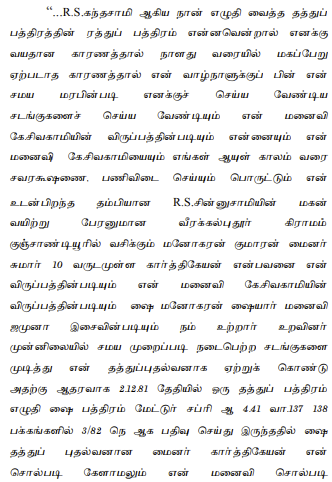
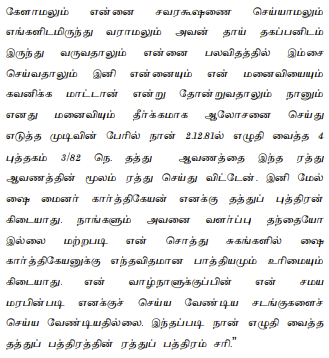
3.1. The suit properties were ancestral properties allotted to R.S.Kandasamy in a partition among his brothers. On and after the said partition, R.S.Kandasamy was enjoying the suit properties. R.S.Kandasamy married the first plaintiff namely, Sivagamiammal according to their caste customs and rituals in the year 1943. Hence, the first plaintiff is the legally wedded wife of Late R.S.Kandasamy. No children were born to the couple. Hence, the first plaintiff and R.S.Kandasamy decided to adopt a son. On December 2, 1981, first plaintiff Sivagamiammal and R.S.Kandasamy jointly adopted the second plaintiff as their son. Thereafter, R.S.Kandasamy passed away on May 2, 1990, at Salem. He was buried in the Suit properties. The second plaintiff, being the adopted son of R.S.Kandasamy performed all the final rites of Late R.S.Kandasamy. After the demise of R.S.Kandasamy, the plaintiffs became the absolute owners of the suit properties and they started enjoying the estate of R.S.Kandasamy.
3.2. The first defendant was a Commercial Tax Officer working in Tondiarpet Division Commercial Tax Office, Madras. His father name is Arockiasamy. Second defendant is the wife of the first defendant. The defendants 3 and 4 are the sons of the defendants 1 and 2. The defendants have no right, title, interest or possession over the suit properties. On May 20, 1990, the defendants came to the suit properties and made attempts to trespass into the suit properties. The defendants are strangers to the suit properties. The plaintiffs with the help of relatives and neighbours rightly prevented the defendants from their illegal attempt to trespass.
3.3. Initially, the plaintiffs filed a Suit for permanent injunction in O.S.No.262 of 1991. Since the defendants created a cloud over plaintiffs' title, the plaintiffs filed another Suit in O.S.No.68 of 1998 for declaration of title and permanent injunction.
4. The case of the defendants is as follows:
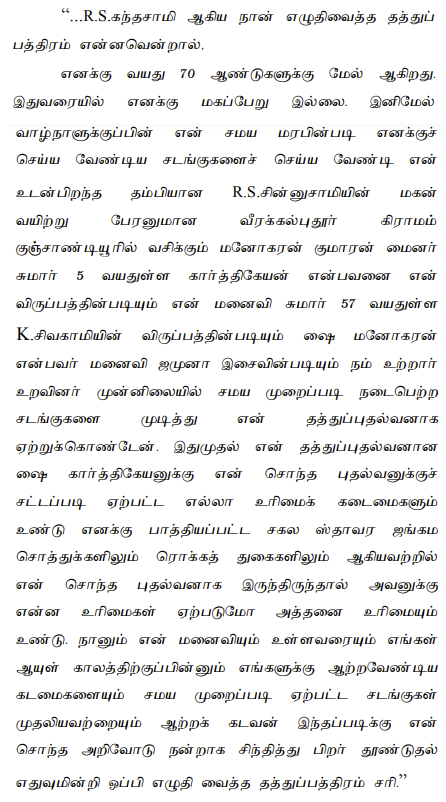
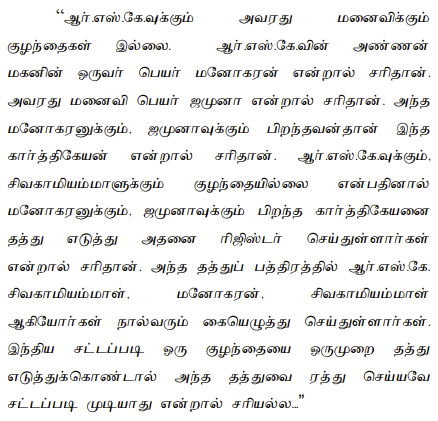
4.1. R.S.Kandasamy executed two separate registered Wills dated December 12, 1986, and February 11, 1987, in favour of the defendants. R.S.Kandasamy passed away on May 2, 1990. Thereafter, the registered Wills came into force and the defendants are in possession and enjoyment of the suit properties. Hence, the defendants alone are the absolute owners of the suit properties. The plaintiffs have no right, title, interest or possession over the suit properties.
4.2. According to the defendants, Arputhammal is the first wife of R.S.Kandasamy, who is no more. Mad

AI
A valid adoption under the Hindu Adoptions and Maintenance Act cannot be cancelled, and a registered adoption deed carries a presumption of validity unless disproven. Additionally, the burden of proo....
![Mirthinjiya Bhattar, [Died] vs S.N. Subramanian, S/o. Late Nainakannu Bhattar - 2026 Supreme(Online)(Mad) 48145](https://supremetoday-s3.b-cdn.net/Madras_1.png)
A registered adoption deed provides only a rebuttable presumption of validity under the statute. The burden to prove the actual ceremony remains on the propounder, and the claim fails if evidence is ....

The main legal point established in the judgment is the validity of the adoption deed and the plaintiff's lack of locus standi to question the adoption.
Under Hindu law both adopted children of a childless couple inherit equally with the surviving spouse; a gift settlement lacking a revocation clause cannot be cancelled unilaterally and binds only to....
The court established that for an adoption to be valid under the Hindu Adoptions and Maintenance Act, 1956, there must be clear and convincing evidence of the actual giving and taking in adoption, wh....
Point of law: A perfectly valid adoption deed can be made without an adoption deed and any status which the adopted son gets by virtue of adoption is due to the proper ceremonies being performed and ....
The validity of an adoption must be established by evidence of actual giving and taking of the child, with presumption favoring registered Adoption Deeds unless convincingly rebutted.

The central legal point established in the judgment is the requirement for a valid adoption to be acted upon, including the physical act of giving and taking the minor in adoption. The burden of proo....

The central legal point established in the judgment is the requirement to prove adoption strictly in accordance with the provisions of the Hindu Adoptions and Maintenance Act, 1956, including the con....
Negative declaratory relief cannot be sought without establishing positive ownership claims under the Specific Relief Act; inadequate court fees leads to dismissal of suit.



An indispensable Tool for Legal Professionals, Endorsed by Various High Court and Judicial Officers
Please visit our Training & Support
Center or Contact Us for assistance

Scan Me!
India’s Legal research and Law Firm App, Download now!


For Daily Legal Updates, Join us on :



 Back to top


