
 Back
Back





IN THE HIGH COURT OF JUDICATURE AT BOMBAY
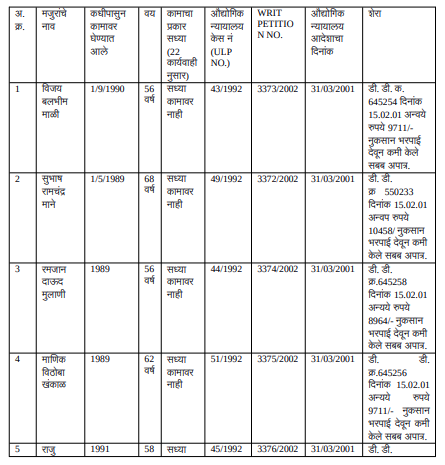
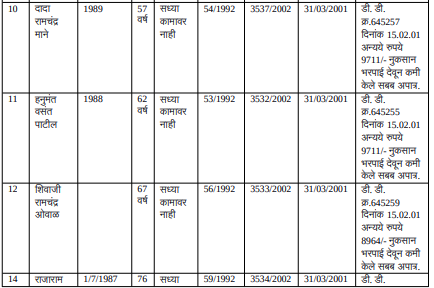
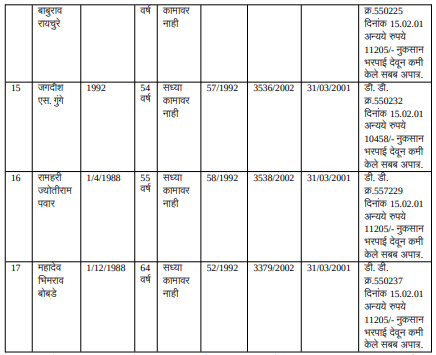
SANDEEP V. MARNE, J.
The Deputy Director and Others – Petitioners
Versus
Vijaya Balbhim Mali – Respondent
Writ Petition No. 3371, 3372, 3373, 3374, 3375, 3376, 3377, 3378, 3379, 3380, 3532, 3533, 3534, 3535, 3536, 3537, 3538 of 2002, Civil Application No. 1325 of 2016
Decided On : 20-09-2024
Permanency - Employment - MRTU and PULP Act Sections - The court analyzed the provisions of the MRTU and PULP Act, particularly Section 30, which empowers industrial adjudicators to grant permanency to workers subjected to unfair labor practices, emphasizing the need for regularization schemes and the criteria for such benefits.
Fact of the Case:
Petitioners challenged the Industrial Court's order granting permanency to Respondents who were daily wage workers under a social forestry program, arguing that they were not entitled to permanency as they did not meet the criteria for continuous service.
Finding of the Court:
The court found that the Industrial Court erred in granting permanency based solely on five years of service without considering the absence of sanctioned posts and the specific government resolutions regarding regularization.
Issues: Whether the Industrial Court was justified in granting permanency to daily wage workers who had not completed the necessary criteria for regularization under applicable government resolutions.
Ratio Decidendi: The court held that the Industrial Court's decision to grant permanency was flawed as it did not consider the relevant government resolutions and the lack of sanctioned posts, which are essential for regularization.
Result: The court partly allowed the petitions, setting aside the Industrial Court's order for permanency and directing consideration for regularization under specific government resolutions.
JUDGMENT :
SANDEEP V. MARNE, J.
1. These petitions are filed by Petitioner No. 2 through the Deputy Director, Social Forestry Division, Solapur challenging the Judgment and Order dated 31 March 2001 passed by the Industrial Court, Solapur, by which complaints filed by the Respondents have been partly allowed and Petitioners are directed to consider the length of continuous services put by them till amendment of complaints on 21 July 1999 for the purpose of grant of benefit of permanency. Petitioners are accordingly directed to issue orders for permanency of the Respondents with continuity of service i.e. consequential benefits, without backwages.
2. Afforestation of barren lands is a program undertaken by the Government of India, which later assumed the name ‘Social Forestry’. The program was soon implemented by various State Governments, including the State of Maharashtra through its Department of Revenue and Forests. The scheme for social forestry included inter-alia the activity of plantation on the lands made available by Gram Panchayats, Public Works Department and other private institutions. For the purpose of undertaking the work of plantation, grass cutting and maintenance of trees/plants, workers were engaged on daily wage basis, as and when needed. Under the program, Petitioners implemented Social Forestation Scheme on the concerned land for three years, whereafter the land was returned to the respective owners.
3. In the above background, Respondents were engaged as daily wage workers under the social forestry program during various years ranging from 1985 to 1991. In the year 1992, Petitioner issued orders transferring the services of Respondents from one village to another. In case of Respondent-Vijaya Balbhim Mali (Writ Petition No. 3373 of 2002) who was working since the year 1990, transfer order was issued on 30 January 1992 from Matsya Beach to Akole Budruk. Respondents got aggrieved by their respective transfer orders and instituted complaints of unfair labour practice before the Industrial Court, Solapur challenging the transfer order. In their complaints, Respondents filed applications for temporary injunction. The complaint as well as application for temporary injunction were resisted by Petitioners by filing their Written Statement contending that Respondents were engaged merely as ‘seasonal workers’ during monsoon season for undertaking the work of plantation, grass cutting and maintenance of plants. That the work is not of regular nature. The Industrial Court passed interim order dated 17 February 1992 directing Petitioners to maintain status-quo in respect of the services of the Respondents until further orders.
4. It appears that though the complaints were filed challenging mere transfer orders, that too of temporary workers, the complaints remained pending for a considerable period of time and in the meantime, services of the Respondents were continued. It appears that Respondents sought inspection of records relating to their services. Accordingly, the person appointed by the Court to carry out inspection and submitted his report in respect of each of the complainants to certify their services prior to filing of complaints. On 21 July 1992, Respondents filed applications for amendment of Complaints by incorporating their grievances relating to grant of permanency. The amendment was allowed by order dated 12 January 2000. Thus, Respondents claimed the relief of permanency in the amendment application on the strength of completion of 240 days of service, from the year of initial engagement.
5. Both the sides led evidence in support of their respective claims. After considering the pleadings, documentary and oral evidence, the learned Member, Industrial Court proceeded to allow the complaint partly directing consideration of services of the Respondents upto the date of filing of application for amendment dated 21 July 1999 for grant of permanency in service. The Industrial Court has accordingly directed Peti
AI
The court established that regularization of daily wage workers requires adherence to specific government resolutions and the existence of sanctioned posts, not merely the completion of five years of....
The judgment emphasizes the statutory rights of industrial workers and the prohibition of unfair labour practices under the MRTU & PULP Act, 1971.
Long-term engagement of employees for over 240 days establishes entitlement to regularization, reinforcing the principle against unfair labor practices applicable to public sector employment.
The court's decision established that when temporary or ad-hoc appointments are continued for a long period of time, the Court has to presume that there is a regular need for service on regular posts....

Prolonged continuous service of employees necessitates regularization irrespective of absence of sanctioned posts, reinforcing the obligation of fair employment practices by the state.

The court confirmed that permanent employment requires formal appointment procedures, and mere long service does not grant entitlement to regularisation without mandated legal protocols.

Private companies cannot use discretion to justify unfair labour practices, and past financial status as a sick unit does not prevent directions of permanency that may increase financial burden.

Regularization of service requires proof of unfair labor practices; long service alone does not confer entitlement without due procedure.

Labour Law – Unfair labour practice - when similarly situated workmen have been grated permanency by the University, non-granting of the same to the present workmen is nothing but an unfair labour pr....



An indispensable Tool for Legal Professionals, Endorsed by Various High Court and Judicial Officers
Please visit our Training & Support
Center or Contact Us for assistance

Scan Me!
India’s Legal research and Law Firm App, Download now!


For Daily Legal Updates, Join us on :



 Back to top


