
 Back
Back





IN THE HIGH COURT OF JUDICATURE AT BOMBAY
A. S. Gadkari, Kamal Khata, JJ.
Lakhani Housing Corporation Private Limited and ors. – Petitioners
Versus
State of Maharashtra Through Government Pleader and ors. – Respondents
Writ Petition No.2167 of 2024 With Interim Application (L) NO.25969 OF 2024
Decided On : 19-11-2024
JUDGMENT :
Kamal Khata, J.
1. In the heart of Mumbai, in Sion Koliwada, lies a sizeable plot of land by Mumbai standards, measuring 45,308.58 square meters (approximately 11.20 acres), commonly known as Guru Teg Bahadur Nagar ("the subject land"). This land once held 25 buildings that housed around 1,200 occupants, originally refugees from Pakistan. Due to the dilapidated condition of these buildings, the BMC demolished them between 2019 and 2022. Consequently, the land has remained vacant for over five years.
2. The residents sought Government intervention for the redevelopment of the property, which led to a Cabinet Decision and the issuance of a Government Resolution to that effect. MHADA was appointed as the planning authority responsible for overseeing the redevelopment of the subject land. Subsequently, MHADA issued an e-Tender to select a Construction and Development Agency (C & D A) for the redevelopment project.
3. Through this Petition, the Petitioners, Lakhani Housing Developers Private Limited ("Lakhani"), who are developers claiming vested rights in the subject land, seek a Writ of Certiorari to set aside the Cabinet Decision, the Government Resolution, and the e-Tender issued by MHADA for the redevelopment of the subject land.
Brief facts:
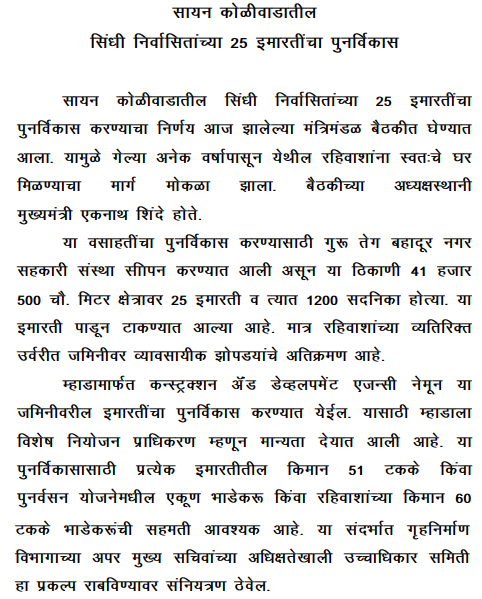
4. By a Cabinet Decision dated 14th February 2024, the State of Maharashtra (Respondent No.1) appointed MHADA as the special planning authority to redevelop the 25 buildings at the Guru Teg Bahadur Nagar Cooperative Society in Sion Koliwada, Mumbai. The original decision, in Marathi, is annexed at page 56, with an English translation provided at page 62. The relevant portion of the decision is available in Marathi on page 60 and is extracted below:
5. A Government Resolution (GR) was subsequently issued on 23rd February 2024, recording this decision. The original GR, in Marathi, is annexed at page 75, with an English translation on page 80. Since it is under challenge, the relevant portion from page 76 in Marathi is extracted below:
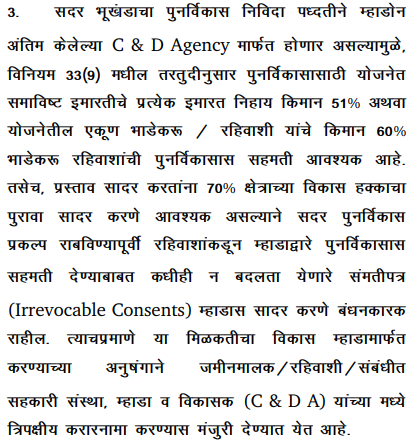
6. The GR specifies that MHADA will implement the redevelopment project under Regulation 33(9) of the Development Control and Promotion Regulations for Greater Mumbai, 2034 (DCPR), by appointing a Construction and Development Agency (C & D A) through a tender process as provided in the DCPR. The GR requires at least 51% of each building's residents, or 60% of the total tenants/residents across all buildings, to consent to the redevelopment. Additionally, it mandates that the C & D A must provide MHADA with proof of the right to develop at least 70% of the area, along with irrevocable consents from residents agreeing to MHADA's redevelopment plans, before the project can proceed.
6.1. The GR further stipulates that the tender documents must specify, as a minimum requirement, that the selected C & D A must build and provide rehabilitation units free of charge, offer the highest housing stock/premium to MHADA, and meet all financial and physical conditions specified in the tender.
7. Mr. Madon learned Senior Counsel for the Petitioners submitted that initially the land belonged to the President of India. Punjabi and Sindhi refugees who proposed to settle in Mumbai, after the partition, were sold 1200 residential tenements in these 25 buildings. Sanad’s were executed in favour of some of the purchasers between the period 1954 and 1987. The conveyances were executed by the President of India in favour of the purchasers in accordance with the provisions of Rules 42 and 33 framed under Displaced Persons (Compensation and Rehabilitation) Act, 1954. These Sanad’s/Conveyances clearly indicate that the transfer was absolute and thus the lands were freehold. No rights of any nature whatsoever were reserved in favour of the President of India, except the right to remove mines and minerals from the lands on which the buildings stood. The residents subsequently themselves formed the Cooperative Housing Societies.
7.1. It is undisputed that the buildings, which were approxima
AI
The court ruled that the petitioners lacked locus standi to challenge the government's redevelopment decision and failed to secure necessary consents from newly formed societies, thus dismissing the ....

The main legal point established in the judgment is the obligation of parties to comply with court directions and the serious consequences for non-compliance.


Majority consent in cooperative societies is binding for redevelopment under Section 41A of the Gujarat Ownership Flats Act, enabling courts to enforce compliance despite minority objections.
The court upheld the validity of the redevelopment process under Section 41A of the Gujarat Ownership Flats Act, 1973, and directed the respondents to vacate their flats and hand over peaceful and va....

The court upheld the validity of the redevelopment project under Section 41A of the Gujarat Ownership Flats Act, 1973, based on the majority consent of the members, dilapidated condition of the build....
The public interest in the redevelopment scheme and the lack of infringement of the petitioners' fundamental or legal rights were the main legal points established in the judgment.
The court ruled that disputed questions of fact regarding land area and project delays are not suitable for Writ jurisdiction, emphasizing the need for timely completion of slum rehabilitation projec....

Society - Process of re-development of its building - Plaintiff has neither made out a prima-facie case nor could show as to how redevelopment, would cause loss to him nor could establish, re-develop....



An indispensable Tool for Legal Professionals, Endorsed by Various High Court and Judicial Officers
Please visit our Training & Support
Center or Contact Us for assistance

Scan Me!
India’s Legal research and Law Firm App, Download now!


For Daily Legal Updates, Join us on :



 Back to top


