
 Back
Back





IN THE HIGH COURT OF JUDICATURE AT BOMBAY
R. M. JOSHI, J.
Sonu S/o Laxman Mahajan - Appellant
Versus
Amrtulal S/o Devlal Lohar - Respondent
SECOND APPEAL NO. 152 OF 1994 WITH CIVIL APPLICATION NO. 6168 OF 1998 IN SA/152/1994
Decided On : 31-01-2025
(A) Bombay Agricultural Tenancy Act, 1948 - Specific performance of contract - The plaintiff sought specific performance of a contract for sale executed by defendants on 20.10.1973, with payments made totaling Rs. 11,500/- - Defendants claimed the agreement was a money lending transaction and executed without knowledge of its contents - The Trial Court decreed specific performance subject to obtaining necessary permissions from the Collector. (Paras 4, 6, 12, 13)
(B) Burden of Proof - The burden lies on the plaintiff to prove the execution and contents of the agreement - Defendants did not file a counterclaim to invalidate the agreement, undermining their claim of ignorance regarding its contents. (Paras 10, 11)
(C) Jurisdiction of Civil Court - The Civil Court cannot assume jurisdiction to grant permission for sale under the Tenancy Act, which is reserved for the Collector. (Paras 12, 13)
Facts of the case:
The plaintiff filed a suit for specific performance based on an agreement to sell property executed by the defendants, who later denied the validity of the agreement, claiming it was a money lending transaction. The Trial Court ruled in favor of the plaintiff, requiring the defendants to obtain necessary permissions for the sale.
Findings of Court:
The decree for specific performance was upheld, with directions for the defendants to apply for permission from the Collector, and provisions for refund if permission was denied.
Issues: The main issues included whether the agreement was valid and binding, the burden of proof regarding the agreement's contents, and the jurisdiction of the Civil Court under the Tenancy Act.
Ratio Decidendi: The court found that the defendants did not sufficiently challenge the agreement's validity and that the Trial Court correctly required permission from the Collector for the sale, affirming the decree for specific performance.
Result: Appeal dismissed.
ORDER :
1. Learned counsel Mr. Vinesh C. Solshe seeks discharge on the ground that the respondents have engaged learned counsel Mr. V. R. Patil. He stands discharged.
2. Original defendants takes exception to the judgment and decree passed by the Trial Court in Regular Civil Suit No. 93/1977 granting decree of specific performance in favour of the plaintiff and confirmation thereof in Regular Civil Appeal No. 186/1986 by First Appellate Court.
3. Parties are referred to as “plaintiff and defendants” for the sake of convenience.
4. There is no dispute about the fact that plaintiff filed suit bearing Regular Civil Suit No. 93/1977 for seeking specific performance of the contract on the basis of agreement to sale executed by defendants dated 20.10.1973 for sale of suit property. There is no dispute about the fact that defendants are the owners and are in possession of the suit property. It is a case of the plaintiff that at the time of execution of agreement dated 20.10.1973, defendants have accepted sum of Rs. 3,500/- and subsequent thereto on 01.12.1973 further amount of Rs. 8,000/- was accepted. Parties were to execute sale deed on or before 23.05.1977. It was further agreed between the parties that the necessary permissions for the sale to be obtained by defendants but at the cost of plaintiff. Since, defendants did not obtain any permission, and there was no execution of sale deed, plaintiff filed suit for specific performance of contract.
5. Defendants filed written statement denying the contentions in the plaint. It is specifically claimed that the transaction in question is money lending transaction. Defendants admitted signature of defendant No.2 and thumb impression of defendant No.1 on agreement to sale (Exhibit 32). It is further claimed that the said document came to be executed by them without knowing the contents of the document. It is also claimed that the plaintiff has mis-represented them about the contents and as such said document is not binding upon him.
6. Before the learned Trial Court, evidence was led. Plaintiff examined himself. Whereas defendant no. 2 examined himself and also led evidence of two other witnesses who were the ad-joining owners of the suit property. Learned Trial Court decreed the suit and directed execution of the sale deed by defendants in favour of the plaintiff subject to permission granted by the Competent Authority in the said sale under the Bombay Agricultural and Tenancy Act, 1948 (for short “the Act”). This judgment was taken exception before the First Appellate Court unsuccessfully. Hence, this appeal.
7. Learned counsel for the appellant/original defendants submits that this Court by order dated 29.07.1994 has admitted the appeal on the grounds which are reproduced herein below :-
II) Whether the Courts below should have granted performance in favour of the plaintiff when the very document itself is not at all proved by the plaintiffs conclusively as neither the scribe nor other witnesses have deposed in support of the plaintiff.
VII) Whether the specific performance of the tenanted land under the provisions of the Bombay Tenancy and Agricultural Lands Act, 1948 can be granted in favour of the plaintiff ?
VIII) Whether a decree of performance can be granted, when there is a clear-cut bar under the provisions of the Bombay Fragmentation and Consolidation Act, since the suit land is a fragment ?
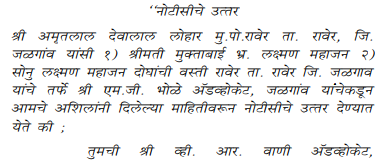
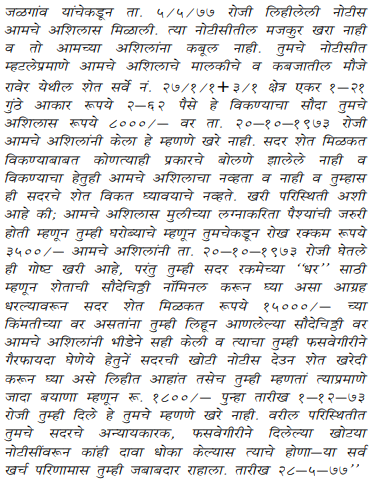
8. It is his submission that when the defendants have specifically come out with the case that the contents of the said document were not known to the defendants at the time of an execution of document. The burden is on the plaintiff to prove not only execution of document but also contents of the document to support said submission. He has placed reliance on the judgment of Kamlabai W/O Ishwar Pujari and others Versus ShantiraI w/o Lalitmohan Rai and others, 1983 Mh.L.J. 221. It is further argued that the defendants have led evidence of two ad-joining owners who have specifically stated about plain
AI
The court affirmed that the burden of proof lies on the plaintiff to establish the validity of the agreement for specific performance, and that permission from the Collector is necessary under the Te....

Specific performance can be granted despite preliminary legal requirements if conditions do not amount to an absolute prohibition under applicable law.

(1) Agreement to Sell – Only a valid and enforceable contract can be ordered to be specifically performed.(2) Agreement to Sell – Court is not bound to order specific performance even if it is lawful....

The court held that specific performance of an agreement for sale is unenforceable without consent from co-parceners and proof of legal necessity, emphasizing the court's discretion in granting such ....

(1) Agreement to sell – Suit for Specific Performance – Decree for specific performance can be passed contingent upon grant of permission.(2) Prohibition on sale of agricultural lands – Embargo creat....
Agreement to Sell is not a conveyance; it does not transfer ownership rights or confers any title.

The absence of signature proof does not invalidate a specific performance decree if the plaintiff demonstrates readiness and willingness to perform the contract as required under the Specific Relief ....

The court confirmed that an executed sale agreement constitutes a binding contractual obligation, dismissing claims that it functioned solely as a loan security.
Contract and Specific Reliefs – Agreement to Sell - It is well settled that remedy of specific performance is an equitable one and Court while granting decree of specific performance exercises its di....

A registered sale deed executed after full consideration cannot be challenged by a suit for specific performance without first seeking its cancellation.



An indispensable Tool for Legal Professionals, Endorsed by Various High Court and Judicial Officers
Please visit our Training & Support
Center or Contact Us for assistance

Scan Me!
India’s Legal research and Law Firm App, Download now!


For Daily Legal Updates, Join us on :



 Back to top


