
 Back
Back





IN THE HIGH COURT OF JUDICATURE AT BOMBAY
G. S. Kulkarni, Advait M. Sethna, JJ.
Luxempire Realty Private Ltd. - Petitioner
Versus
Eminence Landmarks LLP and ors. – Respondents
Writ Petition No. 2068 of 2025
Decided On : 16-10-2025
Key Principle: Arbitrators lack inherent power to lift the corporate veil; such action exceeds arbitral jurisdiction unless explicitly consented to or arising from the arbitration agreement itself. (!) (!) (!) (!) (!) (!) (!) (!) (!) (!)
Separate Legal Personality and Limited Arbitral Authority: Companies enjoy distinct juridical status; veil-piercing is an extraordinary equitable remedy reserved for courts in cases of fraud, sham, or abuse, not routinely available to arbitrators. Arbitral tribunals are creatures of contract, bound by party autonomy and kompetenz-kompetenz under Section 16; extending jurisdiction via veil-lifting to non-signatories or affiliates violates privity. (!) (!) (!) (!) (!) (!) (!) (!) (!) (!) (!) (!) (!) (!) (!)
Group of Companies and Veil-Piercing Overlap: Veil-lifting cannot substitute for group of companies doctrine, which requires mutual intent, direct relationship, composite transactions, and implied consent. Mere common control or economic unity insufficient without evidence of parties' intention to bind the group entity. Arbitrator's unilateral determination on veil lacks legitimacy if no prima facie case from agreement. (!) (!) (!) (!) (!) (!)
Jurisdictional Challenge: Order lifting veil to implead or bind non-signatory is patently lacking inherent jurisdiction, amenable to immediate writ under Articles 226/227. No requirement to await final award; prevents foisting arbitration on unwilling party and miscarriage of justice. Section 16(6) remedies apply only inter se signatories. (!) (!) (!) (!) (!) (!) (!) (!) (!) (!) (!) (!)
No Implied Consent via Conduct: Knowledge of dispute, inter-company dealings, or shared directors do not imply consent to arbitrate or justify veil-piercing. True holding company-subsidiary relationships do not automatically extend arbitration obligations absent explicit agreement. (!) (!) (!) (!) (!) (!) (!) (!) (!) (!) (!)
Outcome in Context: Arbitrator's attempt to lift veil for impleading independent purchaser or non-signatory quashed; no fraud or exceptional circumstances warranting piercing. Jurisdiction confined to signatories' disputes. (!) (!) (!) (!) (!) (!) (!) (!) (!) (!) (!) (!) (!)
| Table of Content |
|---|
| 1. parties involved in the arbitration agreement. (Para 3 , 4 , 5 , 6 , 7) |
| 2. arguments against impleadment of petitioner. (Para 22 , 23 , 24) |
| 3. arguments supporting arbitration jurisdiction. (Para 35 , 36 , 38 , 39) |
| 4. court's analysis of jurisdictional principles. (Para 67 , 68 , 69 , 70 , 71) |
| 5. conclusion of the court to quash the arbitral order. (Para 129) |
JUDGMENT :
G.S. Kulkarni, J.
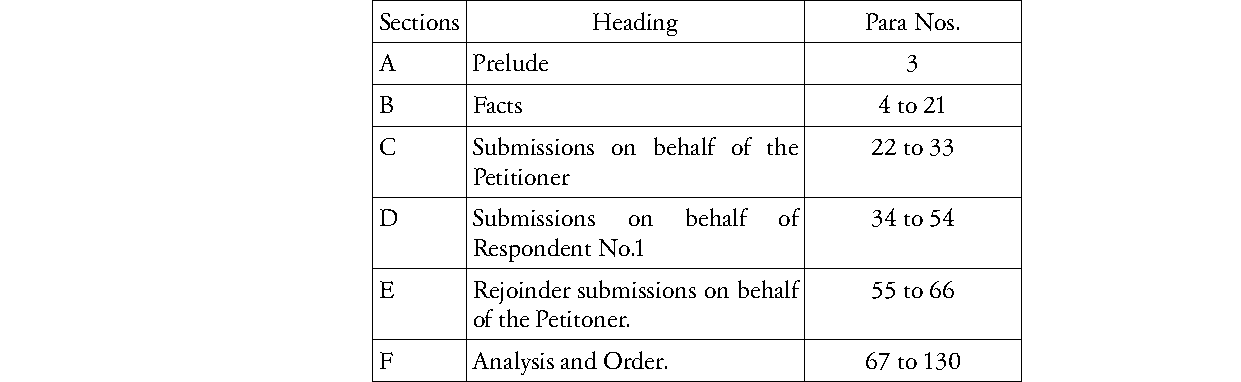
1. This judgment is divided into the following sections to facilitate analysis:-
2. Rule, made returnable forthwith. Respondents waive service. By consent of the parties, heard finally.
A. Prelude:
3. Although short, however, interesting questions arise for determination in the present proceedings arising from the impugned order passed by the learned sole arbitrator by which a third party and a non-signatory to the arbitration agreement, who stands outside the applicability of the group of companies doctrine whether can be impleaded as a party/respondent in the arbitral proceedings between respondent no. 1-Eminence Landmarks LLP (for short “M/s. Eminence”) and Respondent No. 2 - M/s. Gagan Platinum Spaces LLP (for short “M/s. Gagan”), being the principal parties in the pending arbitral proceedings. The second question which falls for determination is, whether considering the nature of the impugned order and the position in law, the present proceedings filed under Article 226/227 of the Constitution can be entertained to interfere in the orders passed by the arbitral tribunal.
B. Facts
4. The facts relevant to the adjudication of the present proceedings are as under: The petitioner – Luxempire Realty Private Ltd. is a private limited company engaged in the business of purchasing lands, in and around the city of Pune for residential and commercial development. The case of the petitioner is that it is a bonafide purchaser of the land, being plot no. 262 described in the Schedule to the Deed of Conveyance dated 29 March, 2024 entered between respondent no. 9 and the petitioner under the Sangamwadi Town Planning Scheme No. 3, situated at village Sangamwadi, Taluka Haveli, District Pune (for short “the said land”).
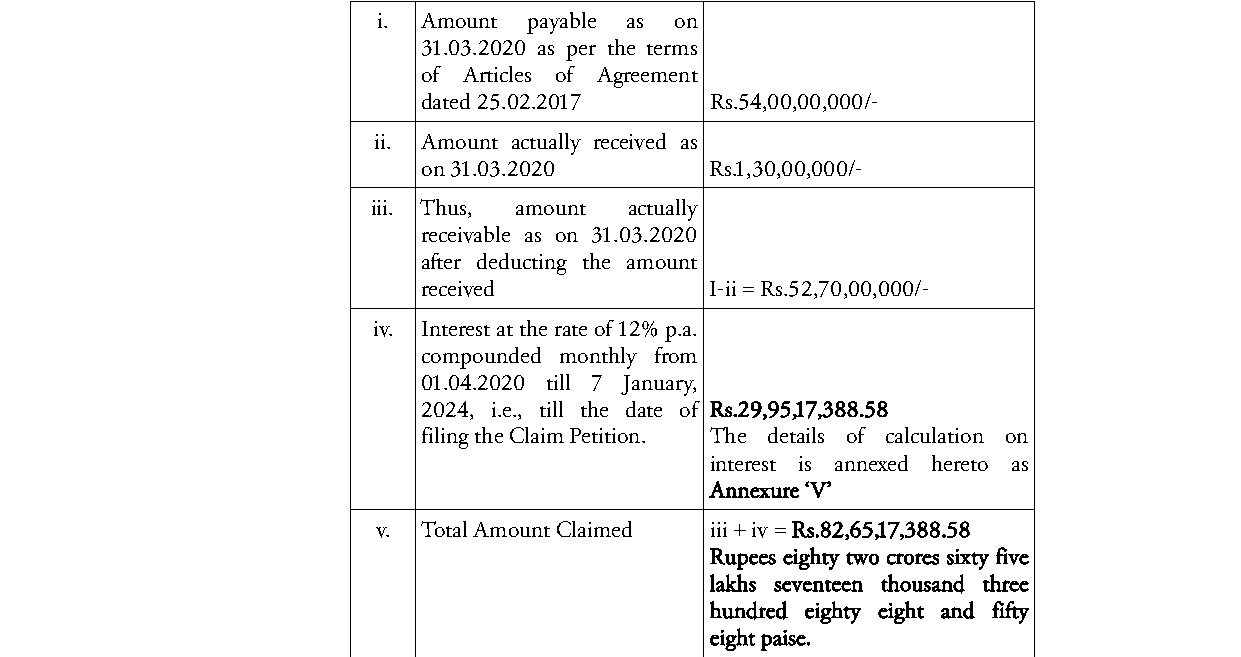
5. M/s. Eminence is a Limited Liability Partnership engaged in the business of investment in real estate ventures. M/s. Gagan is a development firm, engaged in the real estate construction. On 25 February 2017, M/s. Eminence and M/s. Gagan entered into an Articles of Agreement, under which respondent no. 1 advanced a loan of Rs.25 crores to M/s. Gagan for the purchase and development of the said land. Under the terms of the Agreement, M/s. Eminence was guaranteed a minimum assured return of Rs.54 crores by 31 March 2020 (“the Guaranteed Sum”).
6. It is undisputed that at the time of execution of the Articles of Agreement dated 25 February 2017, M/s. Gagan did not own the said land, which was then held by one “Classic Citi Investments Private Limited”. In other words, M/s. Gagan had no right, title and interest over the said land. The understanding between the parties was that M/s. Gagan would acquire the said land by utilizing the funds advanced by M/s. Eminence.
7. On 1 September 2017, Classic Citi Investments Private Limited executed a Sale Deed transferring the said property in favour of respondent no. 9 - Gagan I- Land Township Private Limited. M/s. Eminence contends that respondent no. 9 forms part of the same corporate group as M/s. Gagan - respondent no. 2 to 8 and that it had participated in or benefited from the Agreement, thereby being bound by its terms.
8. Owing to alleged defaults in the repayment of the guaranteed sums in September 2023, M/s. Eminence invoked the arbitration agreement, namely, clause no. 7, as contained in the Articles of Agreement dated 25 February, 2017 executed between M/s. Eminence and M/s. Gagan-respondent no.2 and initiated arbitration proceedings against respondent nos. 2 to 8 on 30 November, 2023.
9. Meanwhile, in December 2023, as the said land was offered for sale by respondent no. 9, the petitio


AI
A non-signatory cannot be impleaded in arbitration proceedings absent explicit consent, highlighting the importance of party autonomy and contractual privity in arbitration agreements.


Non-signatory cannot be impleaded in arbitration absent conduct showing consent via participation in contract's negotiation, performance or termination; substantial financial interest alone insuffici....


A non-signatory party could be subjected to arbitration provided these transactions were with group of companies and there was a clear intention of the parties to bind both, the signatory as well as ....


The jurisdiction of an arbitral Tribunal is restricted to the four corners of the agreement and to persons who are parties to the agreement.



An indispensable Tool for Legal Professionals, Endorsed by Various High Court and Judicial Officers
Please visit our Training & Support
Center or Contact Us for assistance

Scan Me!
India’s Legal research and Law Firm App, Download now!


For Daily Legal Updates, Join us on :



 Back to top


