
 Back
Back





IN THE HIGH COURT OF JUDICATURE AT BOMBAY
A.S. GADKARI, SHYAM C. CHANDAK, JJ.
Gangaram Magan Chavan (Through Jail) – Appellant
Versus
State of Maharashtra – Respondent
Criminal Writ Petition No. 255 of 2025
Decided On : 12-01-2026
| Table of Content |
|---|
| 1. petitioner's conviction for murder (Para 1 , 3 , 4) |
| 2. court's agreement with home department's decision (Para 2 , 7) |
| 3. home department's classification guidelines (Para 5) |
| 4. circumstances of the crime and victim's suffering (Para 6) |
| 5. petition dismissed due to lack of merit (Para 8) |
JUDGMENT :
A.S. GADKARI, J.
1. The Petitioner has sent this Petition through jail seeking relief of placing him in a category of convicts to undergo sentence of 22 years for the crime, for which he is undergoing sentence.
2. Heard Ms. Devkar, learned Advocate appointed by the Legal Aid Committee, High Court, Mumbai and Mr. Palkar, learned APP for the State. Perused the record.
3. The Petitioner is convicted for the offence punishable under Section 302 of the IPC and sentenced to suffer rigorous imprisonment for life by Judgment and Order dated 17th December, 2008, passed by the learned Additional Sessions Judge, Greater Mumbai in Sessions Case No.778 of 2007, for commission of murder of his wife Anjudevi by pouring kerosene on her person and set her on fire with a burning candle. The said act of burning of his wife was committed by the Petitioner on 22nd July, 2007 at about 9.30 p.m. in his house. The deceased suffered 79% superficial to deep burns.
3.1 P.W. No.3 Dr. Chauhan, who performed autopsy on Anjudevi has opined that, the cause of death of deceased was Septicemia due to superficial to deep burns.
4. Appeal preferred by the Petitioner bearing Criminal Appeal No.61 of 2009 against the said Judgment and Order of conviction, has been dismissed by the co-ordinate bench of this Court by its Judgment dated 12th December, 2013.
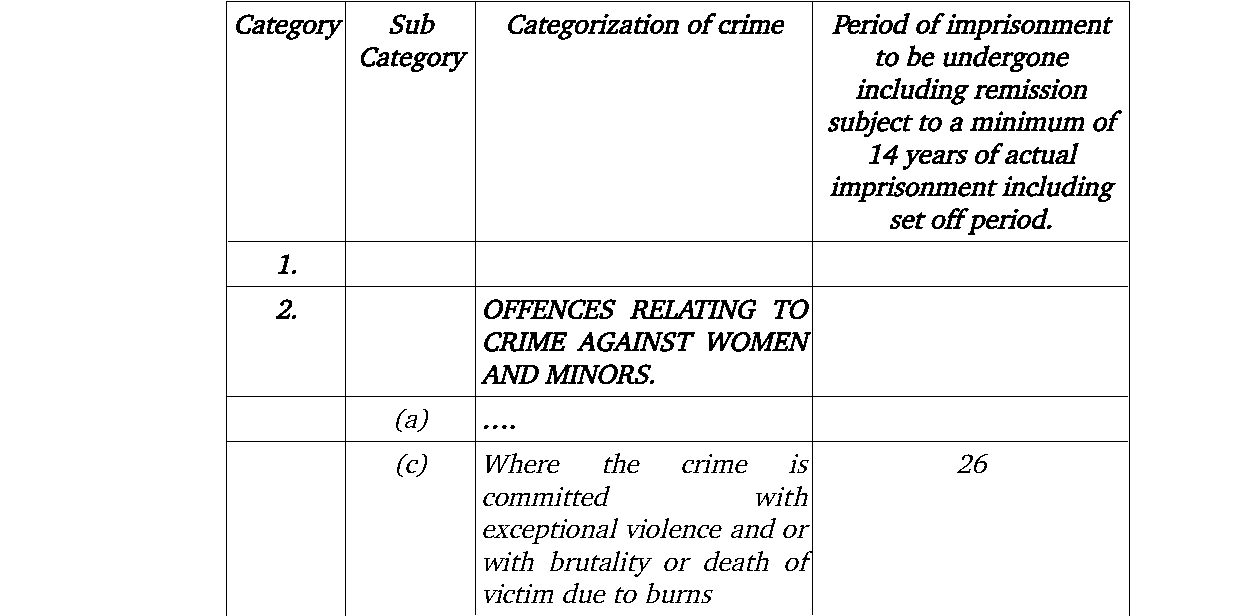
5. The competent Authority of Home Department of Government of Maharashtra after taking into consideration the facts of the case has passed an Order dated 13th August, 2024, placing the Petitioner in category No.2(c) of the Guidelines of 15th March, 2010 issued by the Home Department.
5.1 Category 2(c) of the guidelines of 15th March, 2010 reads as under:-
Annexure-I
6. A bare perusal of record clearly reveals that, the Petitioner was addicted to liquor and used to come home under its influence. He used to quarrel with her wife (deceased) on petty counts. On the date of incident, i.e. on 22nd July, 2007, the Petitioner returned home in a fully intoxicated condition. The deceased requested the Petitioner to bring medicine for their son who was not feeling well. The Petitioner got enraged and started assaulting his wife. Wife of the Petitioner (deceased) told him that, ‘you have money to drink liquor but not to bring medicine for the child’ . After hearing the said thing, the Petitioner poured kerosene on the person of the deceased and ignited her with the burning candle. The deceased suffered 79% of the burn injuries and subsequently died in the hospital while undergoing treatment.
7. Considering the act of the Petitioner, we find that the competent Authority of Home Department of Government of Maharashtra has rightly placed the Petitioner in category No.2(c) of the Guidelines of 15th March, 2010 issued by the Home Department and therefore the request of the Petitioner to place him in a category for which the sentence of 22 years of imprisonment is prescribed, cannot be acceded to.
8. In view of the above discussion, we find no merits in the Petition and is accordingly dismissed.
The court upheld the categorization of a convict under established guidelines, denying a request for a reduced sentence based on the severity of the crime involving murder.


The court confirmed that a dying declaration can be the sole basis for conviction if found credible, and the intentional act of setting a spouse ablaze constitutes murder, not mere culpable homicide.

The admissibility and reliability of dying declarations in establishing guilt in criminal cases.

The court ruled that the appellant's actions constituted culpable homicide under Section 304 Part-II IPC rather than murder under Section 302, due to lack of intent to kill.

The law as far as it concerned septicemia is well settled death occurred after few days. The deceased died during treatment, this High Court substituted the sentence as the deceased died out of septi....


The court established that under Section 427 of the CrPC, life sentences can run concurrently, impacting eligibility for remission based on the nature of convictions.
It is quite clear that if dying declaration dying declaration is absolutely credible and nothing is brought on record that deceased was in such a condition, he or she could not have made a dying decl....



An indispensable Tool for Legal Professionals, Endorsed by Various High Court and Judicial Officers
Please visit our Training & Support
Center or Contact Us for assistance

Scan Me!
India’s Legal research and Law Firm App, Download now!


For Daily Legal Updates, Join us on :



 Back to top


