
 Back
Back





IN THE HIGH COURT OF JUDICATURE AT BOMBAY
SANDEEP V. MARNE, J.
Securities and Exchange Board of India – Applicant
Versus
Mahendra Shah and Anr. – Respondents
Application For Leave To Appeal (Pvt) No. 92 of 2024
Decided On : 24-12-2025
| Table of Content |
|---|
| 1. allegations of fraudulent activities (Para 2 , 3 , 4) |
| 2. compounding application procedures and implications (Para 5 , 6 , 18) |
| 3. jurisdictional authority and sebi's role (Para 9 , 10 , 11) |
| 4. analysis of interest rate determination (Para 15 , 16) |
| 5. importance of sebi's views in compounding (Para 32 , 34) |
| 6. court's order for modification and discharge guidelines (Para 36 , 37) |
JUDGMENT :
SANDEEP V. MARNE, J.
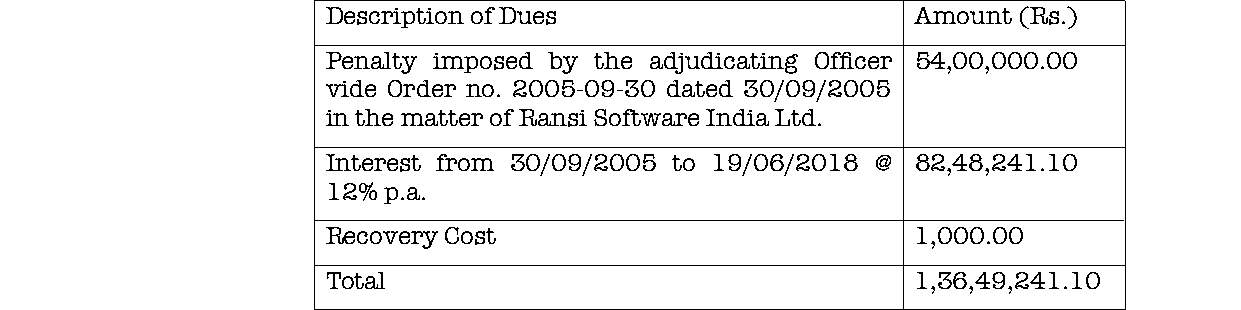
1) This is an Appeal preferred by the Securities and Exchange Board of India (SEBI) allowing the Compounding Application and discharging the Respondent of the offence punishable under Section 24 (2) of the Securities and Exchange Board of India Act, 1992 (SEBI Act). The Special Court has allowed the application preferred by the Respondent for compounding of offences and has permitted compounding by directing Respondent No.1 to pay penalty of Rs.54,00,000/- alongwith interest @ 6% p.a. from the date of adjudication of order in addition to payment of amount of Rs.1,00,000/- towards legal charge. Appellant-SEBI is aggrieved by orders dated 4 March 2024 and 4 April 2024 to the limited extent of the Special Court reducing the rate of interest from 12% p.a. to 6% p.a. and this is the limited remit of enquiry in the present Appeal.
2) Briefly stated, facts of the case are that, Respondent No.1-Mahendra A. Shah was the promoter of Ransi Software India Ltd (RSL). It is alleged that in his capacity as the promoter of RSL, Respondent No.1 was involved in manipulation in issuing preferential shares, on consideration other than cash, to some entities by overvaluing the said entities. When the shares were denied listing due to overvaluation, the unlisted shares were dematerialised and traded in Stock Exchange. It is further alleged that as a promoter of RSL, Respondent No.1 acted in fraudulent manner by publishing news items in order to disseminate false information creating interest in the scrip of RSL. It was alleged that RSL issued shares on preferential basis to shareholders / promoters of non-genuine companies and the shares were traded without listing on the Stock Exchange. Thus, the allegation of violation of provisions of SEBI (Prohibition of Fraudulent and Unfair Trade Practices Relating to Securities Market) Regulations, 1995 were leveled. SEBI accordingly issued summons dated 25 August 2004 and 9 September 2004 calling upon Respondent No.1 to submit the requisite information in respect of his dealings in the script of RSL and to personally appear before the Investigating Authority of SEBI. Respondent No.1 neither submitted information nor appeared before the Investigating Authority.
3) A notice dated 10 June 2005 was issued to Respondent No.1 in terms of Regulation 4 of Securities and Exchange Board of India (Procedure for Holding Inquiries and Imposing Penalties by Adjudicating Officer) Rules, 1995 (SEBI Rules, 1995). Respondent No.1 did not respond to the show cause notice. The Adjudicating Officer directed holding of inquiry and called upon Respondent No.1 to attend the same on 22 July 2005. Respondent No.1 failed to attend the inquiry. He was once again summoned for inquiry to be held on 18 August 2005 and again, he failed to attend the inquiry. The Adjudicating Officer accordingly proceeded to pass order dated 30 September 2005 imposing penalty of Rs.54,00,000/- on Respondent No.1 directing him to pay the same within 45 days.
4) Respondent No.1 failed to pay the adjudicated amount of penalty. Accordingly, Appellant-SEBI filed complaint under Section 24 (2) of the SEBI Act before the Special Court. Respondent No.1 was arrested and by order dated 4 October 2017, he was released on bail subject to direction of scrupulously attending the dates before the Special Court. On account of failure to attend the Court, Respondent No.1 was arrested once again and by order dated 8 April 2019, he was released on bail.
5) In the meantime, Respondent No.1 filed application for compounding of offence under Section 24A of SEBI Act

AI
The court affirmed that the Special Judge has discretion in compounding offence penalties under the SEBI Act, and can determine interest rates independently of SEBI's recommendations.

(1) Power of compounding must be expressly conferred by Statute which creates offence. (2) Section 147 of N.I. Act does not expressly incorporate permission of Court for compounding, conceivably beca....

The main legal point established in the judgment is that SEBI's consent is necessary for compounding the offense under Section 24A of the SEBI Act, and the court must obtain the views of SEBI for gui....

A court may compel the SEBI to disclose documents relevant to compounding applications, reinforcing that while SEBI’s views are influential, they do not override judicial discretion in deciding these....

Statutory interest at 12% per annum on unpaid penalties arises from the expiry of the compliance period, reflecting SEBI's authority in recovery due under the Act.


(1) Dishonour of cheque – Compounding of offence – Section 482, Cr.P.C. and Section 147, N.I. Act, are different and distinct – Offence under Section 138, N.I. Act could be compounded under Section 1....



An indispensable Tool for Legal Professionals, Endorsed by Various High Court and Judicial Officers
Please visit our Training & Support
Center or Contact Us for assistance

Scan Me!
India’s Legal research and Law Firm App, Download now!


For Daily Legal Updates, Join us on :



 Back to top


