
 Back
Back





IN THE HIGH COURT OF JUDICATURE AT BOMBAY
ASHWIN D. BHOBE, J.
Sanjay Sanyal - Appellant
Versus
The State of Maharashtra, through Office In-charge – Respondent
Writ Petition No. 1927 of 2016 With Writ Petition No. 1928 of 2016
Decided On : 20-02-2026
| Table of Content |
|---|
| 1. procedural setup and consolidation of petitions (Para 1 , 2 , 3 , 4 , 5 , 6) |
| 2. disciplinary proceedings against respondent no.2 initiated (Para 7 , 8 , 9 , 10 , 11 , 12 , 13) |
| 3. fir alleges caste-based targeting via suspension (Para 14 , 15 , 16 , 35 , 36) |
| 4. arguments contest fir ingredients under atrocities act (Para 17 , 18 , 19) |
| 5. ingredients of section 3(1)(p) require malicious proceedings (Para 20 , 21 , 22 , 23 , 24 , 25) |
| 6. disciplinary actions not false, malicious, or vexatious (Para 26 , 27 , 28 , 29) |
| 7. departmental proceedings exclude 'other legal proceedings' (Para 30 , 31) |
| 8. caste knowledge alone insufficient for atrocities act (Para 32 , 33 , 34) |
| 9. fir quashed to prevent process abuse (Para 37 , 38 , 39) |
JUDGMENT :
ASHWIN D. BHOBE, J.
1. These proceedings are recorded in accordance with the decision of this Court in Hema Suresh Ahuja & Ors. v. State of Maharashtra & Anr., 2024 SCC OnLineBom 784, as the subject matter pertains to an offence under the Scheduled Castes and the Scheduled Tribes (Prevention of Atrocities) Act, 1989 (for short, “Atrocities Act, 1989”).
2. The Committee constituted in terms of the Notification No. P.1602, dated 09.09.2015, regarding Rules for the presentation and conduct of proceedings in person by parties, vide Office Report dated 31.01.2026, declined permission to Respondent No. 2 (Sreeramappa Chinnappa) to appear in person. On 06.02.2026, Respondent No. 2 appeared through VC and declined the appointment of an Advocate from the Legal Aid Panel. However, Respondent No. 2 pleaded for the appointment of an Advocate to assist this Court. Mr. A. P. Mundargi, learned Senior Counsel, was therefore requested to appear in this matter as an Amicus Curiae.
3. Heard Mr. A. P. Mundargi, learned Amicus Curiae, Mr. Sunip Sen, learned Senior Counsel for the Petitioners in both these petitions, and Mr. Tanveer G. Khan, learned APP for the Respondent – State.
4. Mr. A. P. Mundargi, learned Amicus Curiae, Mr. Sunip Sen, learned Senior Counsel, and Mr. Tanveer Khan submit that the subject matter of both these petitions is the FIR bearing No. II–1 / 2016 dated 24.05.2016 (for short “impugned FIR”), registered with the Tarapur Police Station, District Palghar, under Section 3(1) (viii) {i.e. Section 3(1)(p) of the amended Act} of the Atrocities Act, 1989. Accordingly, they request that both these petitions be taken up together and disposed of by a common order. Both these petitions are taken up together.
5. Kailash Chandra Purohit (Petitioner in Writ Petition No. 1928 of 2016) is Accused No. 1, whereas Sanjay Sanyal (Petitioner in Writ Petition No. 1927 of 2016) is Accused No. 2 in the impugned FIR.
6. Rule in both these petitions was issued on 05.02.2024, and the interim order dated 03.06.2026, granting a stay of the impugned FIR, was confirmed as the interim relief.
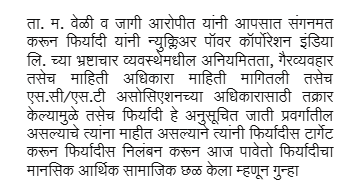
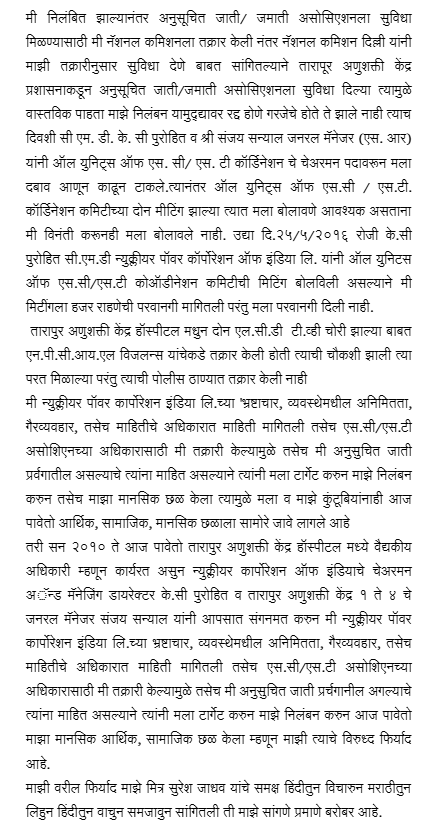
7. Material facts relevant to the present petitions, as derived from the petitions, are that Kailash Chandra Purohit was the Chairman and Managing Director of Nuclear Power Corporation of India Ltd. (NPCIL), whereas Sanjay Sanyal was the General Manager (H.R.) at NPCIL.
8. Respondent No.2 joined NPCIL at the Kaiga Generating Station, Karnataka, as a General Duty Medical Officer (GDMO) in the Grade of Medical Officer ‘C’ on 12.09.1994. Respondent No.2 was promoted thrice during his career in NPCIL under the Merit Promotion Scheme of the Department of Atomic Energy, Bhabha Atomic Research Centre, applicable to Scientific and Technical Personnel, including Medical Professionals.
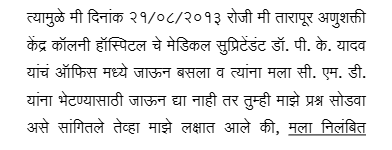
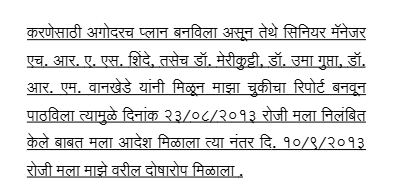
9. A report was received by the Director (H.R.), NPCIL, from the Site Director, NPCIL Tarapur, regarding serious acts of misconduct by Respondent No. 2 on the premises of TAPS Hospital on 21.08.2013. The reported misconduct included preventing the Acting Medical Superintendent of TAPS Hospital from performing his official duties; calling the Police from the nearby Panchmarg Police Station to the Acting Medical Superintendent's chamber and stating that Respondent No.
AI
Disciplinary proceedings under service rules are not 'other legal proceedings' under Section 3(1)(p) of Atrocities Act; mere knowledge of Scheduled Caste status insufficient without proof of caste-ba....

The misuse of the S.C./S.T. Act for personal grievances is impermissible, and allegations must substantiate a prima facie case to avoid abuse of legal processes.

The main legal point established in the judgment is the requirement for specific details and the need for the insult or intimidation to be made in a place within public view to establish a prima faci....
The court established that adverse remarks in performance evaluations by superior officers do not amount to caste-based harassment under the SC/ST (POA) Act unless there is clear evidence of malice o....

The court ruled that allegations under the SC/ST Act and IPC were false and motivated by personal vendetta, emphasizing the need to prevent misuse of legal provisions.

FIR under SC/ST Act quashed absent caste-based insult, humiliation intent linked to caste, or cognizable offence ingredients; prior similar vexatious complaints indicate abuse of process for revenge.


The court quashed proceedings under the SC/ST Act due to lack of public view in the alleged incident, emphasizing the need for specific ingredients to establish the offence.



An indispensable Tool for Legal Professionals, Endorsed by Various High Court and Judicial Officers
Please visit our Training & Support
Center or Contact Us for assistance

Scan Me!
India’s Legal research and Law Firm App, Download now!


For Daily Legal Updates, Join us on :



 Back to top


