
 Back
Back





IN THE HIGH COURT OF JUDICATURE AT BOMBAY NAGPUR BENCH
ANIL L. PANSARE, NIVEDITA P. MEHTA, JJ.
Balkrishna S/o Maroti Meshram – Appellant
Versus
State of Maharashtra – Respondent
Criminal Appeal Nos. 12, 301 of 2010
Decided On : 05-02-2026
| Table of Content |
|---|
| 1. domestic quarrel led to accused pouring kerosene on wife (Para 1 , 2 , 3 , 4) |
| 2. state urges section 307 conviction; accused denies intent (Para 5 , 6 , 7 , 8) |
| 3. witnesses and medical evidence corroborate burn injuries (Para 9 , 10 , 11 , 12 , 13 , 14 , 15 , 16) |
| 4. post-conduct and superficial burns negate section 307 mens rea (Para 17 , 18 , 19 , 20) |
| 5. voluntarily causing hurt by fire proves section 324 offence (Para 21 , 22 , 23 , 24 , 25) |
| 6. conviction upheld; sentence reduced to period undergone (Para 26 , 27 , 28 , 29 , 30 , 31 , 32) |
JUDGMENT :
NIVEDITA P. MEHTA, J.
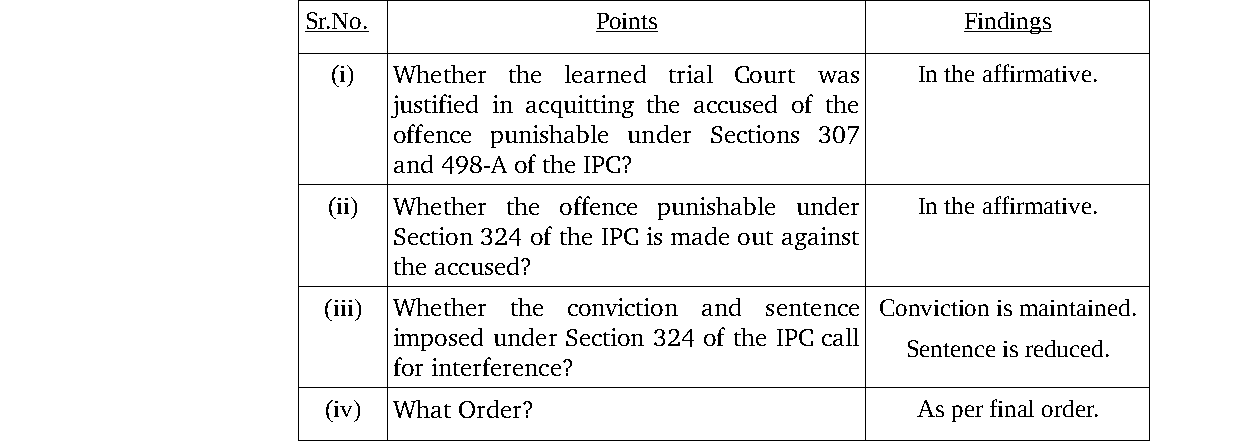
1. Both these appeals are directed against the judgment and order dated 16.12.2009 passed by the learned Sessions Judge, Chandrapur, in Sessions Case No. 19/2009. By the impugned judgment, the accused Balkrushna Maroti Meshram was acquitted of the offences punishable under Sections 307 and 498-A of the Indian Penal Code (for short “IPC”), but was convicted for the offence punishable under Section 324 of the and sentenced to suffer rigorous imprisonment for 2½ years and to pay a fine of Rs.3,000/-. In default of payment of fine, he was directed to suffer rigorous imprisonment for six months.
2. Criminal Appeal No. 301 of 2010 is preferred by the State seeking conviction of the accused for the offence punishable under Section 307 of the IPC, whereas Criminal Appeal No. 12 of 2010 is filed by the accused challenging his conviction under Section 324 of the .
3. The prosecution case, in substance, is that the accused Balkrushna was married to PW 1-Meena on 10.04.2008. After marriage, they resided in a rented premises at Mul, District Chandrapur. Initially the marital life was cordial, however, subsequently the accused allegedly started ill-treating PW 1 by abusing and assaulting her under the influence of liquor.
3.1 On 17.10.2008 at about 3.30 to 4.00 p.m., the accused returned home in an inebriated condition and demanded food. A quarrel ensued on the ground that the PW 1 had already taken her meal. According to the prosecution, in the course of the quarrel, the accused took a stove from the loft, opened the cock of the tank of the stove, poured kerosene from it on the person of PW 1 and ignited a matchstick, thereby setting her on fire. On hearing her cries, neighbours rushed to the spot. The accused then poured water on her person and extinguished the fire. PW 1 sustained burn injuries and was immediately taken to the Rural Hospital at Mul, where her statement came to be recorded.
3.2 The medical examination revealed that PW 1 had sustained burn injuries about 20–25% of her body. On the basis of her statement, the crime was registered and after investigation, charge-sheet came to be filed against the accused for the offences punishable under Sections 307 and 498-A of the IPC.
3.3 Upon completion of investigation, charge-sheet came to be filed before the learned Judicial Magistrate First Class, Mul, who committed the case to the Court of Sessions, Chandrapur, as the offence under Section 307 of the IPC was exclusively triable by the Court of Sessions. The case was registered as Sessions Case No. 19/2009. The learned Sessions Judge framed Charge (Exh.10) against the accused for the offences punishable under Sections 307 and 498-A of the . The accused pleaded not guilty and claimed to be tried. 3.4 In his statement under Section 313 of the Code of Criminal Procedure, the accused denied the incriminating circumstances appearing against him and took the defence of total denial. The defence suggested that the complainant had poured kerosene on herself and sustained burns, and that he had, in fact, tried to save her by extinguishing the fire. The prosecution examined seven witnesses in all, including the complainant, neighbours, the maternal aunt of the complainant, two medical officers and the investigating officer, and relied upon documentary and medical evidence. The accused did not examine any defence witness nor did he adduce any evidence in support of hi
AI
Post-incident conduct of extinguishing fire and superficial burns negate intent or knowledge for attempt to murder; voluntarily causing hurt by fire attracts conviction with proportionate sentence re....

The court upheld the conviction for murder under Section 302 IPC, affirming that the evidence established the appellant's guilt beyond a reasonable doubt despite claims of accidental death.

The court established that the distinction between murder and culpable homicide hinges on the intent of the accused, with Section 304 Part-I applicable when the act does not demonstrate a clear inten....

Unintentional homicide will not come under Section 302 of IPC.

Point of Law : Crimes against women are not ordinary crimes committed in a fit of anger or for property. They are social crimes. They disrupt the entire social fabric. Hence, they call for harsh puni....

It is open to the High Court on an appeal against an order of acquittal to review the entire evidence and to come to its own conclusion. However the Court has to keep it in mind the well-established ....

The court clarified that actions under intoxication leading to death may constitute culpable homicide not amounting to murder, not murder itself.


The court established that culpable homicide can be distinguished from murder based on the presence of intention and premeditation, particularly in cases of sudden provocation.



An indispensable Tool for Legal Professionals, Endorsed by Various High Court and Judicial Officers
Please visit our Training & Support
Center or Contact Us for assistance

Scan Me!
India’s Legal research and Law Firm App, Download now!


For Daily Legal Updates, Join us on :



 Back to top


