
 Back
Back





IN THE HIGH COURT OF JUDICATURE AT PATNA
K. VINOD CHANDRAN, CJ and HARISH KUMAR, J.
CWJC Nos.16760, 16882, 17494, 17770, 17916, 18007, 18008 of 2023 with 380, 1950 and 4252 of 2024
(20.6.2024)
Gaurav Kumar & Anr. (in 16760)
Rakesh Sharma (in 16882)
Bhagwat Kumar (in 17494)
Anjani Kumar Tiwari (in 17770)
Youth For Equality (in 17916)
Mohan Kumar (in 18007)
Shashi Ranjan Singh (in 18008)
Dhirendra Kumar (in 380)
Vikas Kumar (in 1950)
Madhup Kumar Singh
@ Munmun Singh (in 4252)
vs.
State of Bihar & Ors. (in all Except 16882)
Union of India & Ors. (in 16882) ... Respondents
Constitution of India – Articles 14, 15, 16, 243-D and 243-T – Equality of opportunity in public employment and educational institutions – State of Bihar enhancing the reservation to 65% – the rule of 50% limit in reservation applies to the Backward Classes, Scheduled Casts and Scheduled Tribes, which is equally applicable under Article 15(4) and Article 16(4) and in the present case, no extenuating circumstance exists enabling the state to breach the rule – the state attempted no in-depth study or analysis before providing for enhancement of the reservation percentage is established from the records – if proceeded on the mere proportion of population of different categories as against their numerical representation in government services and educational institutions is the admitted position and is the pivotal argument of the state, and it works against the core principles of Articles 15(4) & 16(4) is a given fact – it is held, hence, that the enhancement of reservations beyond the 50% limit is bad in law based on the principles of equality emanating from the constitution, as laid down by the wealth of precedents discussed in the present judgment, which is binding on the H.C. and the state equally – hence, Bihar Reservation of vacancies in posts and services (for Scheduled Caste, Scheduled Tribes and Other Backward Clases) Amendment Act, 2023 and the Bihar Reservation (in Admission to Educational Institutions) Amendment Act, 2023 are set aside as ultra vires the Constitution and violative of the equality clause under Articles 14, 15 and 16 – writ petitions are allowed. (Paras 82 to 84)
Indra Sawhney vs. Union of India, 1992 Supp. (3) SCC 217; State of Kerala vs. N.M.Thomas; (1976) 2 SCC 310; R.K Sabharwal vs. State of Punjab, (1995) 2 SCC 745; M. Nagaraj vs. Union of India, (2006) 8 SCC 212; Chebrolu Leela Prasad Rao vs. State of Andhra Pradesh, (2021) 11 SCC 401; Jaishri Laxmanrao Patil vs. State of Maharashtra, (2021) 8 SCC 1; M.R. Balaji vs. State of Mysore, 1962 SCR Supl. (1) 439; K. Krishna Murthy vs. Union of India, (2010) 7 SCC 202; Janhit Abhiyan vs. Union of India (EWS Reservation), (2023) 5 SCC 1 – Relied.
M. Nagaraj vs. Union of India, (2006) 8 SCC 212; Union of India vs. Rakesh Kumar, (2010) 4 SCC 50; Barium Chemicals Ltd. vs. Company Law Board, AIR 1967 SC 295; B. Venkataramana vs. State of Madras, AIR 1951 SC 229; State of Madras vs. Champakam Dorairajan, 1951 SCR 525; Devadasan vs. Union of India, (1964) 4 SCR 680; R. Chitralekha vs. State of Mysore, (1964) 6 SCR 368; Jarnail Singh vs. Lachhmi Narain Gupta, (2018) 10 SCC 396; Maharishi Mahesh Yogi Vedic Vishwavidyalaya vs. State of Madhya Pradesh, (2013) 15 SCC 677; Minerva Mills vs. Union of India, 1983 SCC 625 – Referred.
K. Vinod Chandran, CJ. – Equality of opportunity pitted against reparations for long years of deprivation of equality, has been the subject of judicial discourse while adjudicating affirmative action; introduced both by the Central and State Governments within this country. One of such affirmative action exceeding the 50% limit; as prescribed by a 9 Judge Constitution Bench in Indra Sawhney vs. Union of India, 1992 Supp (3) SCC 217, enhancing reservation to 65% within the State of Bihar, is challenged in these batch of writ petitions. The State has brought in such reservation based on the Caste Survey, which found the majority of the population within the State, belonging to the marginalized and deprived communities of Backward & Extremely Backward Classes, Scheduled Castes and Scheduled Tribes. The petitioners cry foul on the perceived sacrifice of merit, thus, frustrating the fundamental right of equality of opportunity in public employment & admissions to educational institutions, guaranteed under Part III of the Constitution of India.
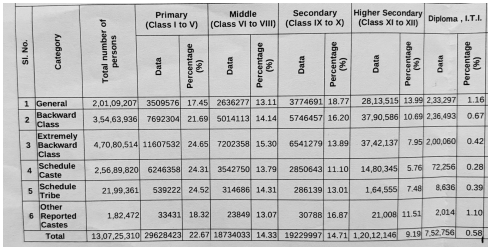
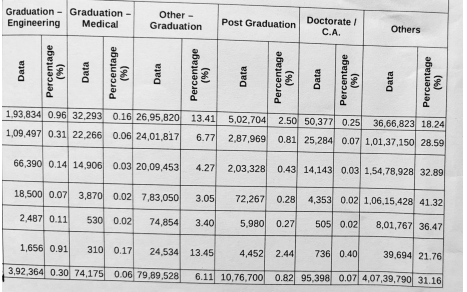
2. Shri Mrigank Mauli, learned Senior Counsel led the arguments for the petitioners which commenced with the statement that the entire edifice of the Amendment Act and the enhancement in reservation, is built upon the Caste Survey, the results of which were published just a few days before the Amendment Bill was introduced in the Legislature. The Caste Survey notified on 06.06.2022 was completed by 05.08.2023 and the report published on 02.10.2023. The caste wise socioeconomic report was brought out on 07.11.2023 and the bill was tabled hastily on 09.11.2023. There was hence, no analysis carried out despite the Preamble of the Act referring to such an analysis. The automatic escalation of the percentage for each and every caste referred to in the Bihar Reservation of Vacancies in Posts and Services (for Scheduled Castes and Scheduled Tribes and Other Backward Classes) Act, 1991, (hereinafter referred to as ‘Reservation Act’), was mechanically carried out without reference to the real facts & figures coming out of the Caste Survey. It is specifically argued that though land holding of every individual was one of the terms of reference in the caste survey, there was no analysis of the economic status of each community granted reservation, based on the details of the land holdings collected in the survey or an examination of the productive nature of such holding.
3. The Preamble was read over to us which according to the learned Senior Counsel speaks of a proportional representation having been attempted, as is the provision of reservation in elections to local bodies. It is pointed out that such proportional representation, confined to SC and ST, as coming out from 243D and 243T, based on Article 330(2) cannot be imported automatically into Article 16. Article 16(4) specifically speaks of adequate representation as the yardstick to determine the benchmark, for providing reservation in appointments in posts, to any backward class of citizens. Though the word ‘adequate’ is not employed in Article 15(4), the Hon’ble Supreme Court has held it to be a valid basis for understanding the social and educational standards of backward class of citizens and of the SC and ST. The economic criteria hence, is an important index on which the percentage of reservation has to be considered which has been totally ignored while bringing out the present amendment. It is also pointed out that the rejoinder of the petitioner makes a better analysis of the facts and figures coming out of the caste survey; which also would belie the contention of the State in support of enhancement of the percentage of reservation.
4. Referring to the Preamble, the learned Senior Counsel also points out the casual manner in which drafting was carried out, employing words without any meaning, especially in the portion where the very ob


Sub-classification within Scheduled Castes for affirmative action is constitutionally permissible if it meets the intelligible differentia test and doesn't exclude any caste from benefits, overruling....

(1) When Constitution Bench in Indra Sawhney held that 50% is upper limit of reservation under Article 16(4), it is law which is binding under Article 141 and to be implemented. When law is laid down....


Promotions for SC/ST candidates against unreserved vacancies require quantifiable data proving inadequacy of representation, and any related clarifications issued without such data are unconstitution....
(Majority View):(1) EWS reservation – 103rd Constitution Amendment cannot be said to breach basic structure of Constitution by permitting State to make special provisions, including reservation, base....

(1) Reservation for OBCs is only a “statutory” dispensation to be provided by State legislations unlike “constitutional” reservation regarding SCs/STs which is linked to proportion of population.(2) ....

The judgment established the principle that the 50% ceiling limit in reservations applies only to vertical reservations for SCs, STs, and Backward Communities, and does not apply to horizontal reserv....



An indispensable Tool for Legal Professionals, Endorsed by Various High Court and Judicial Officers
Please visit our Training & Support
Center or Contact Us for assistance

Scan Me!
India’s Legal research and Law Firm App, Download now!


For Daily Legal Updates, Join us on :



 Back to top


